Yasha’s Trauma and Recovery
Jacob's LadderYasha’s trauma and recovery are defined by a hard-won recognition that physical skill and determination cannot make him immune to intimate-partner violence. His Krav Maga training had supported his belief that he could always protect himself, but Sander’s violence breaks that certainty; later, Yasha’s efforts to minimize his injuries and the upheaval around him show how survival can coexist with an incomplete reckoning. His story gives recovery a bodily and practical shape: seeking company, grounding himself in the present, and being urged to accept help.
Self-Protection and Its Limits
Before the assault, Yasha believed he would always be able to take care of himself. He was combat trained in Krav Maga, and that training had, until then, seemed to confirm his confidence. His attraction to large, brutal men like Sander sits beside that belief, but does not cancel it: Yasha understands himself as someone who can manage physical danger, not as someone who expects to be overcome by it.
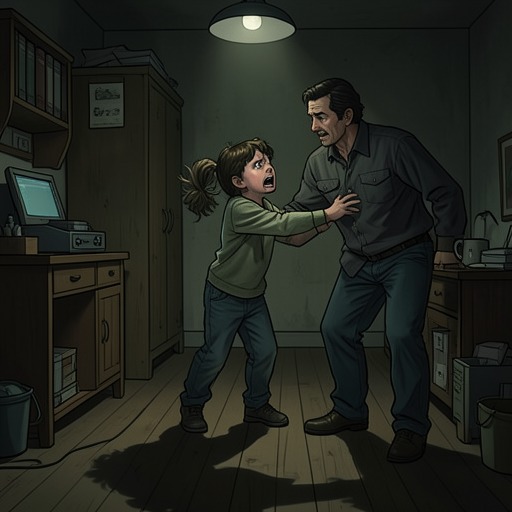
The moment Sander’s grip tightens and his face darkens with fury makes that confidence suddenly insufficient. Yasha describes the change as a point at which what could not have happened on an ordinary day happens anyway. The contrast matters: the assault is not evidence that his training was meaningless, but that violence inside a relationship can overturn the assumptions on which self-protection depends. His own strength cannot guarantee control over another person’s actions.
This rupture complicates any simple account of vulnerability. Yasha’s capacity for self-defense and his exposure to abuse are both part of his experience; neither cancels the other. The gap between what he had believed his body could do and what happened to him helps explain why recovery is not merely a return to confidence. It also requires confronting the limits of the protection he once thought he possessed.
Seeking Company and Managing Triggers
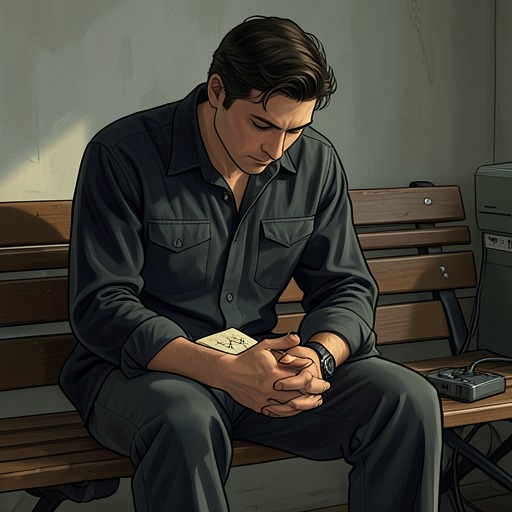
At a support-group meeting, Yasha holds coffee and looks around a small circle of silent, tense women. He does not know how he got there, a detail that makes his arrival feel less like a settled decision than a step he has reached without fully understanding. The scene places his experience among other people’s presence without suggesting that their histories are identical. For Yasha, sitting in the circle is itself a departure from facing the consequences alone.
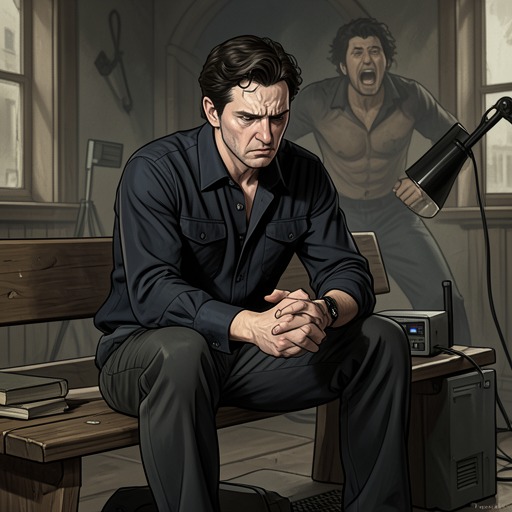
His trauma also emerges through sensory reactions that arrive before he can simply dismiss them. Gusty wind blows leaves and scraps of paper along the pavement outside the firehouse, while the flag overhead whips and snaps. The sound sends Yasha’s heart racing and makes the instinct to dive to the ground and cover his head almost impossible to ignore. The ordinary outdoor setting does not prevent the reaction; it is the wind and sharp noise that make his body behave as if danger is present.
Yasha counters that reaction by deliberately orienting himself to where he is. He reminds himself that he can hear the Pacific Ocean and that he is safe. The briny air and the mixture of ocean, fish, wood smoke, decay, and ozone anchor the moment in a specific environment. This grounding does not erase the fear, but it gives him a way to distinguish the present from the danger his body anticipates. Recovery here is an act of attention: the alarm remains real even as Yasha names where he is now.
Violence in the Home and the Work of Recognition
The damage Sander leaves in Yasha’s apartment makes the violence visible beyond the immediate encounter. Sander has emptied bedroom drawers, rifled through papers and mail, and scavenged through the media center. Yasha notices that many of his least-favorite DVDs remain, an oddly specific remnant amid the intrusion. The apartment has become a record of disorder and violation, extending the harm into personal belongings and the space where Yasha lives.
When the aftermath is discussed, Yasha describes his head wound as mostly bluster and says the scene looks worse than it was. His interlocutor reacts with shock, calling attention to the way he is minimizing what happened. The contrast between the physical tableau and Yasha’s downplaying of it shows how recognition can become a point of conflict: someone else sees the seriousness that he is trying to reduce. The slipped foot of little Madeline is part of the scene’s grisly detail, while Yasha’s attention turns instead to the other person’s mouth, which is easier for him to face than their eyes.
That exchange does not establish that Yasha has fully accepted the scale of the danger. It does, however, make minimization visible rather than leaving it unchallenged. When told that he needs professional help, Yasha nods and says he understands. He is also offered a private route if the group is not workable. The suggestion leaves room for choice about how to seek support rather than treating one setting as the only possible path.
Danger, Support, and an Unfinished Recovery
Another warning makes the stakes concrete: Sander could have killed Yasha in the apartment, and an expensive knife could have been used to end his life. Yasha answers that he does not need to be told this. The reply suggests that the danger is not news to him, even as his earlier minimization shows how difficult it is to hold that danger fully in view. Knowing what could have happened and responding to what did happen are not the same task.
Across these moments, recovery is neither a single declaration nor a complete resolution. Yasha enters a circle of support despite uncertainty, works to ground himself when wind and noise trigger an urge to protect his head, and hears others challenge the way he diminishes his injuries. His responses remain mixed: he can identify the present as safe, acknowledge the need for help, and still push against another person’s account of the harm.
The account therefore presents recovery as a negotiation between bodily alarm, personal agency, and outside recognition. Yasha’s combat training once stood for dependable self-sufficiency; after Sander’s violence, that ideal cannot bear the whole weight of his safety. The group, the offer of private professional help, and the act of naming his surroundings provide different forms of support, but the available scenes do not claim that they have cured his trauma. They show instead the work of beginning to live with what his body remembers while allowing other people to see the danger more clearly than he sometimes can.