Analise’s post-traumatic stress disorder
Jacob's LadderAnalise’s post-traumatic stress disorder is shown as an ongoing condition shaped by a life-threatening attack and intensified by the prospect of facing her former husband again. The novel makes its effects visible through her guarded social world, her jumpiness, and the difficulty of approaching a hearing that will bring her back into contact with the man who stabbed her.
The Attack and Its Aftermath
Analise’s history is disclosed by Muse, who explains that the man Analise was married to stabbed her sixteen times. He went to prison for the attack, and her survival is described as a miracle. The severity of that violence establishes the background to her later distress without suggesting that the danger ended when the assault stopped or when her husband was incarcerated. The upcoming parole hearing makes the past an immediate pressure in the present.
The novel does not provide a clinical account of Analise’s symptoms or a full description of the attack. Instead, the history arrives in a brief explanation to Yasha, followed by visible details of how Analise now moves through the world. That limited perspective matters: her condition is named, but she is not reduced to a diagnostic description. Readers learn about her through the facts of the assault, the people she still trusts, and her response to being watched.
A Narrow Circle of Trust
Muse says Analise is afraid of everybody and no longer talks to people except Mary Catherine and Muse’s mother. The restriction is strikingly broad: the difficulty is not confined to her former husband or to a single place, but reaches into ordinary contact with other people. At the same time, the exceptions show that her social world is not entirely closed. Mary Catherine and Muse’s mother remain people with whom she can communicate, though the account does not explain what that communication involves or how it developed.
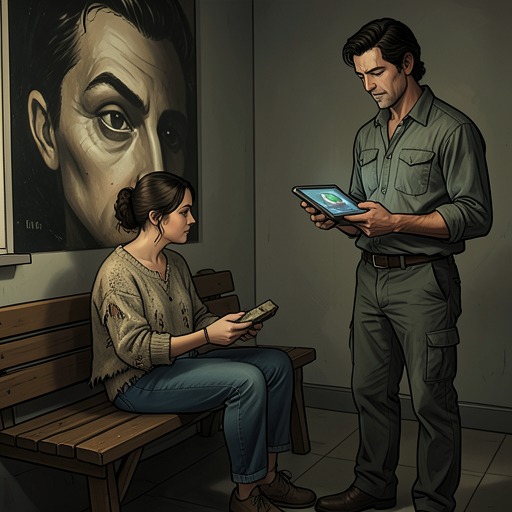
Yasha sees this guardedness rather than hearing it directly from Analise. After asking whether she is afraid of him, he receives Muse’s explanation and then watches Analise for a moment. When she seems to sense that someone is looking at her, she backs away from the two of them and into the room. The small retreat gives the account a physical endpoint: what Muse describes as a general fear becomes, in the scene, a response to attention. The narration does not claim to know exactly what Analise feels in that instant; it shows her creating distance.
Work and the Coming Hearing
Analise continues to work early in the mornings at the place where Muse and Yasha encounter her, while also holding another job in the afternoons. These details establish a demanding daily routine, but the novel does not identify either job as treatment or explain how her symptoms affect her ability to work. Her employment is presented alongside her PTSD, not as proof that the condition has disappeared. She can maintain work and still be described as sometimes badly affected and especially jumpy during the current period.
The reason for that heightened fear is concrete and time-bound. Her former husband’s parole hearing is due in three weeks. Analise, Mary Catherine, and Muse’s mother are preparing to travel to Soledad to speak at it. The hearing therefore places Analise in a difficult position: the process concerning the man who attacked her also creates an occasion for her own testimony. The account establishes her participation and the approaching journey, but does not specify what she will say or what outcome she hopes for.
Trauma in the Present
Muse anticipates that seeing the former husband again will be terrible for Analise, and describes her as extremely jumpy as the hearing approaches. That expectation links the earlier assault to a present threat without claiming that the assault is recurring. The prospect of renewed contact is enough to make the hearing an active source of distress before the encounter takes place. Analise’s retreat when she senses Yasha watching her offers a separate, immediate instance of how exposure to other people can unsettle her.
Her portrayal holds together two facts that might otherwise be mistaken for opposites: she continues to work, and her trauma remains consequential. A routine that includes early mornings and a second afternoon job coexists with restricted communication, visible withdrawal, and fear about the parole proceeding. The story does not present productivity as recovery, nor does it use PTSD to erase Analise’s capacity to act. She is among the people preparing to speak at the hearing, even as the prospect of seeing her former husband again is expected to be deeply painful.
Analise’s condition also shapes how the people around her respond. Muse explains her history quietly and moves Yasha aside to speak privately, while Yasha’s attention shifts from wondering whether Analise fears him to recognizing the much larger history behind her reserve. That exchange supplies context for her behavior without making her responsible for reassuring a newcomer. The scene leaves the distance she creates intact: her silence and retreat are presented as meaningful limits, not as an invitation for others to press closer.