Nacho’s Bar
Jacob's LadderNacho’s Bar is a neighborhood restaurant and drinking spot whose unpretentious rooms bring together firefighters, local residents, couples, and visitors passing through St. Nacho’s. Its significance lies not in a single defining event but in its changing uses: a place for a meal, a post-shift drink, a gathering with friends, or, later in the evening, a gay bar. For Jacob, it becomes one of the town’s most legible expressions of social welcome, where different kinds of people share space without the atmosphere feeling formal or exclusive.
Setting and Character
When Jacob first approaches the bar with a group of firefighters, he recognizes a familiar kind of local establishment: it offers food as well as a full bar, has a game on television, and gives no impression of either pretension or desperation. Its dark, sturdy bar and tables arranged over Saltillo tile establish a lived-in, practical setting. People gather at the counter or around the tables casually, as if the place is already part of their ordinary routines. The details make the bar feel welcoming through use rather than display.
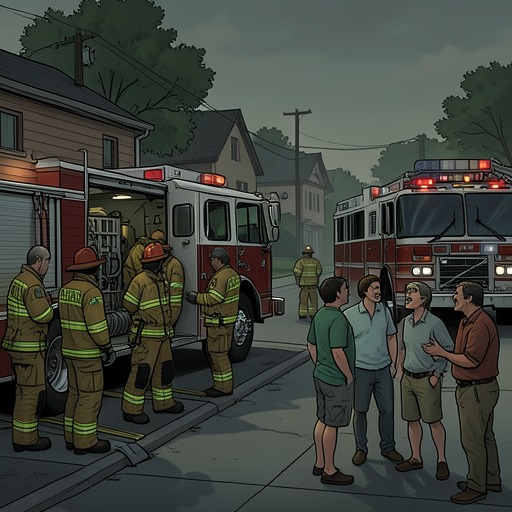
Its social life extends beyond a single crowd or purpose. A firefighter tells Jacob that the beach is attractive that time of year and that the bar is known for Sunday brunch; the group plans to go there for drinks after its shift, around six. The invitation links the bar to both the town’s leisure and the firefighters’ shared life after work. It is not described as an exclusive gathering place: rather, the invitation offers Jacob an easy way to join people he has begun to know, in a setting where conversation and company need no special occasion.
A Shared Social Space
The bar’s crowd is notably eclectic. During dinner with Cam, Jacob observes a same-sex couple, then notices a group of younger patrons using sign language; they may be deaf or practicing. Cam points out people he knows, including the owner, Jim, and Jim’s partner, Alfred, as well as firefighters and police officers dining with their wives. A tattooed and pierced violinist moves from table to table playing dinner music and taking requests. The scene’s inclusiveness comes through this accumulation of ordinary particulars: different patrons occupy the same room, while the music and meal carry on around them.
That variety gives the bar a different social texture from a place organized around one narrow idea of respectability. Jacob finds the crowd relaxed, and the surroundings accommodate both familiar local connections and people whose lives differ from one another. The evidence does not make the bar a formal institution or assign it a stated political purpose. Its importance is more concrete: it provides a public setting in which same-sex couples, public-service workers, restaurant staff, and other patrons can be present together as part of the same evening.
Dinner, Music, and Changing Uses
Dinner at Nacho’s Bar is a recurring part of its identity. When Jacob and Cam decide to eat there, the kitchen is still working and the violinist is playing dinner music from table to table. The music is not presented as a concert separated from the room; it moves through the meal, and requests are taken along the way. Later, Jacob returns with Daniel. They share a large bowl of chips and salsa and line up beer bottles on the table until a busboy clears them. The ordinary food and drinks matter to the setting’s character: the bar accommodates a meal shared between friends as readily as a larger group’s visit after a shift.
Its use also changes over the course of the evening. Jacob explains to Daniel that the establishment is a brunch place and that the food is good, but that later it becomes a gay bar. The transition gives the venue a distinctive rhythm: it remains a restaurant and place to drink while taking on another social role at night. Daniel’s surprise at this information makes the change visible within the conversation, while Jacob treats it as an established feature of the place. The bar’s multiple identities are not framed as a contradiction; they are part of what makes it an unusually flexible community space.
Encounters and Narrative Significance
The bar connects Jacob’s personal relationships to the wider life of St. Nacho’s. After spending time with Muse, he makes his way there and finds the firefighters on the patio, relaxed after work in jeans and T-shirts marked SIFD Sparks. On another night, he hears music from Nacho’s Bar while walking down from the pier toward the brightly lit building. The sound helps locate the establishment within the town’s night-time landscape, drawing attention to it from outside before Jacob reaches the gathering around it. Elsewhere, a commotion at the door accompanies JT’s arrival with a woman on his arm, briefly making the entrance a point of public attention.
These appearances make the bar more than a backdrop for meals. It is a place where Jacob can enter a social circle, recognize familiar faces, and encounter the town’s mixture of everyday life and changing intimacy. Its openness is conveyed through practical welcome—the invitation to join the firefighters, tables shared by varied patrons, dinner music, and the shift from brunch and food service to a gay bar—rather than through a declaration about what St. Nacho’s represents. In this way, Nacho’s Bar concentrates the town’s social character: ordinary, communal, and capacious enough to let different kinds of belonging become visible.