Santo Ignacio Fire Department
Jacob's LadderThe Santo Ignacio Fire Department is a local service anchored by a firehouse, its trucks and engines, and a crew whose workday extends into an informal social life. Its presence is shown less through emergencies than through ordinary encounters: firefighters washing equipment, an invitation to meet after a shift, and coworkers relaxing together at a neighborhood bar. These glimpses make the department both a working institution in the town and a route by which Yasha becomes acquainted with JT, Cam, and their circle.
Identity and Setting
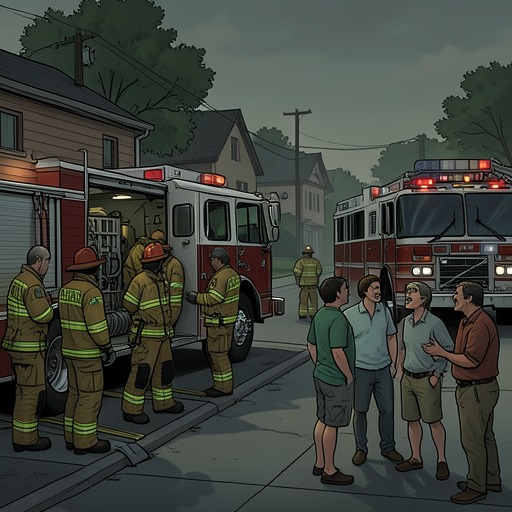
The department is associated with a large garage and a fire station on a town street. When Yasha is walking toward the pier, he realizes that his route has taken him down the street where the station stands. Several men from the department are scrubbing one of the trucks in the driveway. The scene establishes the service through visible, practical activity rather than an account of its organization or its emergency work: the vehicle is being washed, the crew is present, and the station opens directly onto the street.
The firehouse also sits beside an appliance store. On another afternoon, Yasha gets out of Ken Ashton’s car and sees Cam outside, wiping down one of the engines. The adjacent businesses and the engine-maintenance task place the service within the town’s everyday geography. It is not set apart from ordinary commercial life; the firehouse is part of the same local landscape through which Yasha moves on errands and visits.
The Crew and Its Workday
The evidence presents the department as a group of firefighters who share shifts and the upkeep of their equipment. The men at the station scrub a truck together, while Cam is later seen wiping down an engine. These separate glimpses give routine maintenance a recurring place in the department’s portrayal. The vehicles are not merely background: they make the crew’s occupation legible in scenes otherwise focused on Yasha’s movement through town and his encounters with people he is coming to know.
The story offers no detailed account of the department’s command structure, staffing, response procedures, or record of calls. Its organizational character instead emerges through small, concrete details: a shared workplace, a shift ending at around six, and firefighters who leave work together for a drink. This limited view keeps the department grounded in the scenes that feature it rather than supplying unsupported claims about how it operates beyond them.
Social Life and Yasha’s Introduction
JT makes the department a point of connection when he tells Yasha that the beach is good that time of year and that Nacho’s Bar is a place to unwind. He says a group of them will go there after their shift, at about six, and begins to invite Yasha along. The offer links the crew’s work schedule to its social routine: the shift has an endpoint, and the firefighters have a familiar place to gather afterward. It also gives Yasha a possible opening into JT’s circle, not just a glimpse of the station from the street.
That introduction is briefly interrupted when a muscular firefighter puts an arm around JT’s shoulders. JT gives a soft oomph and is held in what the narration describes as a choke hold while making the introductions. The moment presents physical familiarity between coworkers, but it also complicates the invitation: Yasha meets the group amid its own established camaraderie, with JT temporarily caught in another man’s embrace. The department’s social character is conveyed through this gesture rather than through a formal description of its members.
Later, Yasha finds the firefighters on the patio at Nacho’s Bar. Most have changed into jeans and T-shirts marked SIFD Sparks. They are relaxed and drinking beer; Cam smokes, holding a cigarette in one hand and an ashtray in the other. The work clothes and equipment of the station give way to casual clothes and a shared evening, but the printed shirts retain the crew’s affiliation. The gathering shows the department extending beyond the firehouse into a recognizable group identity, while the patio, drinks, and smoking remain specific details of this particular scene rather than evidence of a wider organizational custom.
Narrative Role and Limits
The department’s importance to the story lies in the way it brings workplace, place, and relationship into contact. Its station supplies recurring points of encounter with Cam; JT’s invitation turns the crew’s end-of-shift gathering into a potential social welcome for Yasha; and the firefighters’ patio scene makes that circle visible as a group. The department is therefore more than a street landmark, even though the narrative gives little institutional background. It helps render the town as a network of familiar routes and shared spaces, from the firehouse driveway to the bar patio.
The book’s glimpses remain selective. The available scenes do not identify the firefighters by name beyond Cam and JT, explain the meaning of the SIFD Sparks shirt, or describe the department’s relationship with town government. Nor do they show the crew responding to an emergency. What they do establish is enough to distinguish the department’s visible roles: a workplace where vehicles are maintained, a group organized around shifts, and a social circle whose members welcome Yasha into their after-work orbit. Its everyday details, rather than a dramatic call, give the service its place in the narrative.