Adele Varens
Jane EyreAdele Varens, Mr. Rochester's ward, is a lively, affectionate French child who becomes Jane Eyre's first pupil at Thornfield Hall. Though not a major driver of the plot, she serves as a crucial emotional touchstone for Jane, representing both the warmth of domestic affection and the complications of Rochester's past. Her presence at Thornfield allows Jane to exercise her capacity for love and care, and their bond endures long after Jane's marriage, with Adele eventually becoming a grateful and devoted companion.
Identity and Background
Adele is introduced as a small, pale child of about seven or eight, with a redundancy of hair falling in curls to her waist and a lively, coquettish manner that reflects her French upbringing. She was born on the Continent and came to England only six months before Jane's arrival, speaking almost no English at first. Her mother was Celine Varens, a French opera-dancer with whom Mr. Rochester had a passionate affair in Paris. Rochester installed Celine in an hotel, gave her servants, a carriage, cashmeres, and diamonds, but discovered her infidelity with a young vicomte. After breaking with Celine, he learned that she had given birth to Adele, whom she claimed was his daughter. Though Rochester sees no proof of paternity in her countenance—remarking that his dog Pilot is more like him than she is—he took the destitute child out of the slime and mud of Paris and transplanted her to Thornfield, where Mrs. Fairfax found Jane to train her. Adele herself remembers living with her mother, who taught her to dance, sing, and recite verses, and who entertained many gentlemen and ladies. After her mother went to the Holy Virgin, Adele lived with Madame Frederic, a poor woman not related to her, until Mr. Rochester brought her to England.
Life at Thornfield and Relationship with Jane
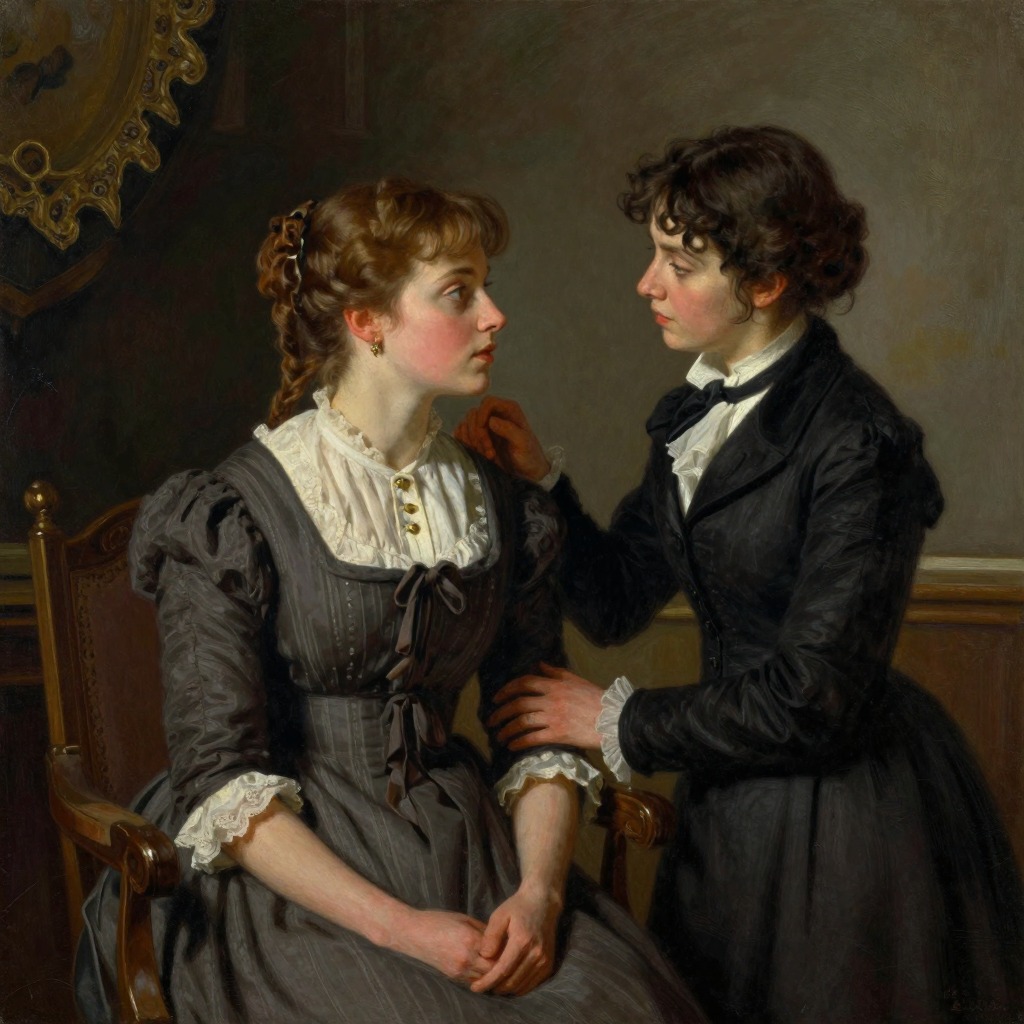
Adele quickly becomes attached to Jane, calling her "ma bonne amie, ma chere Mdlle. Jeannette" and chattering fluently in French. Jane finds her sufficiently docile though disinclined to apply, having not been used to regular occupation. Jane teaches her French, drawing, and music, and Adele makes reasonable progress, entertaining for Jane a vivacious though perhaps not very profound affection. Jane, in turn, feels a conscientious solicitude for Adele's welfare and a quiet liking for her, though she recognizes that Adele has no great talents or marked traits of character. Adele's coquettish nature, inherited probably from her mother, sometimes surfaces—she is delighted by her pink satin frock and wreath of rosebuds, and she performs a song from an opera about a forsaken lady with surprising theatricality. During the house party at Thornfield, Adele is dressed in her best and presented to the ladies, where she is alternately mocked by Blanche Ingram as "a little puppet" and kindly received by Mrs. Dent and the Eshton sisters. She participates in the charades, bounding forward with a basket of flowers, and later sits on the knee of Henry Lynn, trying to talk French with him.
Rochester's Ambivalence and Adele's Future
Mr. Rochester's attitude toward Adele is marked by a cold, almost resentful ambivalence. He calls her "that French floweret" and admits he would sometimes fain be rid of her, keeping her only on the Roman Catholic principle of expiating sins by one good work. He tells Jane that Adele is the illegitimate offspring of a French opera-girl and that he acknowledges no natural claim on her part to be supported by him. Yet he has taken her out of destitution and provided for her. When Jane, anticipating Rochester's marriage to Blanche Ingram, suggests that Adele ought to go to school, Rochester agrees, saying he will send her to school to get her out of his bride's way. After Jane's flight from Thornfield and the fire that destroys the hall, Adele is placed in a school with strict rules and a severe course of study. Jane, after her marriage to Rochester, visits Adele and finds her pale, thin, and unhappy. She takes Adele home, but soon finds she cannot be her governess because her husband needs all her time and care. Instead, Jane places Adele in a more indulgent school near enough to visit often and bring her home sometimes. As Adele grows up, a sound English education corrects her French defects, and she becomes a pleasing, obliging, docile, good-tempered, and well-principled companion, repaying Jane's kindness with grateful attention.
Thematic Significance
Adele functions as a living link to Rochester's past—a tangible reminder of his youthful indiscretions and the moral complexity he carries. For Jane, Adele is an object of genuine affection and a test of her own principles: when Rochester reveals Adele's illegitimacy, expecting Jane to recoil, Jane instead declares that she will cling closer to the lonely little orphan. Adele also embodies the theme of nurture over nature: though born of a frivolous, mercenary mother, she is shaped by Jane's patient teaching and later by a sound English education into a worthy young woman. Her eventual happiness and gratitude provide a quiet counterpoint to the novel's more dramatic resolutions, affirming that love and care can redeem even the most unpromising beginnings.