Bessie Leaven
Jane EyreBessie Leaven, the nurse at Gateshead Hall, is the first adult in Jane Eyre's life to offer her any semblance of kindness, yet she does so inconsistently, mingling sharp scolds with rare moments of warmth. As the only person at Gateshead who sometimes treats Jane as a human being rather than an interloper, Bessie occupies a pivotal place in Jane's emotional development: she is neither a secure attachment figure nor an enemy, but a capricious source of the very affection Jane craves and learns to live without. Her presence—and her eventual departure from Jane's life—marks the beginning of Jane's long education in the difference between conditional kindness and genuine love.
Identity and Role at Gateshead
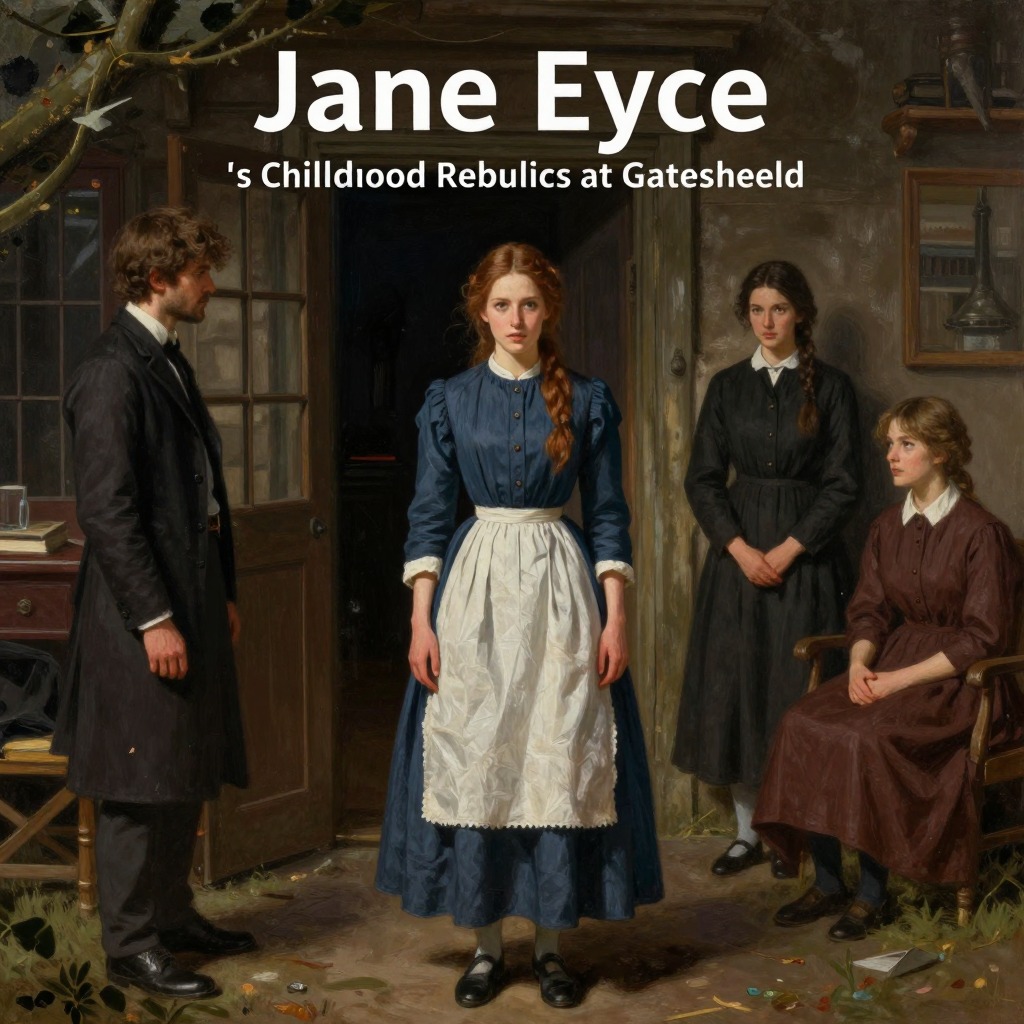
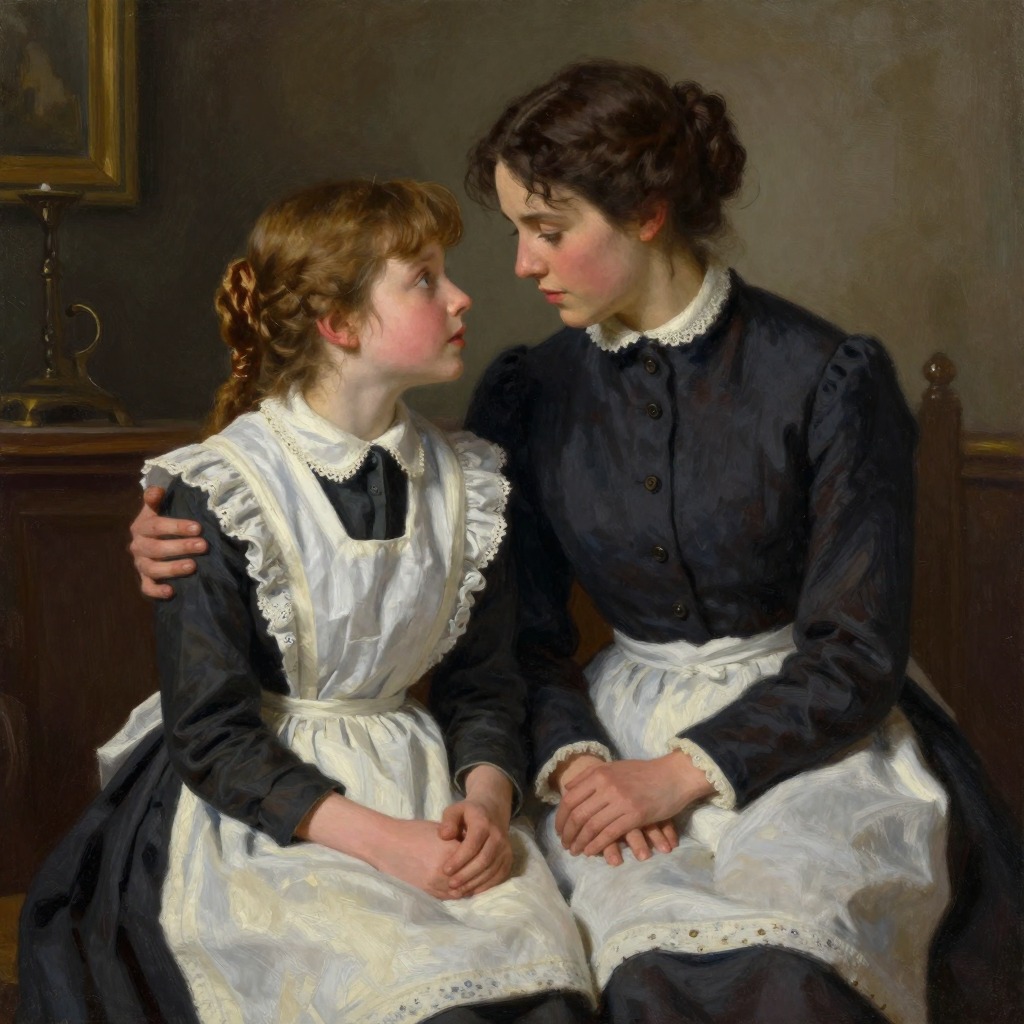
Bessie is the nursery maid at Gateshead Hall, a slim young woman with black hair, dark eyes, nice features, and a clear complexion, possessed of a sweet singing voice and a remarkable knack for storytelling . She is smart in all she does, but her temper is capricious and hasty, and her ideas of principle or justice are indifferent . She frequently scolds Jane, calls her a "queer, frightened, shy little thing" , and on one occasion threatens to tie her down with garters . Yet she also brings Jane a tart on a prized china plate , sings ballads to her (E00149–E00172), and twice kisses her goodnight, saying "Good night, Miss Jane" . This alternation between harshness and tenderness makes Bessie an unpredictable figure in Jane's early life—neither wholly cruel nor wholly kind, but a living lesson in the unreliability of affection from those who hold power over a dependent child.
Bessie's Treatment of Jane: Cruelty and Occasional Comfort
Bessie's treatment of Jane is marked by a sharp tongue and a quick hand. She scolds Jane for crying , scrubs her face mercilessly with a coarse towel , and delivers a homily of an hour's length proving that Jane is "the most wicked and abandoned child ever reared under a roof" . She joins Martha Abbot in reproaching Jane for striking John Reed, telling her she is "less than a servant" (E00077–E00078) and warning that if Mrs. Reed turned her off, she would have to go to the poorhouse . Yet Bessie also shows Jane unexpected kindness: after the red-room incident, she speaks to Jane with "unwonted kindness" , brings her Gulliver's Travels from the library , and sings her the ballad of the poor orphan child (E00153–E00172). When Jane is ill, Bessie sits up with her and speaks of her with concern, telling Sarah that she "daren't for my life be alone with that poor child to-night: she might die" . This duality—the same woman who threatens to tie Jane down also fears for her life—creates in Jane a confused but persistent attachment: "such as she was, I preferred her to any one else at Gateshead Hall" .
Bessie's Departure and Jane's Farewell to Gateshead
On the morning of Jane's departure for Lowood, Bessie is the only person yet risen . She presses Jane to eat, wraps biscuits in paper for her bag, helps her on with her pelisse and bonnet, and walks her to the gate in the dark winter morning (E00368–E00369). When the coach arrives, Jane clings to Bessie's neck with kisses, and Bessie cries to the guard, "Be sure and take good care of her" (E00383–E00384). This farewell is the first significant separation in Jane's life, and Bessie's tearful concern stands in stark contrast to Mrs. Reed's cold dismissal. Jane later reflects that Bessie's presence, "compared with the thoughts over which I had been brooding, seemed cheerful" , and that even Bessie's transitory anger no longer troubled her after her victory over Mrs. Reed .
Later Life and Reunion with Jane
Nearly nine years later, Bessie—now married to Robert Leaven, the Gateshead coachman, and living at the lodge—travels to Lowood to see Jane before she leaves for Thornfield (E00798–E00804). She brings her three-year-old son Bobby and tells Jane she has a little girl christened Jane . In their reunion, Bessie frankly assesses Jane's appearance: "You're not grown so very tall, Miss Jane, nor so very stout" , and admits that Jane "was no beauty as a child" . Yet she also praises Jane's accomplishments—her piano playing, her painting, her French—and declares, "Oh, you are quite a lady, Miss Jane! I knew you would be" . It is Bessie who tells Jane about her father's brother, a Mr. Eyre who came to Gateshead seeking her and then sailed to Madeira (E00831–E00837), information that eventually leads to Jane's inheritance. Bessie's visit is the last time Jane sees her; they part at the door of the Brocklehurst Arms, each going her separate way .
Narrative Role and Significance
Bessie functions as a transitional figure in Jane's emotional landscape: she is neither the outright antagonist that Mrs. Reed is nor the sustaining presence that Helen Burns and Miss Temple become. Her inconsistent kindness teaches Jane that affection from a dependent's caretaker is contingent and unreliable, a lesson that sharpens Jane's hunger for genuine, principled love. Bessie's ballads—especially "My feet they are sore, and my limbs they are weary" (E00153–E00172)—become part of Jane's inner life, and the image of the poor orphan child resonates with Jane's own sense of abandonment. Bessie's later reappearance, with her frank assessment of Jane's plainness and her pride in Jane's accomplishments, shows that Bessie's regard, though limited, is real: she is the only person from Gateshead who seeks Jane out, and the only one who brings news of Jane's unknown relatives. In the end, Bessie represents the imperfect, human affection that Jane must learn to accept without idealizing—a love that is neither wholly safe nor wholly false, but simply the best that a flawed person can offer.