Edward Fairfax Rochester
Jane EyreEdward Fairfax Rochester, the master of Thornfield Hall, is one of the most memorable Byronic heroes in English literature—a figure of dark, sardonic power, fierce intelligence, and a secret history that binds him to Jane Eyre in a love that must be tested by fire, conscience, and catastrophe before it can be fulfilled. He enters the novel not as a conventional romantic lead but as a harsh, enigmatic presence: a man of middle height and considerable breadth of chest, with a dark face, stern features, a heavy brow, and eyes that can be at once searching and mocking. His appearance is deliberately unhandsome—Jane tells him to his face, at their second meeting, that she does not think him handsome—yet his voice, his manner, and the sheer force of his personality exert an immediate and lasting fascination. He is nearly forty when Jane meets him, a decade and a half older than she, and he carries the weight of a life already marked by error, suffering, and willful isolation.
Identity and Background
Rochester is the second son of an avaricious father who, determined to keep the family estate intact, sent him to Jamaica at the age of twenty-one to marry Bertha Antoinetta Mason, a Creole heiress whose family concealed a hereditary madness. The marriage was a catastrophe: Bertha degenerated into a violent, intemperate lunatic, and Rochester found himself bound to a woman he could neither love nor legally escape. After four years of torment, he brought her back to England and confined her to the third storey of Thornfield Hall under the care of Grace Poole, then spent a decade wandering the Continent in a restless, often dissolute search for companionship and meaning. He took a series of mistresses—the French opera-dancer Celine Varens, the Italian Giacinta, the German Clara—but found in each only a hollow repetition of his disgust. By the time Jane arrives at Thornfield, he has become a man who "abhorred the very thought" of his own house, who shunned it like a plague-house, and who lived in a state of bitter, self-aware cynicism, convinced that happiness was irrevocably denied him.
Life and Plot Trajectory
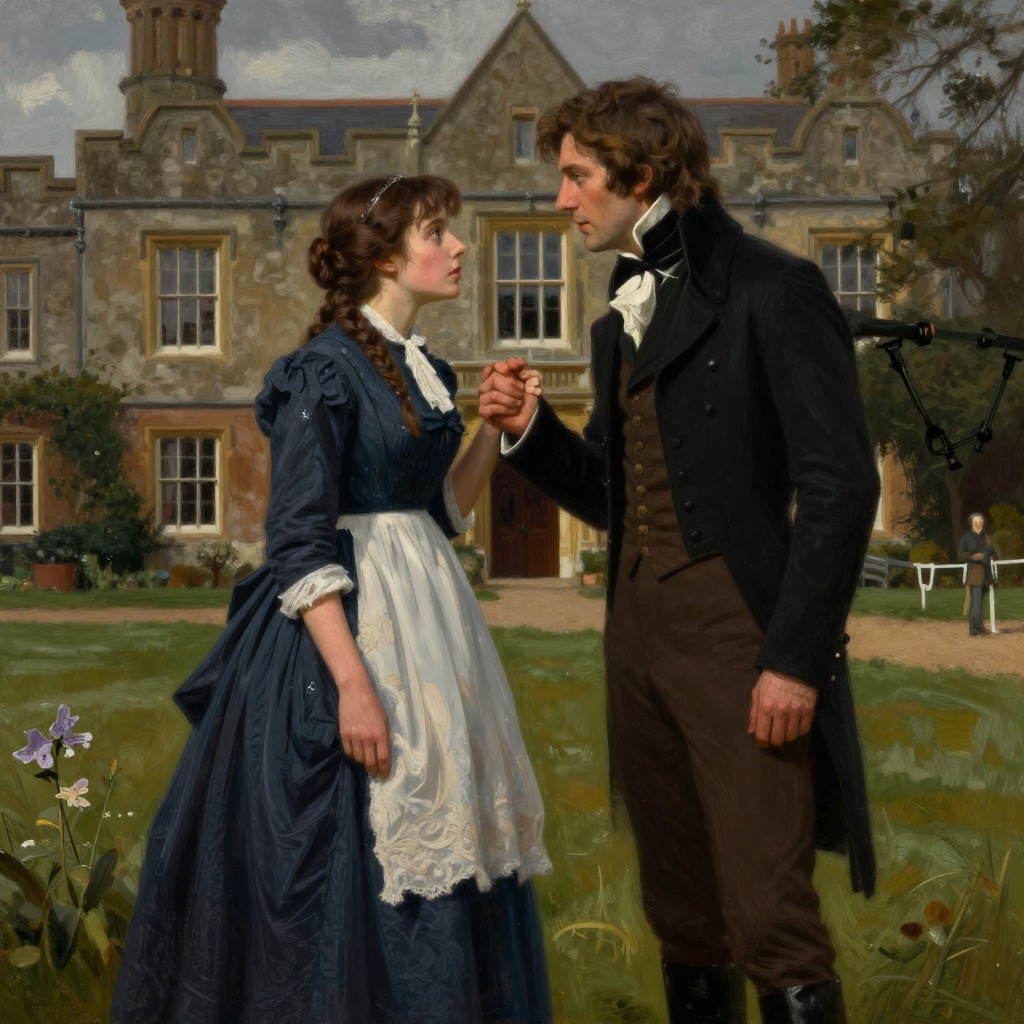
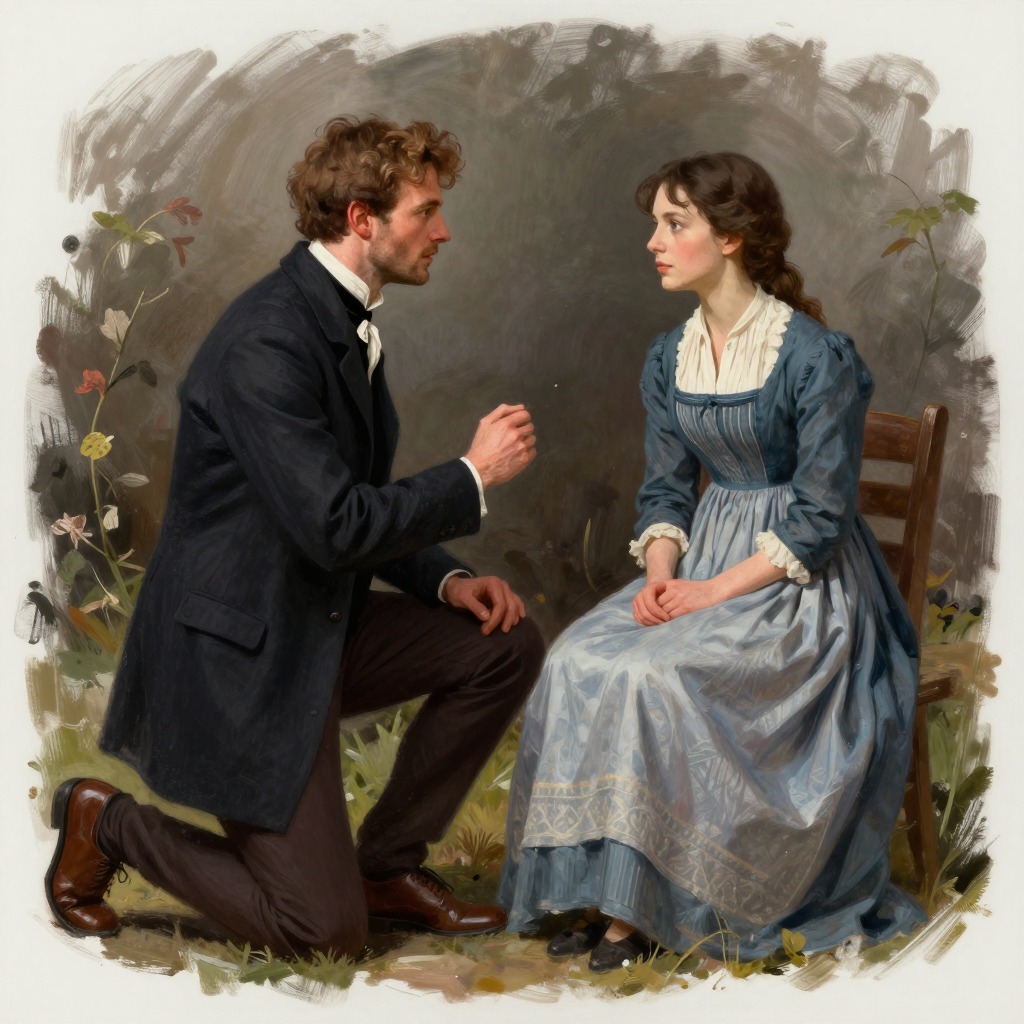
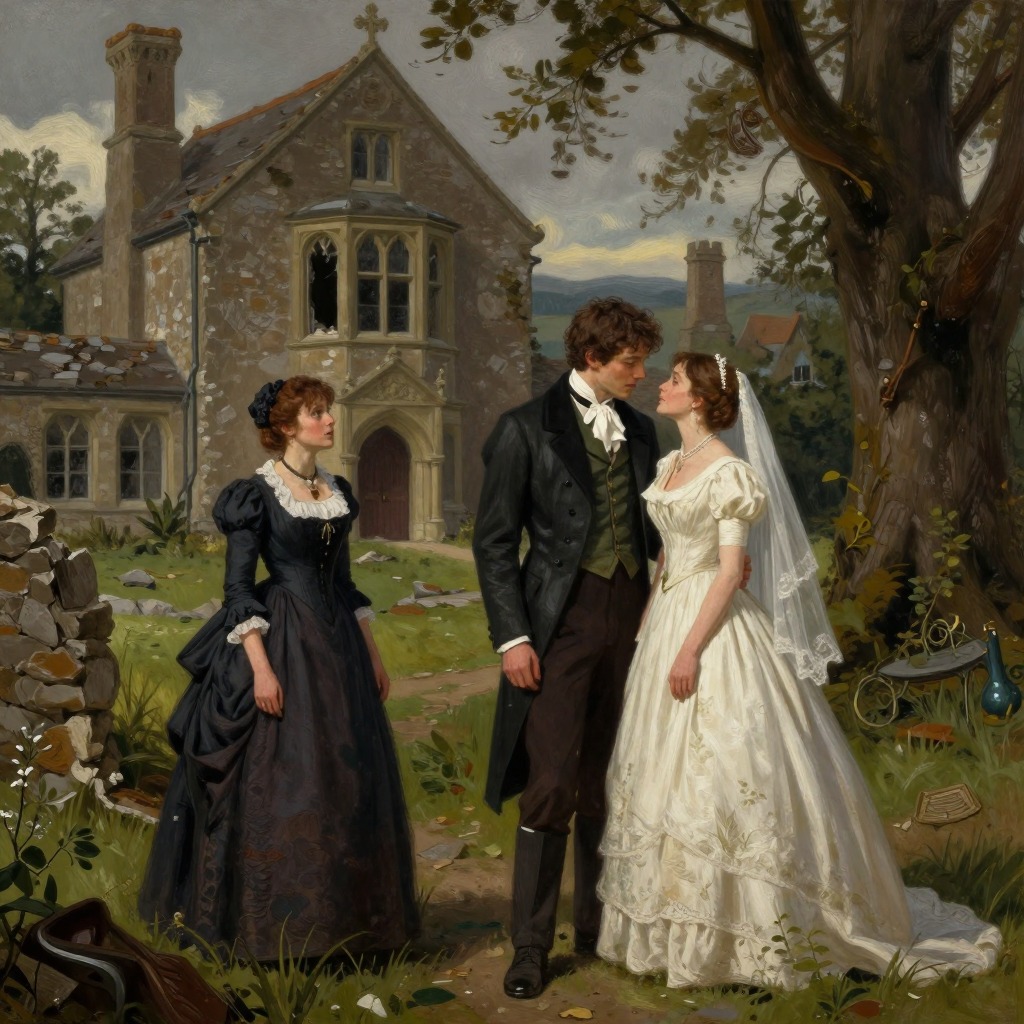
Rochester's first encounter with Jane is the famous Hay Lane incident, where his horse slips on a sheet of ice and he sprains his ankle. The small, quiet figure who offers him help—a governess, as he later learns—strikes him with an inexplicable force. He begins to observe her with a fascination that deepens into something far more serious. He tests her, teases her, draws her out in long evening conversations, and finds in her a mind and spirit unlike any he has encountered: "You are not to suppose that I desired perfection, either of mind or person. I longed only for what suited me—for the antipodes of the Creole." He stages the elaborate charade of the gipsy fortune-teller to probe her feelings, and when she passes every test of integrity and self-possession, he resolves to marry her, concealing the existence of his mad wife in a desperate gamble for happiness. The wedding is interrupted by the revelation of Bertha's existence, and in the devastating scene that follows, Rochester pours out the full story of his marriage—the deceit of the Mason family, his father's greed, his own youthful blindness—and makes a passionate, anguished plea for Jane to stay with him as his wife in all but law. When she refuses, he is left in a state of near-madness himself, and after her flight, he descends into a hermit-like existence at Thornfield, refusing all society.
The climax of his physical story comes when Bertha sets fire to the house. Rochester, displaying the courage that has always been part of his nature, helps the servants to safety and then ascends to the roof to rescue his wife. She leaps to her death, and he is crushed by falling masonry, losing one eye and the sight of the other, and suffering the amputation of one hand. He retreats to Ferndean Manor, a damp, isolated house buried in a wood, where he lives as a blind, crippled recluse, attended only by the old servants John and Mary.
Key Actions and Objectives
Rochester's central objective throughout the novel is to escape the prison of his first marriage and find genuine love and companionship. This drive leads him to a series of morally ambiguous actions: the concealment of Bertha's existence, the attempted bigamy, and the sustained deception of Jane. Yet his motives are never simply selfish. He genuinely believes that his marriage to Bertha was a nullity in all but law, and that he has a right to seek happiness. He tells Jane, "I was wrong to attempt to deceive you; but I feared a stubbornness that exists in your character." His actions are those of a man who has been driven to the edge of despair and who sees in Jane his last hope of redemption. He also shows a consistent, if flawed, sense of responsibility: he provides for Bertha's care, he takes in Adele Varens (the illegitimate daughter of Celine Varens, who may or may not be his child), and he settles an annuity on Mrs. Fairfax after the fire.
Relationships and Conflict
The central relationship of Rochester's life is with Jane Eyre. It is a union of minds and spirits that transcends the social and physical disparities between them. He is drawn to her integrity, her intelligence, her refusal to be cowed by his authority, and her essential goodness. "I have a pleasure in owing you so immense a debt," he tells her after she saves him from a fire in his bed. Their love is tested by the revelation of Bertha, by Jane's principled refusal to become his mistress, and by the long separation that follows. The conflict between them is not merely external but internal: Rochester must learn to submit his will to a moral law he has spent years defying, and Jane must learn to trust that her love can survive the wreck of her ideals. His relationship with Bertha is one of horror and revulsion, but also of a grim, inescapable duty. He speaks of her with a hatred that Jane rebukes, but he also acknowledges that "she cannot help being mad." His relationship with St. John Rivers, whom he never meets, is one of implicit rivalry for Jane's allegiance; Rochester's jealousy when he learns of St. John's proposal is both comic and touching.
Change and Ending
Rochester's transformation is the novel's most powerful arc of redemption. The proud, sardonic, self-willed man who declared "I will break obstacles to happiness, to goodness—yes, goodness" is broken by the very obstacles he tried to defy. The fire at Thornfield, the loss of his sight and his hand, and the long solitude at Ferndean humble him into a state of penitence and dependence. When Jane returns to him, he is no longer the master who commanded but the blind man who must be led. Yet his spirit is not crushed; it is purified. He tells Jane, "Of late, Jane—only—only of late—I began to see and acknowledge the hand of God in my doom. I began to experience remorse, repentance; the wish for reconcilement to my Maker." Their reunion is a scene of extraordinary tenderness, in which Rochester, unable to see, must touch and hear to believe that Jane is real. He marries her, and in the ten years that follow, he recovers the sight of one eye—enough to see his first-born son, who has inherited his own large, brilliant, black eyes. He becomes, in Jane's words, "my husband's life as fully as he is mine."
Narrative Role and Evaluation
Rochester functions as both the object of Jane's love and the embodiment of the temptations and trials she must overcome. He is the Byronic hero in his classic form: dark, brooding, passionate, and morally ambiguous, yet capable of profound feeling and genuine transformation. His presence dominates the middle third of the novel, and his absence haunts the final third. He is also a figure of considerable psychological complexity: his self-awareness is acute, his capacity for self-laceration is deep, and his love for Jane is rendered with a specificity and intensity that makes it one of the great literary romances. Charlotte Brontë gives him a voice that is at once commanding and vulnerable, sardonic and tender, and his speeches—from the confession in the orchard to the desperate plea in the library—are among the most powerful in the novel. He is not a simple villain or a simple hero, but a man who must be broken before he can be saved, and whose salvation is earned not by his own efforts alone but by Jane's unwavering fidelity to principle and to love.
Rochester's character has been reinterpreted across numerous adaptations, most notably in Jean Rhys's 1966 novel Wide Sargasso Sea, which gives voice to his first wife, Bertha Mason, and reframes his colonial past. The 2011 film adaptation directed by Cary Joji Fukunaga, starring Michael Fassbender as Rochester, earned critical acclaim and award nominations for its performances and costume design. The line "Reader, I married him" from Chapter 38 has become a cultural touchstone, inspiring works such as Tracy Chevalier's 2016 anthology Reader, I Married Him, commissioned for Brontë's bicentenary, and referenced in Liane Moriarty's 2018 novel Nine Perfect Strangers. Emma Tennant's novel The French Dancer's Bastard reimagines Rochester's relationship with Adèle, questioning whether she was his biological daughter. These adaptations and allusions attest to the enduring fascination with Rochester's complex, Byronic persona.