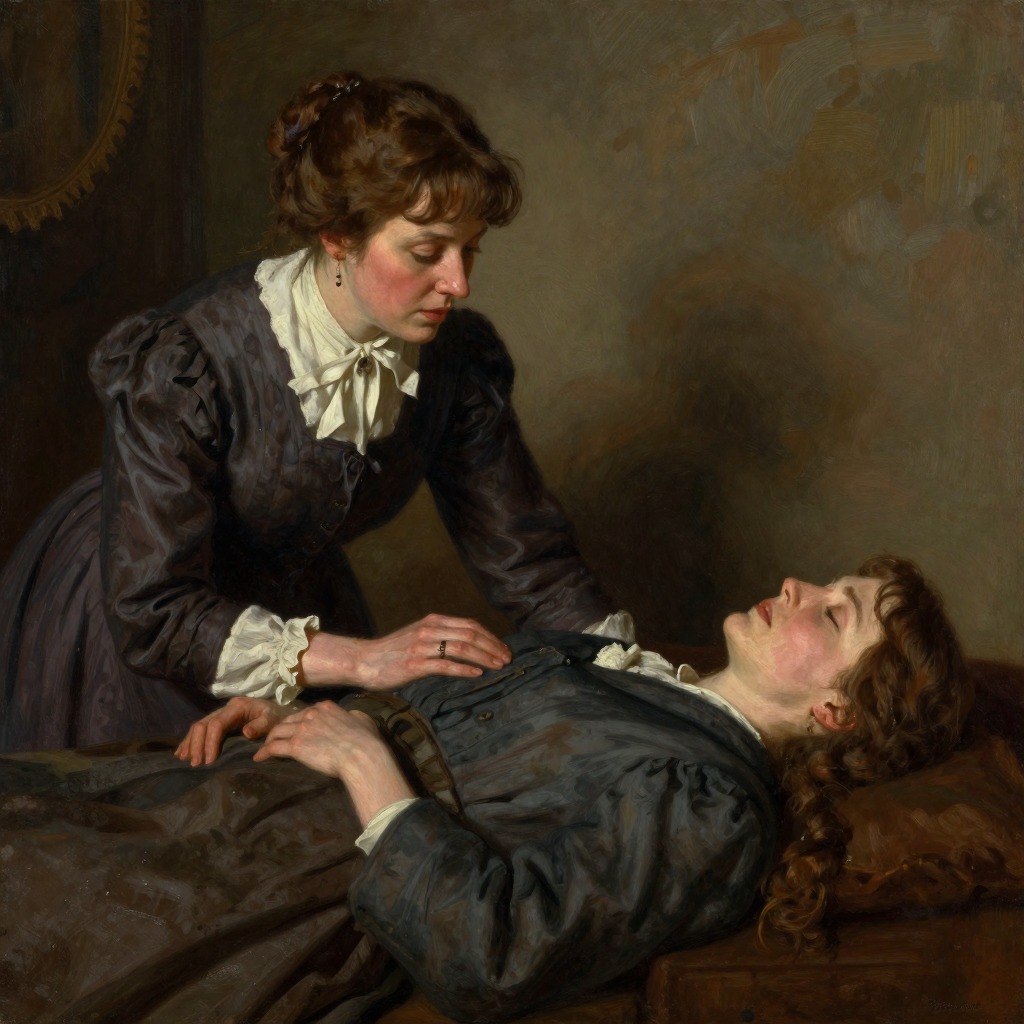
Gateshead Hall
Jane EyreGateshead Hall, the Reed family seat in -shire, is the first and most formative of the novel's oppressive domestic spaces. It is here that the orphaned Jane Eyre, taken in by her uncle Mr. Reed on his deathbed, endures ten years of relentless humiliation, physical abuse, and emotional starvation at the hands of her aunt, Mrs. Reed, and her three cousins, John, Eliza, and Georgiana. The hall is not merely a setting but an active agent of Jane's suffering: its architecture, its hierarchies, and its cold, luxurious interiors are designed to exclude and punish her. The red-room, in particular, becomes the site of a primal trauma that reverberates through the entire narrative, establishing the core conflict between Jane's fierce inner sense of justice and the external world's denial of her worth.
Architecture and Atmosphere of Exclusion
Gateshead Hall is described as a large, stately mansion, yet for Jane it is a prison. The drawing-room, where Mrs. Reed reclines with her children, is explicitly forbidden to Jane, who is relegated to the breakfast-room window-seat, hidden behind a red moreen curtain. The house is filled with luxurious furnishings—mahogany, damask, crimson cloth—but these only emphasize Jane's status as an outsider. The red-room, the largest and stateliest chamber, is a square room with massive mahogany pillars, deep red damask curtains, and a snowy Marseilles counterpane. It is chill, silent, and solemn, seldom entered, and haunted by the memory of Mr. Reed's death nine years earlier. This room, with its great looking-glass and its air of dreary consecration, becomes the stage for Jane's most terrifying ordeal: locked in alone after she fights back against John Reed, she suffers a fit of hysterical terror, believing she sees her uncle's ghost, and loses consciousness. The experience leaves her with a shock she feels "to this day."
The Reed Family and Systematic Cruelty
The hall's inhabitants embody a spectrum of cruelty. John Reed, a fourteen-year-old schoolboy, is described as large, stout, with a dingy skin and bleared eye, habitually gorging himself at table. He bullies Jane continually, striking her and throwing a book that cuts her head. His mother is blind and deaf to his violence, even when it occurs in her presence. Eliza is headstrong and selfish, Georgiana spoiled and spiteful, and Mrs. Reed herself is a woman of robust frame and an eye "devoid of ruth," who maintains a marked line of separation between Jane and her own children. The servants, Bessie and Miss Abbot, enforce this hierarchy, telling Jane she is "less than a servant" and that her place is to be humble. The cumulative effect is a system of oppression that denies Jane any appeal, any ally, any recognition of her humanity.
The Red-Room Trauma and Its Aftermath
The red-room incident is the novel's foundational trauma. After John Reed strikes her and she fights back, Mrs. Reed orders Jane locked in the red-room. There, in the gathering darkness, Jane's fear of the supernatural—the ghost of her uncle, who died in that room—combines with her sense of utter injustice. She sees a light, believes it is a herald of a ghost, and screams. Mrs. Reed, instead of showing mercy, locks her in again, and Jane has a species of fit, falling unconscious. The aftermath is a period of physical and mental illness, during which the apothecary Mr. Lloyd is called. Jane's conversation with him leads to the suggestion that she be sent to school, a prospect she eagerly embraces. The trauma of the red-room is not merely a childhood memory; it becomes a touchstone for Jane's later experiences of confinement and injustice, and it fuels her passionate declaration to Mrs. Reed that she will remember the cruelty "to my dying day."
Jane's Confrontation and Departure
Jane's final months at Gateshead are marked by a growing defiance. She confronts Mrs. Reed directly, declaring, "I am not deceitful: if I were, I should say I loved you; but I declare I do not love you." This outburst, which Jane later describes as her "first victory," is a turning point. She leaves Gateshead on the morning of January 19th, by a coach that passes the lodge gates at six a.m., severing herself from the only home she has known. The departure is stark: she refuses to bid Mrs. Reed goodbye, and as she passes through the hall, she cries, "Good-bye to Gateshead!" The hall, with its hostile roof and its memories of suffering, is left behind, but its legacy—the deep-seated need for love, justice, and independence—accompanies her to Lowood and beyond.
Narrative and Thematic Significance
Gateshead Hall functions as the novel's initial, definitive image of a world that denies Jane any place or value. It is the space where the central conflict between the individual's moral integrity and society's arbitrary hierarchies is first staged. The hall's luxurious but cold interiors, its locked rooms, and its cruel inhabitants establish the pattern of oppression that Jane will encounter in various forms throughout her life. Her departure from Gateshead is not an escape from the problem of injustice but the beginning of her lifelong quest to find a home where she can be loved and respected as an equal. The memory of Gateshead, and particularly of the red-room, haunts her dreams and informs her moral choices, most crucially when she must decide whether to stay with Rochester as his mistress or to flee into the unknown. In the end, the hall's legacy is not merely one of suffering but of the strength forged in resistance.