Hay
Jane EyreHay is a small village situated about two miles from Thornfield Hall, a distance Jane Eyre often covers on foot. It functions as a practical hub for the Thornfield estate, housing the post office where Jane mails letters, the church where she attends services, and the parsonage where the local clergyman resides. More than a mere geographical marker, Hay becomes the stage for several pivotal moments in Jane's story, most notably her first encounter with Mr. Rochester and the subsequent revelation of his past.
Geography and Setting
Hay lies in a valley, its few chimneys sending up blue smoke, and is reached by a lane that inclines uphill all the way from Thornfield. The surrounding landscape is characterized by fields, hedges rich with wild roses in summer and nuts and blackberries in autumn, and a causeway that can become icy in winter. The village itself is small, with a single street, a little shop selling cakes of bread, and a church with a spire that Jane can see from the fields. The parsonage, a well-built though small house, stands near the churchyard in the middle of a garden. The area is described as quiet and lonely, with hills beyond Hay and many becks threading their passes.
Key Events and Encounters
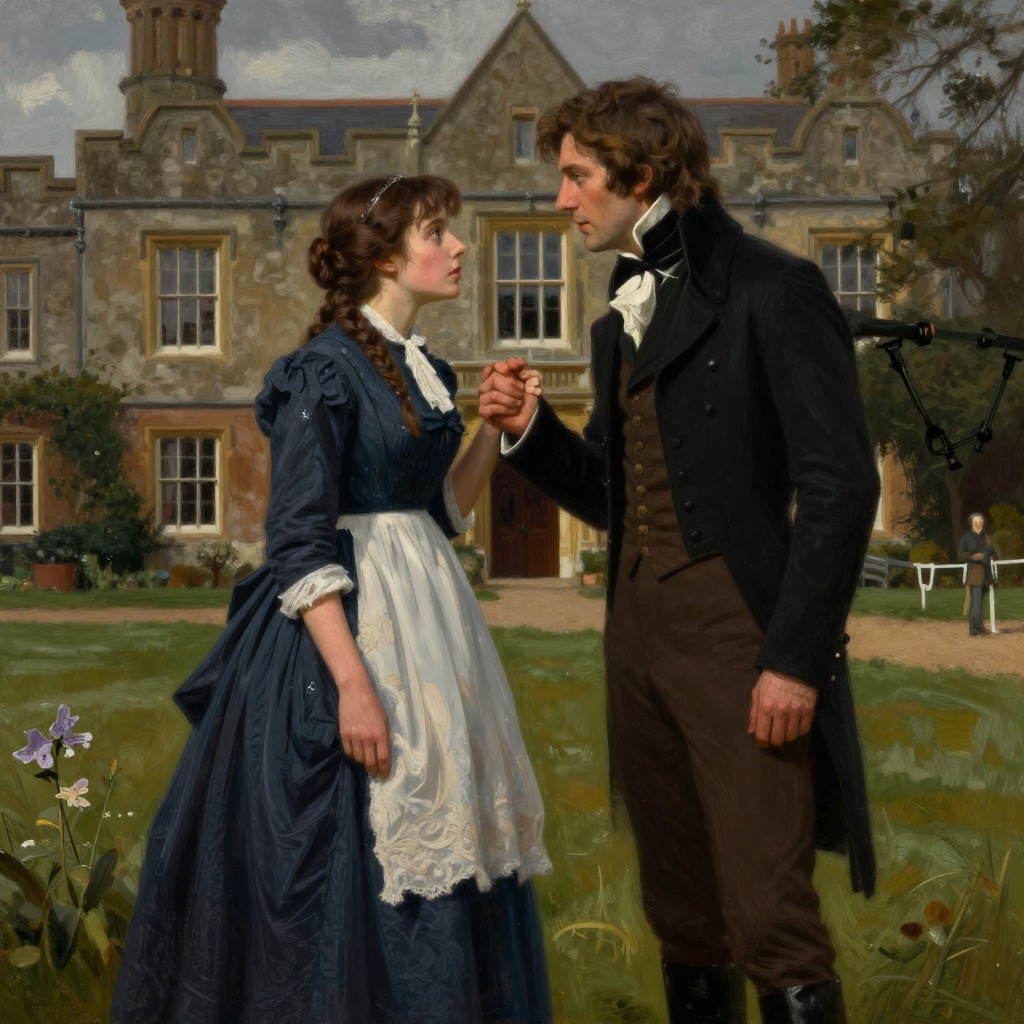
Hay is the destination for Jane's walk on a cold January afternoon when she volunteers to post a letter for Mrs. Fairfax. It is on this walk, in the lane leading to Hay, that she first encounters Mr. Rochester after his horse slips on a sheet of ice. He asks her if she lives at the house with battlements, pointing to Thornfield, and she confirms she is the governess. Later, after the interrupted wedding, Jane learns from the innkeeper at the Rochester Arms that Mr. Rochester, now blind and crippled, has taken refuge at Ferndean, a manor house about thirty miles away. The inn itself, bearing the name "The Rochester Arms," is where Jane stops to inquire about Thornfield Hall after finding it a blackened ruin.
Associated People and Groups
The village is home to the local clergyman, Mr. Wood, who officiates at the church near the gates of Thornfield. The parsonage is also the residence of the Rivers family's father before his death, and it is where Jane, after her flight from Thornfield, first seeks help but finds the clergyman away. The inhabitants of Hay include farm labourers, workers at Mr. Oliver's needle-factory and iron-foundry, and the shopkeeper who refuses to take Jane's handkerchief in exchange for bread when she is starving. The village also has a dressmaker or plain-workwoman, though there is little employment for them.
Narrative Significance
Hay functions as a threshold between the isolated world of Thornfield and the broader society beyond. It is the site of Jane's first, fateful meeting with Rochester, which initiates their complex relationship. Later, it becomes a place of desperate need when Jane, having fled Thornfield, arrives at Whitcross and wanders towards Hay, seeking work and shelter. Her rejection at the parsonage and the shop underscores her utter destitution. Finally, the Rochester Arms in Hay provides the crucial information about Rochester's fate after the fire, leading to their reunion at Ferndean. Thus, Hay bookends two of the most significant phases of Jane's life: the beginning of her love for Rochester and the discovery of his survival and suffering.