Mrs. Reed
Jane EyreMrs. Reed, the widowed mistress of Gateshead Hall and Jane Eyre's aunt by marriage, is the novel's first and most persistent antagonist. A woman of robust frame, square-shouldered and strong-limbed, with a dark, opaque skin, nearly flaxen hair, and an eye devoid of ruth, she governs her household with exact, clever management but reserves for her orphaned niece a relentless aversion that borders on cruelty. Her treatment of Jane—marked by exclusion, physical punishment, and public humiliation—not only defines Jane's miserable childhood but also ignites the fierce sense of injustice and moral independence that will later drive the heroine's most consequential choices.
Identity and Background
Mrs. Reed is introduced as the mother of Eliza, John, and Georgiana Reed, and the widow of Jane's maternal uncle, Mr. Reed. She occupies a position of considerable domestic authority at Gateshead Hall, a comfortable country house where she reclines on a sofa by the fireside with her darlings about her, dispensing Jane from the family circle on the grounds that the child must first acquire "a more sociable and childlike disposition." Her physical description—a somewhat large face with a developed under jaw, low brow, large chin, and a constitution "sound as a bell"—suggests a woman built for control rather than tenderness. She is an exact, clever manager whose household and tenantry are thoroughly under her command, though her children at times defy her authority and laugh it to scorn. Her marriage to Mr. Reed bound her by a deathbed promise to rear Jane as one of her own, a pledge she kept only in the barest legal sense while resenting every moment of its imposition.
Cruelty Toward Jane
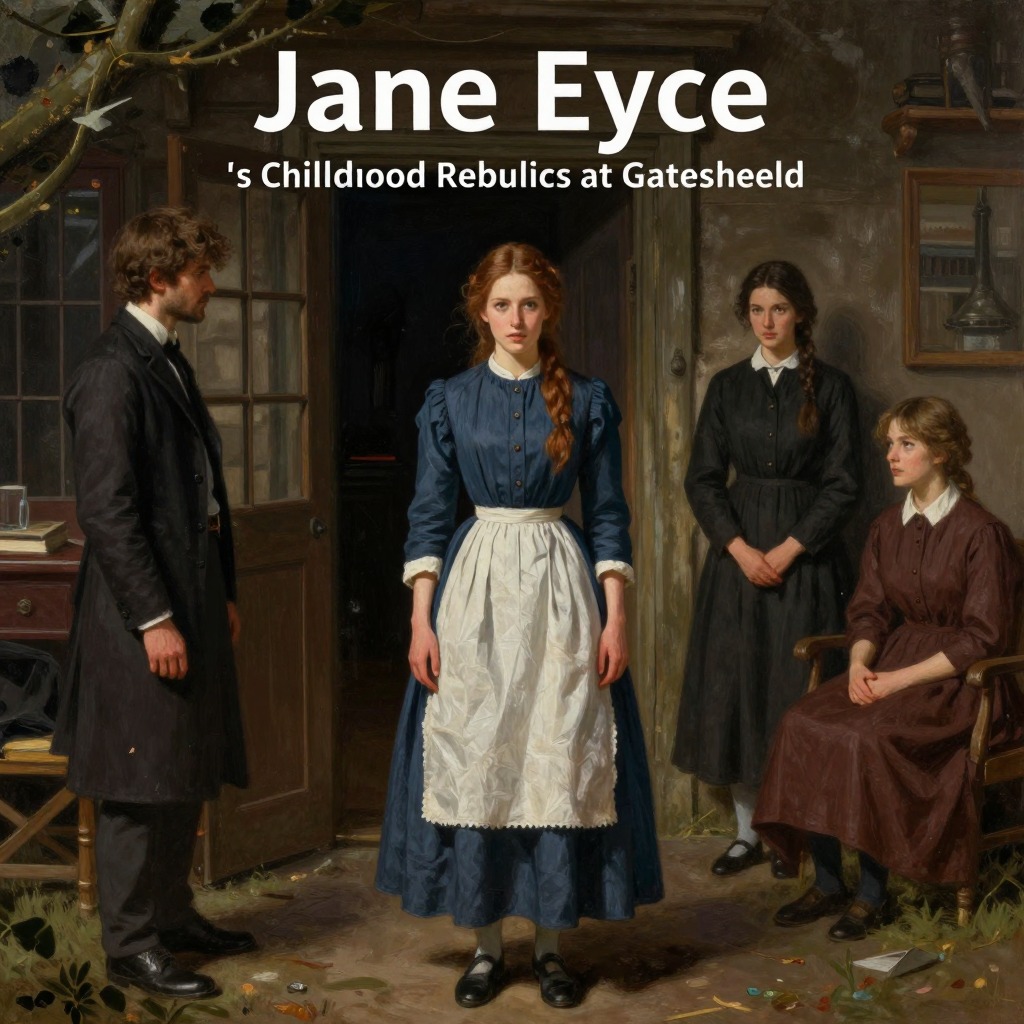
From the opening chapters, Mrs. Reed's treatment of Jane is systematic and unrelenting. She never sees John Reed strike or abuse Jane, though he does both in her very presence; she is "blind and deaf on the subject." When Jane finally fights back after John throws a book that cuts her head, Mrs. Reed orders her locked in the red-room—the chamber where Mr. Reed died—and refuses to release her even when Jane, frantic with terror, begs for mercy. "I abhor artifice, particularly in children," she declares, thrusting Jane back and locking her in again, an act that precipitates a fit of unconsciousness. Later, when Mr. Brocklehurst visits to arrange Jane's admission to Lowood School, Mrs. Reed warns him that Jane has "a tendency to deceit," a public accusation that cuts Jane to the heart and that she knows to be false. She stipulates that Jane spend all her vacations at Lowood, effectively severing her from any possibility of family life. When Jane finally confronts her, declaring "I am not deceitful: if I were, I should say I loved you; but I declare I do not love you," Mrs. Reed looks frightened and offers water, but the moment of vulnerability passes; she never relents.
Relationship with Her Own Children
Mrs. Reed's favoritism toward her own children is stark and damaging. John Reed, a schoolboy of fourteen who gorges himself habitually at table and bullies Jane continually, is called "her own darling" even after he twists the necks of pigeons, kills pea-chicks, sets dogs at sheep, and calls his mother "old girl." Eliza, headstrong and selfish, is respected; Georgiana, with her spoiled temper and acrid spite, is universally indulged for her beauty. This unequal distribution of affection not only isolates Jane but also fosters in the Reed children a sense of entitlement that leads to John's ruin—he goes to college, is plucked, runs up debts, and is supposed to have killed himself—and to the bitter estrangement of the sisters after their mother's death. Mrs. Reed's own health declines under the strain of John's dissipation; she grows stout but not strong, and the news of his death brings on a stroke.
Deathbed Confession and Unreconciled End
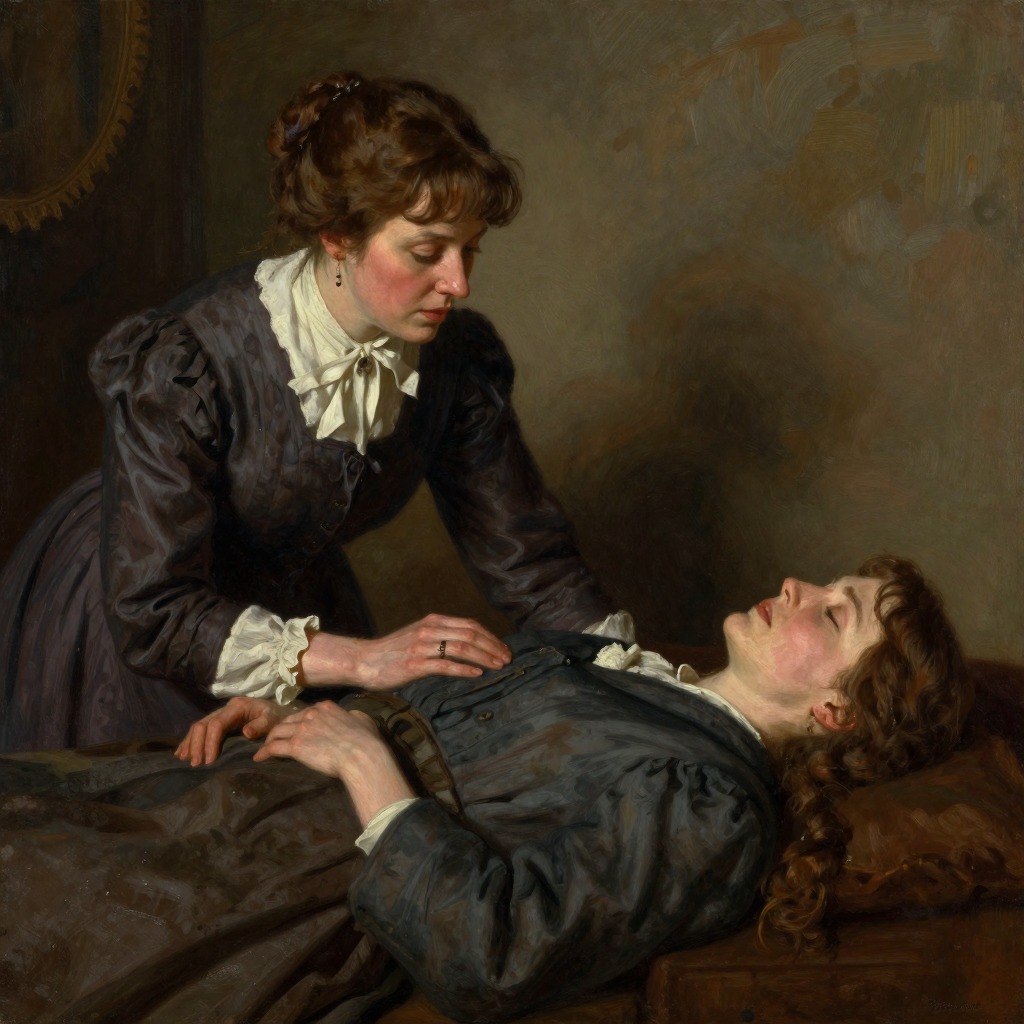
On her deathbed, Mrs. Reed summons Jane, who has traveled a hundred miles from Thornfield to attend her. The dying woman's mind wanders between resentment and confession. She admits to two wrongs: breaking her promise to raise Jane as her own child, and—more devastatingly—concealing a letter from Jane's uncle, John Eyre of Madeira, who had wished to adopt Jane and make her his heir. "I could not forget it; and I took my revenge," she confesses; she wrote back that Jane had died of typhus at Lowood. Even now, she cannot bring herself to ask forgiveness; when Jane approaches her cheek to be kissed, Mrs. Reed will not touch it. "Living, she had ever hated me—dying, she must hate me still," Jane reflects. Mrs. Reed dies that night, her body laid out with her eye of flint covered by its cold lid, her brow and strong traits still bearing the impress of her inexorable soul. Neither Jane nor Eliza sheds a tear.
Thematic Significance
Mrs. Reed functions as the embodiment of loveless, arbitrary authority against which Jane defines her own moral identity. She represents the world of conventional family feeling that excludes the orphan, the world that equates wealth with worth and treats dependence as a crime. Jane's confrontation with her—"I am glad you are no relation of mine: I will never call you aunt again as long as I live"—is the first major assertion of her independent will, a rehearsal for the later, more costly refusals she will make. Mrs. Reed's death, unredeemed by reconciliation, underscores the novel's insistence that some injuries cannot be undone by time alone, and that forgiveness, however freely offered, cannot be compelled. Her final act of spite—depriving Jane of her uncle's fortune for years—ironically sets in motion the chain of events that leads Jane to her inheritance and her cousins, transforming loss into the foundation of a new family.