Slattern placard
Jane EyreThe Slattern placard appears during Jane Eyre's early months at Lowood Institution, a charity school governed by the stern and parsimonious Mr. Brocklehurst. It is a piece of pasteboard on which Miss Scatcherd, the history and grammar teacher, writes the word "Slattern" in conspicuous characters. The placard is then bound like a phylactery round the forehead of Helen Burns, a thirteen-year-old pupil whom Miss Scatcherd has already singled out for constant criticism over her untidy habits, careless posture, and failure to keep her belongings in order. The punishment is inflicted after Miss Scatcherd pulls out Helen's drawer and finds her things in what Helen herself admits was "shameful disorder." Helen is told that the next day she will also have half-a-dozen of the untidily folded articles pinned to her shoulder, but the placard is the more visible and public mark of disgrace.
The Incident and Jane's Reaction
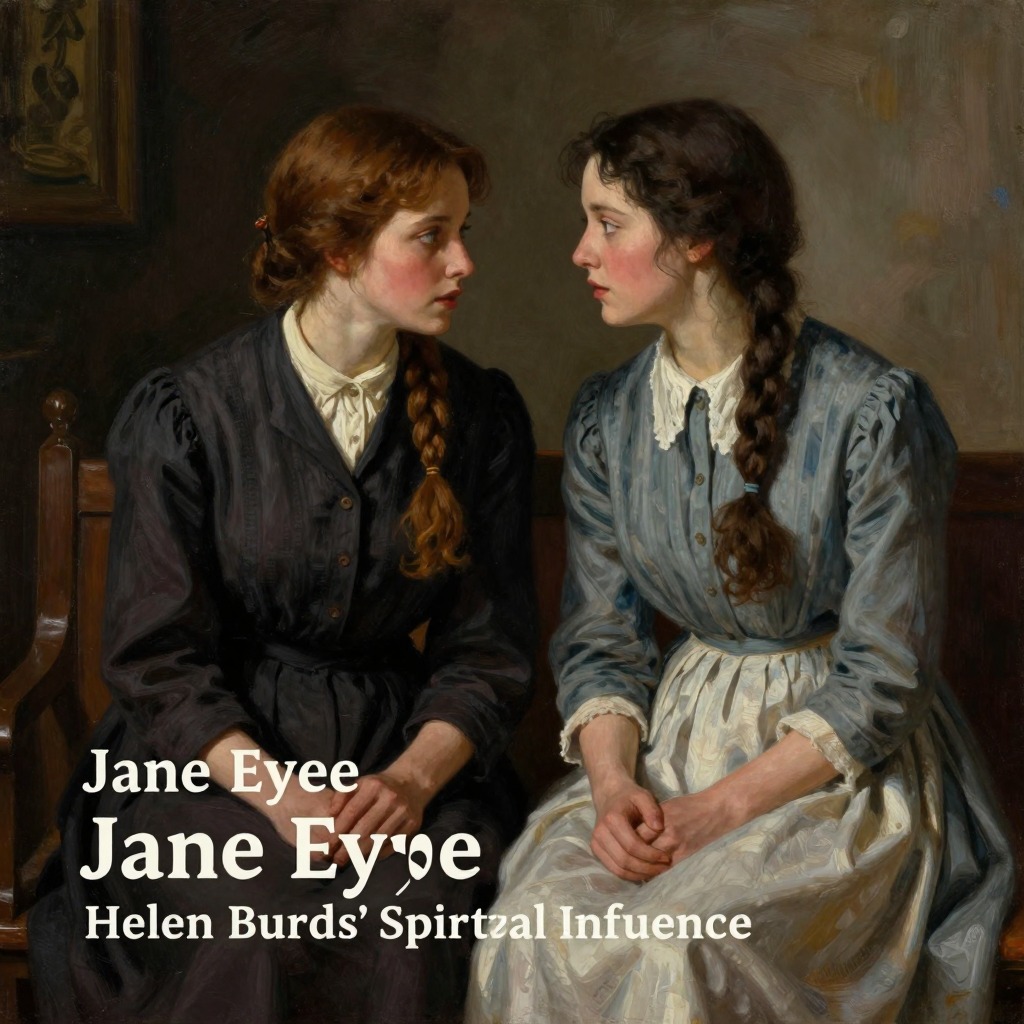
Helen wears the placard all day, from morning until evening, without complaint. She accepts it as a deserved punishment, remaining "patient, unresentful" throughout the ordeal. Jane, by contrast, is consumed by a fury that she cannot express. The spectacle of Helen's sad resignation causes Jane an "intolerable pain at the heart," and tears—"hot and large"—continually scald her cheek. The moment Miss Scatcherd withdraws after afternoon school, Jane runs to Helen, tears the placard off her forehead, and thrusts it into the fire. This act of defiant destruction is the only outlet Jane has for the indignation that Helen herself refuses to feel. The placard thus becomes the physical object around which the two girls' radically different responses to injustice are dramatized: Helen's Christian forbearance and Jane's instinctive, passionate revolt.
Symbolic and Thematic Significance
The Slattern placard functions as a concentrated emblem of Lowood's disciplinary philosophy. Mr. Brocklehurst has designed the school to "mortify in these girls the lusts of the flesh" and to teach them "shame-facedness and sobriety." Public shaming is a routine instrument of this regime: girls are made to stand in the middle of the schoolroom for minor infractions, and the placard extends this logic by literally labeling a perceived moral failing on the body. The word "Slattern" reduces a complex human being to a single, degrading category, and the method of display—bound to the forehead like a phylactery—parodies religious devotion while enforcing social humiliation. For Jane, who has already suffered the trauma of being locked in the red-room at Gateshead and publicly denounced as a liar by Mr. Brocklehurst, the placard reactivates her deepest wounds: the sense of being unjustly condemned and the helplessness of a child before arbitrary adult power. Her destruction of the placard is therefore not merely a gesture of friendship but a symbolic rejection of the entire system that produces such instruments of cruelty.
Contrast with Helen Burns' Philosophy
The placard episode is the culmination of a series of contrasts between Jane and Helen that the novel has been building since their first conversation. Helen has explained to Jane that she accepts Miss Scatcherd's severity because she recognizes her own faults: she is "slatternly," careless, and forgetful of rules. She believes it is "far better to endure patiently a smart which nobody feels but yourself, than to commit a hasty action whose evil consequences will extend to all connected with you." Jane, however, cannot comprehend this doctrine. She insists that when struck without reason, one should "strike back again very hard." The placard brings this philosophical disagreement to a concrete, visceral test. Helen wears the badge of shame without visible distress, her composure rooted in a faith that looks beyond earthly judgment to a divine justice that will ultimately vindicate the innocent. Jane, who has not yet found such faith, can only act out her rebellion in the physical world, burning the symbol of Helen's degradation even as she cannot alter the reality of the school's power over them.
Aftermath and Narrative Role
Jane's act of burning the placard is immediately followed by a significant shift in her fortunes at Lowood. Within a week, Miss Temple receives a letter from Mr. Lloyd that corroborates Jane's account of her childhood, and she is publicly cleared of the charge of deceit. The placard incident thus marks a turning point: it is the last time Jane is powerless to defend herself or a friend against institutional injustice. After her vindication, she throws herself into her studies with renewed energy, rising to the top of her class and eventually becoming a teacher. The placard itself never reappears in the novel, but its memory lingers as a touchstone for the moral education Jane undergoes at Lowood. She learns from Helen the value of endurance and forgiveness, but she never fully adopts Helen's passivity; instead, she internalizes the lesson that dignity must sometimes be asserted through defiant action. The Slattern placard, in its small, brutal way, helps forge the independent spirit that will later enable Jane to refuse Rochester's offer of a bigamous marriage and to resist St. John Rivers' proposal of a loveless missionary union.