St. John Rivers
Jane EyreSt. John Rivers is a figure of formidable moral clarity and emotional austerity, a clergyman whose unyielding commitment to his missionary calling places him among the most complex and challenging characters in Jane Eyre. As Jane's cousin, rescuer, and would-be husband, he embodies a path of principled self-denial that stands in stark contrast to the passionate, worldly love offered by Edward Rochester. His presence in the novel forces Jane to confront the limits of duty and the claims of the heart, ultimately clarifying the nature of the union she truly desires.
Identity and Background
St. John Rivers is introduced as a tall, slender young man of about twenty-eight to thirty, with a face of almost Greek perfection: a straight, classic nose, an Athenian mouth and chin, large blue eyes with brown lashes, and a high, colourless forehead partially streaked by careless locks of fair hair . He is the son of a clergyman and the brother of Diana and Mary Rivers, a family of ancient lineage whose fortunes have declined. His full name is St. John Eyre Rivers, making him Jane's cousin through her father's sister . He serves as the incumbent of a poor country parish in Morton, a position he finds increasingly constricting .
Life and Plot Trajectory
St. John first appears when he discovers Jane, nearly dead from hunger and exposure, collapsed at the door of his family home, Marsh End . He insists on admitting her despite the protests of the housekeeper, Hannah, and oversees her recovery . After Jane recovers, he secures her a position as the mistress of a village school in Morton, a humble post he offers with characteristic bluntness, warning her of its poverty and obscurity (E03389–E03390). When Jane inherits twenty thousand pounds from their uncle, John Eyre, St. John reveals their kinship and helps her prove her identity . Jane, in turn, insists on dividing the fortune equally among the four cousins, a decision St. John initially resists but ultimately accepts after arbitration .
Key Actions and Objectives
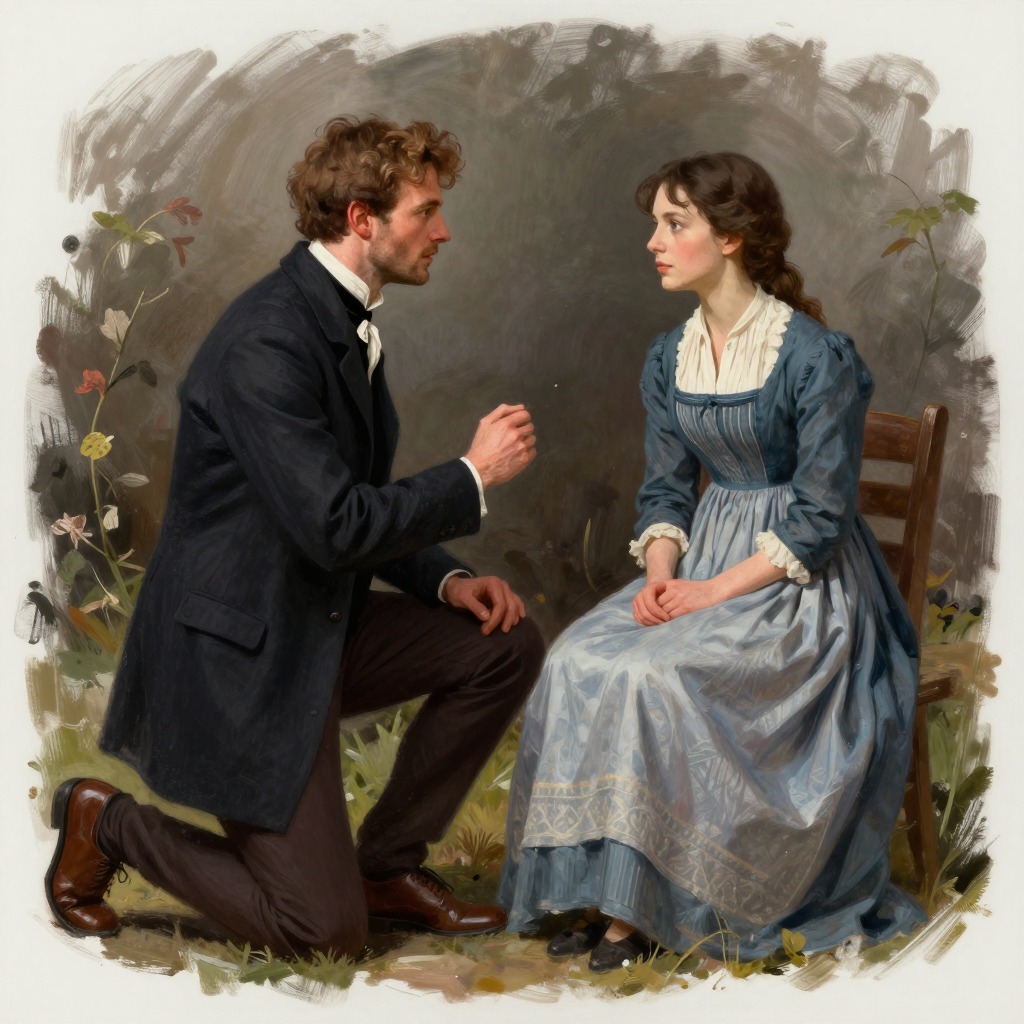
St. John's central objective is his missionary vocation. He resolves to leave England for India, a decision he describes as a divine calling that has transformed his life from one of wretched misery to one of purpose (E03456–E03457). He studies Hindostanee in preparation, and later insists that Jane learn it as well, intending her to accompany him as his wife and fellow-labourer . His proposal to Jane is not an expression of personal love but a calculated request for a helpmeet suited to his work. He argues that God and nature intended her for a missionary's wife, that she is formed for labour, not for love, and that her refusal would be a denial of God . When Jane refuses, he subjects her to a week of cold, silent punishment, withdrawing his favour without overt hostility, a tactic she finds more painful than open anger .
Relationships and Conflict
St. John's relationships are defined by his unwavering principles. He feels a powerful but strictly suppressed attraction to Rosamond Oliver, the beautiful and wealthy daughter of the local magnate, but he refuses to marry her because she would not make a suitable missionary's wife (E03543–E03545). He tells Jane that his love for Rosamond is a mere fever of the flesh, while his soul remains fixed on its sacred purpose . With his sisters, Diana and Mary, he is affectionate but distant, and they both recognize his inexorable nature . His relationship with Jane is the most fraught. He admires her intellect, her fortitude, and her capacity for sacrifice, but he cannot offer her warmth or tenderness. When she refuses his proposal, he accuses her of being a castaway and warns her of the fate of the fearful and unbelieving .
Change and Ending
St. John undergoes no softening or transformation. He leaves England for India and pursues his missionary work with relentless energy, described as a resolute, indefatigable pioneer who hews down the prejudices of creed and caste . He remains unmarried, his toil drawing near its close. In his final letter, he anticipates his sure reward and incorruptible crown, and his last recorded words are a response to his Master's promise: "Amen; even so come, Lord Jesus!" . Jane reports that she knows a stranger's hand will write to tell her that the good and faithful servant has been called into the joy of his Lord .
Narrative Role and Evaluation
St. John Rivers serves as a crucial foil to Mr. Rochester and a test of Jane's moral integrity. He represents the path of absolute duty, self-denial, and spiritual ambition, a path that is noble but also cold, hard, and ultimately inhuman. His proposal forces Jane to choose between a life of loveless service and a life of passionate, equal love. Her rejection of him is not a rejection of principle but an affirmation of her whole self—her need for love, for warmth, for a union that engages both heart and soul. St. John's character thus illuminates the novel's central theme: that true morality is not found in the suppression of feeling but in the integration of principle with genuine human affection. He is a good and great man, but as Jane herself recognizes, he would make a terrible husband, and his fate is to be admired from afar, not embraced as a partner.