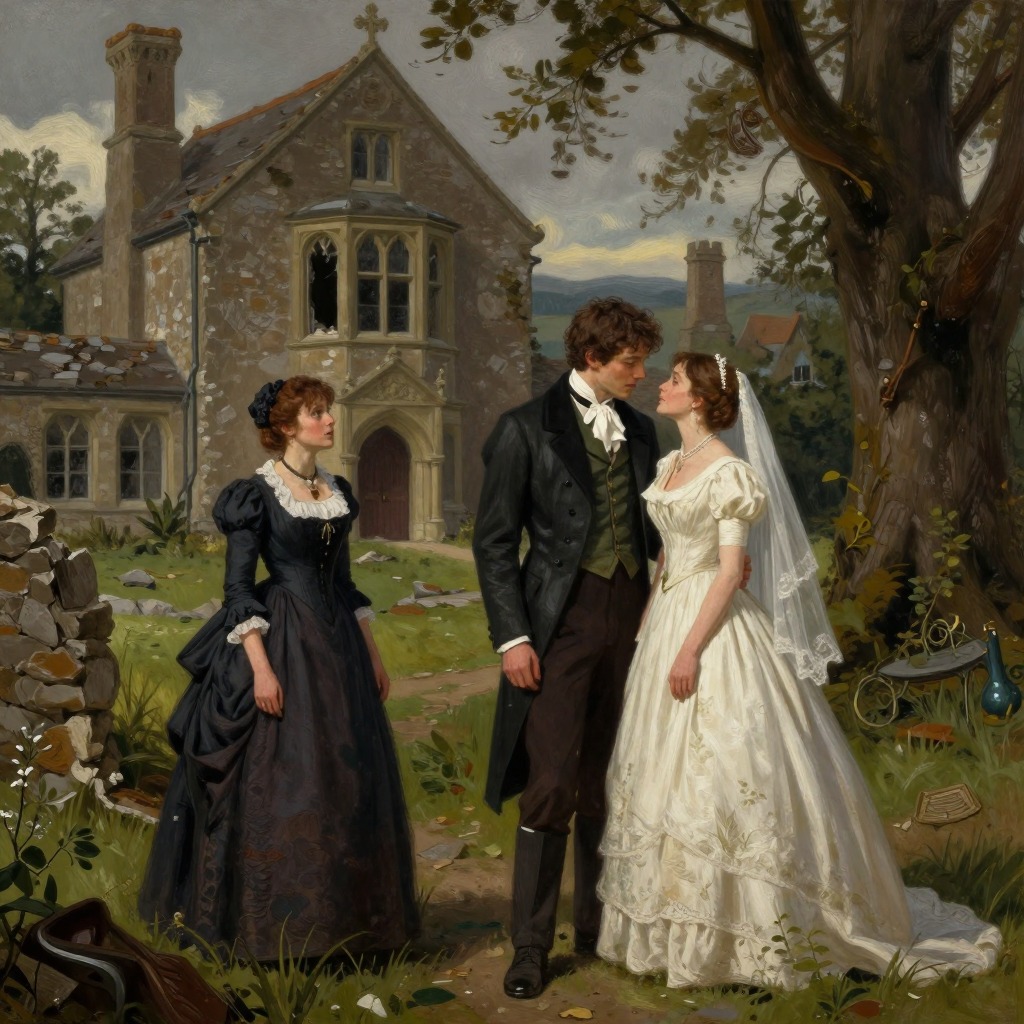
The Rochester Arms
Jane EyreThe Rochester Arms is the wayside inn where Jane Eyre alights from the coach on her return journey to Thornfield Hall, and its name—read in gilt letters on the sign—triggers a surge of emotion that crystallizes the entire arc of her quest. The inn stands two miles from Thornfield, across the fields, and its very designation, bearing the Rochester family name, announces to Jane that she has entered the domain of the man she still loves, even as she fears what she may find. The moment is charged with both hope and foreboding: her heart leaps up at the sight, then falls as she confronts the possibility that her master may be beyond the British Channel or, worse, that only his lunatic wife remains at the hall. The inn thus functions as a threshold between the long uncertainty of her year of exile and the revelation that will either crush or redeem her.
Location and Setting
The Rochester Arms is situated in a landscape of green hedges, large fields, and low pastoral hills—mild and verdant compared with the stern North-Midland moors of Morton where Jane has spent the past months. The inn itself is a wayside establishment, the kind of place where coaches stop to water their horses, and its signboard, painted with gilt letters, is the first object Jane's eye falls upon after she steps down from the coach. The ostler confirms that Thornfield Hall is just two miles away across the fields, and Jane, having paid her fare and satisfied the coachman, stands before the inn with her box left in the ostler's charge, ready to proceed on foot. The inn's proximity to Thornfield makes it the natural point of inquiry, and the sensible course would be to ask the people there whether Mr. Rochester is at home—but Jane cannot bring herself to do so, dreading a reply that would crush her with despair.
Narrative Significance
The Rochester Arms serves as the hinge between Jane's long journey of self-imposed exile and the climactic discovery of Thornfield's fate. It is the same spot where, a year earlier, she had alighted from the coach in a state of utter desolation, and now she returns with a transformed sense of purpose. The inn's name, bearing the Rochester crest, acts as a heraldic sign that she is on her master's very lands, and the sight of it produces a physical and emotional reaction: her heart leaps up, then falls again as the thought strikes her that her master may be gone. The inn thus becomes a place of suspended judgment, where Jane must choose between prolonging doubt—and therefore hope—and seeking the truth that may destroy her. She ultimately decides to walk on toward the hall, deferring the fatal question, and the inn recedes from the narrative as she crosses the fields toward the ruin that awaits her.
Thematic Resonance
The Rochester Arms embodies the tension between hope and despair that defines Jane's return. The gilt letters on the sign are a promise of belonging—the name of the man she loves—but they also remind her of the social and legal barriers that have separated them. The inn is a place of transit, not of rest, and Jane's refusal to inquire there reflects her unwillingness to surrender the last shred of possibility. In the broader structure of the novel, the inn marks the point where the geographical journey of the heroine converges with the emotional and moral journey she has undertaken: she has achieved independence, wealth, and kinship, but she has not yet learned whether the man she loves is alive, dead, or lost to her forever. The Rochester Arms, with its ordinary facade and extraordinary name, is the last way station before the revelation that will either confirm her worst fears or open the door to a reunion that seems almost too miraculous to hope for.