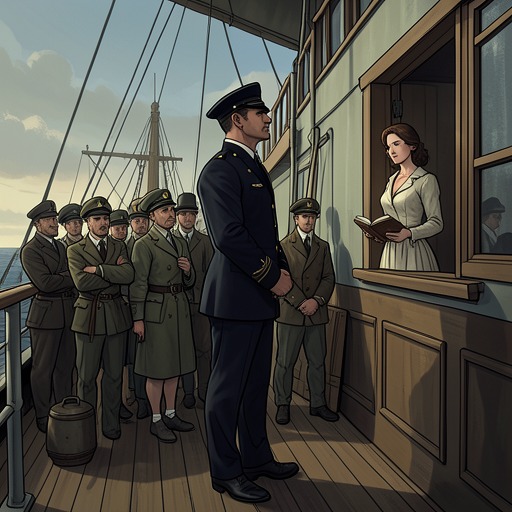
Admiralty
Just DesertsThe Admiralty is the British naval authority that converts imperial urgency into personal risk and, through Sir David Pentland’s career, helps set in motion the economic history of Grenadine Reef. Its demand that a newly refitted warship reach the West Indies immediately sends Sir David into hurricane conditions; the resulting naval action produces the treasure that finances his estate and shapes the fortunes of Elizabeth Bennet and the later Pentland-Darcy succession.
Naval Authority and Imperial Urgency
The Admiralty appears as the institution responsible for placing naval vessels on station and determining the urgency of their deployment. In 1770, Sir David Pentland was the newly appointed captain of HMS Glory, which had undergone a refit in Plymouth. Although the hurricane season had begun, the Admiralty required the ship to proceed to the West Indies without delay. The order exposes the practical logic of imperial naval administration: strategic presence mattered enough to justify sending a vessel into a season of exceptional danger.
The voyage did not become a disaster for HMS Glory, but it imposed immediate costs. The ship encountered the edge of the first hurricane of the season, was badly battered, lost several spars, and suffered one broken leg among the crew, though the vessel survived. The Admiralty’s administrative decision therefore forms the first link in a chain joining institutional policy, maritime hazard, military distinction, and private wealth.
The Treasure Salvage and Sir David’s Knighthood
The same storm that endangered HMS Glory also destroyed a Spanish treasure galleon attempting to reach Havana. The galleon ran aground on a reef near one of the Grenadine Islands and broke apart; nearly all of its crew died in the wreck during the hurricane. HMS Glory reached the remains two days later, finding what was left of the hull wedged on the reef.
Sir David’s crew salvaged a substantial portion of the treasure before the wreck was finally smashed apart and sank. The action became the central exploit on which his reputation rested. He was knighted for it, and his share of the recovered treasure enabled him to purchase the estate later known as Grenadine Reef. The Admiralty thus does not merely provide background military bureaucracy: its deployment decision places Sir David where a wreck, a salvage operation, and a transformative prize can occur.
Career, Resignation, and the Pentland Household
The Admiralty’s influence continues through the consequences of naval service for Sir David’s personal life. After rescuing Radha Bhimani, caring for her during a near-fatal recovery, and marrying her, Sir David became increasingly disillusioned by the hostility directed at her. Radha had survived kidnapping, attempted enslavement, pirate captivity, and a stomach wound that was considered nearly fatal, yet people on Barbados treated her survival as an embarrassment and subjected her to cruel remarks.
Sir David had already been uncertain about continuing his naval career, and the treatment of Radha became the final cause of his resignation. He left the service, returned to Britain with her, converted to the Church of Scotland, and married her near Edinburgh. After their wedding trip they moved to London and used the treasure-derived wealth to acquire the estate. The Admiralty’s institutional world therefore stands in sharp contrast with the private household Sir David chose: naval service brings him honour and money, but leaving it allows him to protect Radha and build a different domestic life.
Wealth, Investment, and Institutional Echoes
The treasure associated with Sir David’s naval exploit remained economically active long after the salvage itself. Sir David and Radha lived quietly, entertained little, avoided expensive London seasons, had no children, and invested their surplus income rather than consuming it. Those investments multiplied the original fortune and later helped finance the doubling of Grenadine Reef and the purchase of smaller estates.
The Admiralty’s maritime economy also echoes in Elizabeth Bennet’s later investment thinking. When Elizabeth surveys servants, tradesmen, workers, and sailors about their beer preferences, she identifies breweries in Alton and Lewes and proposes acquiring acreage suitable for hops and barley. Sir David then extends the inquiry toward Southampton and Portsmouth, reasoning that merchant seamen and the Royal Navy consume large quantities of beer. The naval world represented by the Admiralty consequently becomes part of a broader commercial network linking military and merchant shipping, agricultural production, breweries, labour, and estate income.
Long-Term Consequences and Narrative Significance
The Admiralty’s most lasting narrative consequence is the conversion of naval action into an inherited social infrastructure. The captured Spanish treasure creates the capital for Grenadine Reef; the estate’s restrained management generates further investment income; and that wealth eventually supports the enlarged estates and carefully divided inheritances planned by Elizabeth Bennet and Fitzwilliam Darcy. Their arrangement gives Grenadine Reef to Helena Darcy, assigns Pemberley to Bennet, distributes portions of the former Grenadine Reef and Longbourn lands to the twins David and Richard, and allocates other estates among the remaining sons.
The final lands around the dower house retain the maritime memory in another form. Elizabeth and Fitzwilliam Darcy build a lodge there and name it St Vincent Lodge after the nearest large island to the site where Sir David discovered the wrecked treasure ship. The Admiralty is not a speaking character or a sustained scene-setting organization, but its command structure initiates the chain of events that the later generations inherit. In the novel’s institutional geography, naval policy becomes private fortune, private fortune becomes refuge and investment, and investment becomes a planned future for families whose lives are still marked by a wreck found under orders to reach the West Indies.