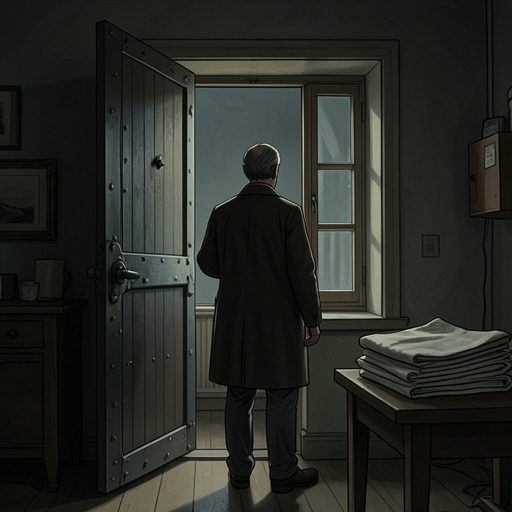
Bennet family entail on Longbourn
Just DesertsThe Bennet family entail on Longbourn is the legal and dynastic mechanism governing succession to the Bennet estate. By reserving Longbourn and its attendant lands for a male heir, it leaves the Bennet daughters exposed despite their connection to the property, makes marriage an economic emergency, and helps explain the pressure placed on Elizabeth Bennet to accept William Collins. When the last possible male heir dies without male issue, the rule is broken, transforming Longbourn from an inherited obligation into property Thomas Bennet may dispose of as he chooses.
Origin and Operation
The entail reaches back to Martin Bennet, who received both the deed to Longbourn and its attendant lands after loyal service to Charles the Second between 1651 and 1660. Its operation is established through a chain of male succession: the family traces every generation from Martin Bennet through legal documents preserved since the original entail, parish records, and the Bennet Family Bible. The decisive condition is not simply that the property belongs to the Bennet family, but that it must pass through the recognized male line. The existence of five daughters therefore does not secure the estate for the immediate family; without a qualifying male heir, the property is directed toward the next eligible man in the succession.
That structure makes the entail more than a technical rule. It separates residence, labor, and family attachment from legal control. Thomas Bennet occupies Longbourn and remains its master, yet his daughters cannot rely on inheriting it, while William Collins becomes the prospective successor merely because he stands within the permitted male line. The arrangement converts the estate into a source of anxiety for women and an instrument of pressure in the marriage market.
Marriage Pressure and Female Dependence
The entail gives practical force to Mrs. Bennet's determination that Elizabeth Bennet marry William Collins. Elizabeth understands that the proposed marriage is entangled with Longbourn rather than grounded in affection. She rejects the idea that a bride can be forced into marriage or treated as something to be bought, insisting that her refusal has nothing to do with romantic preference alone: the issue is that Longbourn has been placed above her welfare. In her judgment, her mother cares more for the estate than for her daughter, and the entail allows that distorted priority to govern the household.
The rule also exposes the difference between legal ownership and actual management. Thomas Bennet has an academic bent and regards books as his first love; estate business is something he does when necessary, but not his main focus. Longbourn consequently reflects its master's limited attention. After Elizabeth Bennet leaves, Jane Bennet and Mary Bennet work tirelessly, yet they do not realize how much Elizabeth had previously accomplished behind the scenes. The household still has enough food, but everyone can see that the estate ought to produce more. The entail preserves the property in theory while doing nothing to guarantee competent administration in practice.
This contrast becomes sharper beside Grenadine Reef. Lady Radha Pentland has the better head for business and investments, and Sir David Pentland openly acknowledges that her attention made the family prosper. The comparison suggests that the entail's male succession does not measure ability; it merely grants legal advantage according to sex and lineage. At Grenadine Reef, practical intelligence and sustained supervision produce prosperity. At Longbourn, formal succession and weak stewardship coexist with decline.
The Rule Is Broken
The legal turning point comes after William Collins dies of a fever on Friday, December 4, 1812, at the small inn in Pepperstock, west of Grenadine Reef. He became ill while traveling toward Meryton, worsened after being made to sit in a cold carriage outside Longbourn, and was delirious when inn staff found him. He never recovered consciousness and therefore never heard that Charlotte Collins had survived an arduous labor and delivered a daughter, Angela Collins. Charlotte herself was seriously ill before recovering, and it remained uncertain whether she would be able to have more children.
Collins's death matters to the entail because he dies without male issue. Thomas Bennet, his brothers-in-law Philips and Gardiner, Sir William Lucas, and Clive Bredason, the vicar of Longbourn Chapel, examine the succession from Martin Bennet onward. Their inquiry confirms that there are no male heirs in any line. The conclusion is explicit: the last heir has died without male issue, so the entail is broken.
Once the rule is legally ended, Thomas Bennet may leave Longbourn to whichever child he chooses, divide it among his children, or sell the estate. The change is recorded and filed with the Court of Chancery, turning what had seemed an immovable dynastic command into a matter of personal disposition. The legal release arrives too late to save William Collins or to erase the damage caused by years of insecurity, but it removes the mechanism that made his succession possible.
Consequences for Longbourn and Elizabeth Bennet
The breaking of the entail gives Elizabeth Bennet a new possibility: Longbourn need not be surrendered to an unwanted male relative, yet neither must it remain untouched as a single inheritance. She argues that dividing the estate among three, four, or five daughters would leave each with only small pockets of land. Entails exist, in part, to prevent estates from being broken into ever smaller pieces, and she recognizes that simply abolishing the rule does not solve the problem of coherent management.
Her preferred solution is for Fitzwilliam Darcy to buy Longbourn and keep it intact while incorporating it into Grenadine Reef. In that arrangement the estate would remain connected to a former Bennet rather than being scattered among the sisters or lost to an unrelated successor. The proposal turns a rule designed to preserve male dynastic continuity into an opportunity for deliberate stewardship. What the entail had enforced through exclusion, Elizabeth seeks to preserve through choice, negotiation, and competent management.
The rule's collapse also changes the meaning of Elizabeth Bennet's future. She is no longer required to secure her family's continued occupation of Longbourn by marrying William Collins, and the estate ceases to be the hidden lever behind her mother's pressure. Her later marriage to Fitzwilliam Darcy can therefore be understood separately from the original succession crisis, even though the legal fate of Longbourn remains part of the couple's shared responsibilities.
Legal and Thematic Significance
The Bennet family entail on Longbourn embodies the collision between inherited property law and women's limited agency. It gives the appearance of orderly continuity while making the family's daughters economically vulnerable, allowing a distant or unsuitable male heir to possess a stronger claim than the women who live in, work for, and depend upon the estate. Its consequences are social as well as legal: it intensifies marriage pressure, distorts parental priorities, and links a woman's security to a transaction she may not freely choose.
The book nevertheless distinguishes the entail's formal authority from effective control. At Grenadine Reef, Elizabeth Bennet becomes the real mistress of the estate through knowledge, supervision, and contractual protection, even though the legal position of a married woman would ordinarily place assets under her husband's control. The marriage settlement specifically requires Elizabeth Bennet's written permission for dispositions concerning Grenadine Reef and the smaller estates, preserving her authority over the property in practice. Against the static logic of male succession, the narrative places a more flexible model of governance in which expertise and responsibility matter more than gender alone.
The entail's ending is consequently neither a simple triumph of individual freedom nor a rejection of estate continuity. It removes an unjust inheritance constraint, but Elizabeth Bennet still values the land's integrity and seeks a solution that prevents fragmentation. The decisive movement is from compulsory lineage to chosen stewardship: Longbourn survives not because the old rule remains intact, but because the family can finally decide what preservation should mean.