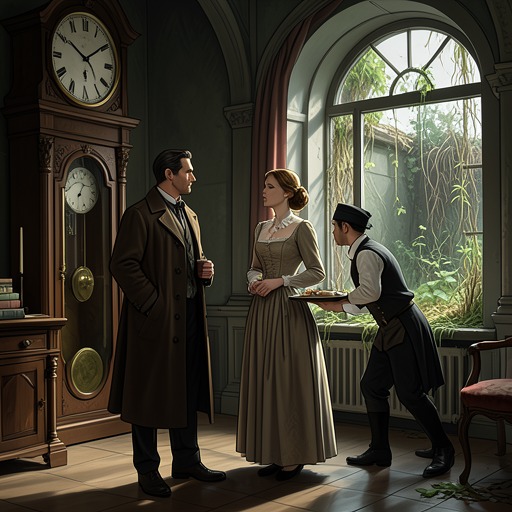
Bingley's abandonment of Netherfield
Just DesertsBingley's abandonment of Netherfield is not merely a change of residence but a revealing act of evasion. After the ball that initiated his acquaintance with Jane Bennet, Charles Bingley leaves for London and never resumes possession of Netherfield Park. The closed house, neglected estate, ignored servants, and absent master expose the gap between his agreeable manners and the responsibilities attached to his position.
Departure and Broken Expectations
The immediate sequence begins with Bingley's departure for London, allegedly for four days, on the morning after the ball. Fitzwilliam Darcy accompanies him. Bingley is expected to return in time to prepare Netherfield Park for winter, visit or assist the tenants, and provide the customary Boxing Day gifts to servants and dependants. Instead, he does none of these things. His sisters begin closing the house on the very day he leaves and depart for London the following morning, making the withdrawal appear organized rather than accidental.
The abandonment also breaks the expectations created by Bingley's earlier conduct. Jane Bennet had enjoyed his company and initially believed the acquaintance might develop into something meaningful, although she later judged her feeling to have been an infatuation produced by the arrival of the first new single man in the neighbourhood for a year. The disappearance therefore prevents a romance from reaching any settled declaration while confirming, in retrospect, how little substance stood behind the Bingley family's social display.
Neglect of the Estate
The most serious feature of Bingley's action is his neglect of those who depend upon Netherfield Park. No instructions are sent to the steward about preparing for winter. No assistance reaches the tenants from the master of the estate, and no gifts are distributed to the servants on Boxing Day. The absence of these ordinary duties makes the empty house a practical crisis rather than a symbolic absence alone. Bingley possesses the authority to act, but the estate receives silence instead.
Elizabeth Bennet treats this failure as evidence of character. She calls the Bingleys selfish and interested primarily in personal advantage, while conceding that her judgment that their conduct reveals their tradesman origins is unfair when measured against Edward Gardiner, who would not behave similarly. That qualification sharpens rather than weakens the criticism: the problem is not commerce or birth, but the refusal to accept stewardship as a moral obligation. Jane is particularly grateful to have recognized the family's nature before marriage, since living with Caroline Bingley in the same household would have made the consequences of that selfishness intimate and permanent.
Caroline Bingley's Letter and the Social Fallout
The family's withdrawal is accompanied by Caroline Bingley's letter to Jane Bennet, a document Elizabeth regards as fiction rather than honest explanation. Caroline claims, among other things, that Charles Bingley is courting Georgiana Darcy, even though Georgiana is only fifteen and several years away from entering society. The false report is dangerous because it places a private family matter into circulation and threatens Georgiana's reputation; it also demonstrates Caroline's willingness to use another young woman as an instrument in managing her brother's social and romantic prospects.
Jane keeps the letter and gives it to Elizabeth. Rather than accepting its claims, Jane reads it with a jaundiced eye and recognizes the Bingley family's motives. The letter thus converts an unexplained absence into an apparent campaign of manipulation. Elizabeth hopes to place it in Fitzwilliam Darcy's hands, knowing that Caroline Bingley may face the cut direct and possibly a libel suit. The abandonment of Netherfield is consequently linked to a second withdrawal: Caroline's attempt to control the story is exposed as an act capable of producing social and legal consequences.
Bingley's Later Admission
When Darcy encounters Bingley later in London, Bingley confirms that he has not returned to Netherfield Park. He says that he and Caroline stayed with the Davies family on an estate near the Leicester-Derbyshire border, north of Castle Donington, rather than going back to his own property. Darcy notices the dismissive way Bingley speaks of Netherfield and asks directly whether he intends to return.
Bingley's answer is evasive but financially revealing. He says that he thinks not, because he doubts anyone will buy out the remaining lease and the money has already been spent. The statement shows that abandonment has not erased the obligation attached to the property; it has merely left Bingley paying for a lease he no longer uses. Darcy recognizes the obvious remedy: Bingley could return, manage the estate, and attempt to recover the funds. The two men had previously spent many mornings discussing the responsibilities of estate management, but Bingley's conduct demonstrates that he absorbed little of that instruction.
Consequences and Narrative Significance
Bingley's abandonment damages more than his prospects with Jane Bennet. It exposes his dependence on Caroline Bingley, his susceptibility to withdrawal when social circumstances become inconvenient, and his failure to understand that wealth carries duties toward tenants and servants. The lack of correspondence intensifies the injury: the estate is not simply left behind, but left without explanation or continuing care.
The episode also creates a lasting contrast between agreeable character and dependable character. Bingley's pleasant company initially encourages affection, yet the abandoned estate supplies a concrete measure of his shortcomings. Later, when Fitzwilliam Darcy acquires the remaining lease of Netherfield Park, the property becomes part of a broader pattern in which Bingley's avoidance has to be absorbed by others. Netherfield therefore remains as the material record of a choice made in London: Bingley preserves his comfort in the short term, but forfeits trust, responsibility, and control over the estate that was supposed to express his independence.