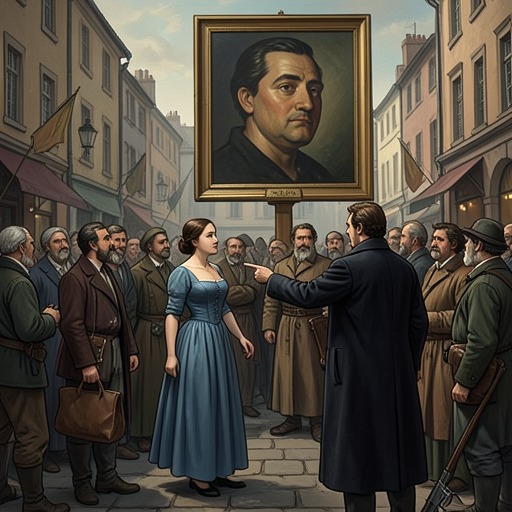
Charlotte Lucas
Just DesertsCharlotte Lucas occupies a crucial position in the novel’s argument about women, marriage, and agency. At nineteen, approaching twenty, she has accepted the prevailing social logic that a woman should marry to cease burdening her parents, establish her own household, and secure a respectable future. Unlike Jane Bennet, who hopes to marry a man she deeply loves, Charlotte does not treat her husband’s personal qualities as the central question. Her decision to marry William Collins therefore becomes both a practical act of self-preservation and a painful test of Elizabeth Bennet’s belief that marriage should involve love, respect, and personal choice.
Identity and Social Position
Charlotte is the daughter of Sir William Lucas and Lady Lucas and a close friend of Elizabeth Bennet and Jane Bennet. Mrs. Bennet describes her as plain, repeating Lady Lucas’s own assessment and contrasting her appearance with Jane’s beauty. Yet Charlotte’s lack of beauty does not make her passive or unintelligent. She understands the narrow conditions governing a woman’s future and responds to them with calculation rather than romantic expectation.
Her friendship with Elizabeth is established before the central marriage conflict. When Elizabeth was young, Charlotte was already preoccupied with marriage, not because she had identified a particular beloved but because marriage promised release from dependence on her parents and the creation of a home of her own. Her parents’ apparently happy marriage may have influenced her, but Charlotte’s stated priorities remain security, independence within the available social structure, and a respectable husband. In this respect she represents the practical alternative to Jane’s romantic ideal and Elizabeth’s insistence on emotional and intellectual compatibility.
Marriage as Strategy
Charlotte’s position is shaped by the same legal and economic constraints that trouble Elizabeth. Women possess limited control over their property and future, and Charlotte sees marriage as the surest available route to a household of her own. Her reasoning treats marriage less as the culmination of feeling than as a social arrangement whose benefits can be assessed: a decent man, relief for her parents, and an establishment under her own management.
This logic places her in sharp contrast with Elizabeth and Jane. Jane repeats that she will marry only for the deepest love, while Elizabeth has learned from Madeline Gardiner and Lady Radha that love must also survive the practical pressures of daily life. Charlotte, by contrast, regards romantic love as something better suited to novels than to the urgent business of securing a woman’s future. The contrast is not merely personal. Through Charlotte, the narrative exposes a society in which women are expected to treat marriage as protection against dependency while being criticized if their choices offend romantic ideals.
The Proposal from William Collins
William Collins first proposes to Elizabeth after the Meryton Assembly. Elizabeth refuses him because she neither respects him nor can imagine loving him. Collins refuses to accept her answer as sincere, relying instead on the conventional notion that a woman initially says no in order to heighten a suitor’s suspense. Elizabeth’s refusal is supported by Thomas Bennet, but Mrs. Bennet reacts with sustained fury, making Elizabeth’s home life increasingly intolerable.
Only two days after proposing to Elizabeth, Collins leaves Longbourn with Charlotte and proposes to her on the following Saturday. Charlotte accepts. The speed of the sequence is central to Elizabeth’s judgment: Collins proposes to Elizabeth on Thursday morning, departs with Charlotte that afternoon, and offers marriage to Charlotte before the weekend has ended. Charlotte’s acceptance shows that she evaluates Collins according to the practical requirements of her future rather than according to Elizabeth’s standards of admiration or love.
Friendship with Elizabeth Bennet
Charlotte’s decision does not immediately destroy the outward appearance of her friendship with Elizabeth, but Elizabeth cannot regard it as before. Elizabeth is less troubled that Collins will eventually become master of Longbourn than by Charlotte’s willingness to accept a man who had proposed to her only days earlier. To Elizabeth, the choice reveals a shallowness in the friendship and demonstrates that Charlotte’s priorities are fundamentally different from her own.
The consequences are especially severe because Collins’s inheritance will displace the Bennet family from Longbourn after Thomas Bennet’s death. Lady Lucas repeatedly reminds Mrs. Bennet that Charlotte will one day be mistress of the estate, and Mrs. Bennet directs her resentment toward Elizabeth. Elizabeth becomes, in her mother’s eyes, the daughter responsible for the loss of Longbourn because she refused Collins. Charlotte’s private security therefore carries a public and familial cost for Elizabeth, intensifying the sense of betrayal.
Elizabeth declines Charlotte’s invitation to visit Hunsford Parsonage at Easter. She remains willing to correspond, but she has no desire to live under the same roof as Charlotte and Collins. The refusal marks the movement of the relationship from intimate friendship toward, at best, acquaintance. Charlotte has chosen the life that Elizabeth rejected, and the two women can no longer pretend that the choice is morally or emotionally neutral between them.
Narrative Significance
Charlotte is not simply a foil who proves Elizabeth right. Her choice is understandable within the social world that confines her. She wants a home, relief for her parents, and protection from the insecurity attached to unmarried womanhood. The novel therefore places two forms of female agency beside each other: Elizabeth exercises agency by refusing an unacceptable marriage, while Charlotte exercises it by accepting the marriage most likely to secure her position.
That contrast also exposes the limits of both choices. Elizabeth gains moral and emotional integrity but suffers her mother’s hostility and loses the immediate protection that Longbourn represents. Charlotte gains a household and a route toward becoming mistress of Longbourn, but Elizabeth believes the marriage has sacrificed affection and respect. Charlotte’s significance lies in this unresolved tension. She demonstrates how a woman may make a rational choice inside an irrational system, while showing why Elizabeth’s later insistence on love and partnership carries genuine social risk rather than merely romantic sentiment.