Coming out (social debut)
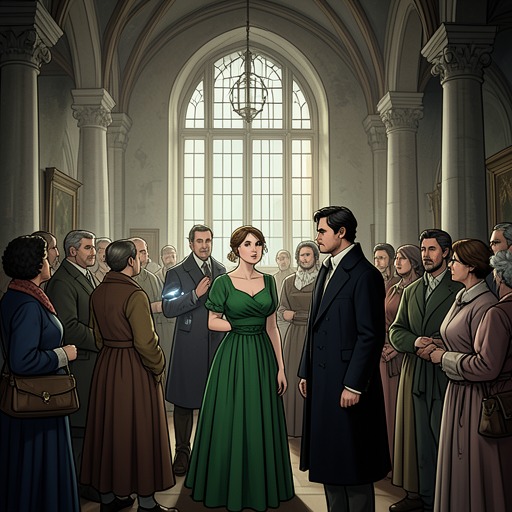
Just DesertsComing out (social debut) is presented as both a social milestone and a system of supervision. For the Bennet daughters, entering society means becoming visible at Assemblies and available for public judgment, but it does not amount to simple freedom: preparation, clothing, chaperonage, family strategy, and the management of male attention all determine how that visibility can be used.
Meaning and Family Context
Coming out is first associated with Jane Bennet’s projected debut. When Jane is fifteen, with her first Assembly approaching, Mrs. Bennet treats the occasion as a major campaign and fills Longbourn with anxious preparation. Elizabeth Bennet considers the excitement excessive and the timing premature, and the preparations intensify the longstanding conflict between mother and daughter. Mrs. Bennet’s concern is not merely ceremonial; she understands social debut as the beginning of a daughter’s matrimonial prospects.
Elizabeth’s position within the family gives the ritual a sharper edge. Mrs. Bennet regards her as the least favourite daughter, while Thomas Bennet favours her because she is the most academically gifted of the five sisters and shares his love of books and curiosity. Elizabeth therefore approaches society with an education that encourages observation and independent judgment, but from a household in which her mother repeatedly tries to shape her into a marriageable spectacle.
Elizabeth Bennet’s Debut
Elizabeth’s own coming out takes place during the autumn of 1806 and winter of 1807. Because she has lived at Longbourn all her life, attended the local church, and visited Meryton almost weekly, her first Assembly is not an entry into an unknown world. The local community already knows her, so the event functions less as an unveiling of a stranger than as a formal change in status.
The real ordeal is the struggle over her dress. Elizabeth’s figure has developed into a notably womanly shape, and Mrs. Bennet insists on clothing her in a way that accentuates it through fabric, lace, and cut. Elizabeth accepts some of the decorative choices but refuses the low neckline her mother wants. She will not appear as a newly debuted young woman displaying her body for public attention because that presentation does not accord with her sense of self. Mrs. Bennet makes the conflict more uncomfortable by loudly recalling that similar bodily display helped attract Thomas Bennet during their courtship. Elizabeth finally threatens to ruin the dress before leaving Longbourn, forcing her mother to retreat and returning the household to its old antagonism.
The episode shows that debut is a performance negotiated between the young woman and the people who claim authority over her. Elizabeth is expected to be seen, but not to determine entirely how she is seen. Her refusal does not reject society itself; it rejects the conversion of her body into a family-managed advertisement.
Social Routes and Constraints
The debut system depends on controlled movement as much as on public appearance. Elizabeth’s ordinary escapes from Longbourn reveal how carefully she must avoid being stopped by Mrs. Bennet. Rather than take the visible eastern path toward Oakham Mount, she leaves through the kitchen, circles around the western side of the house, and goes north toward the brook marking Longbourn’s boundary. Even before her formal social entry, movement through domestic and estate space is shaped by surveillance and permission.
The same restrictions govern her later relationship with Sir David Pentland. As a young gentlewoman, Elizabeth cannot be alone with an unrelated man or correspond with him directly. Vivian Harkness and Violet Harkness create a thin but workable veneer of respectability: Vivian chaperones Elizabeth’s visits in a phaeton, relays questions and answers, and helps carry letters between them. Social rules therefore obstruct direct communication, but the participants adapt the rules without abandoning the relationship.
The wider social world is similarly organized around managed visibility. When Netherfield Park is finally let in the late summer of 1811, the arrival of Charles Bingley and his party immediately raises the question of whether they will attend the evening Assembly. New single gentlemen are understood as socially valuable because their presence may alter the marriage prospects of local young women. An Assembly is thus a public gathering with private stakes: dance, conversation, and observation become instruments through which families assess possible alliances.
Expansion Beyond the Assembly
Coming out does not confine Elizabeth to flirtation or marriage hunting. It becomes the threshold through which she develops a practical public identity. Her visits to Grenadine Reef and her conversations with Lady Radha Pentland teach her how to think about the responsibilities of a lady of an estate. The instruction is informal, transmitted through shared experience rather than a formal curriculum, and it gives Elizabeth a model of womanhood that joins affection, competence, and responsibility.
Her social education also grows through work. Elizabeth accompanies Madeline Gardiner on visits to the Asylum for Female Orphans, a large institution in St. George’s Fields reached by crossing the Thames at Blackfriars Bridge. The Asylum houses about 200 girls between nine and fourteen, cleans and feeds new arrivals, and provides practical education intended to secure employment, especially in domestic service. Elizabeth’s entry into the public world therefore leads not only toward courtship but toward charitable and administrative labour.
In London, her social visibility becomes more conspicuous and more dangerous. A theatre outing places Elizabeth on Fitzwilliam Darcy’s arm as they enter the Earl’s box, making her visible to the other patrons. She sits in the centre of the front row with Darcy and Georgiana Darcy beside her, while the Gardiners and Richard Fitzwilliam occupy the raised row behind. The arrangement transforms a private association into a public spectacle: Elizabeth must control her instinct to look around, endure the attention of the theatre, and learn how public appearance can alter the meaning attached to a relationship.
Significance and Continuing Development
Elizabeth’s debut marks the beginning of a longer process rather than a single night. Its immediate conditions include family pressure, bodily scrutiny, restrictions on unsupervised contact, and the expectation that a young woman’s public presence will serve matrimonial purposes. Yet Elizabeth steadily enlarges what that presence can mean. She becomes a correspondent, learner, estate adviser, charity worker, and participant in public social life without surrendering the judgment that made her resist her mother’s dress.
The contrast between Longbourn and the other spaces she enters is decisive. At home, her mother’s shrill preparations and constant criticism make social femininity feel coercive. Through Lady Radha Pentland, Madeline Gardiner, and Edward Gardiner, Elizabeth encounters alternative forms of adult womanhood grounded in practical care, household management, business knowledge, and love. Her coming out consequently becomes a redefinition of entry into society: visibility is no longer merely exposure to marriage markets, but an opportunity to acquire skills, form chosen relationships, and act responsibly within spaces that initially restrict her.