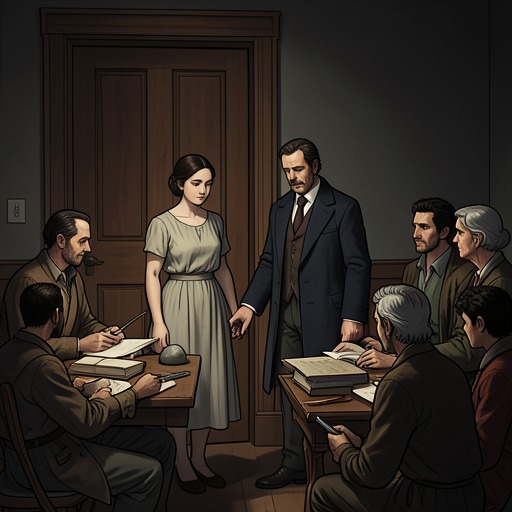
Cyrus Denny
Just DesertsCyrus Denny, identified in the narrative as Lieutenant Denny, is the officer at the center of Lydia Bennet’s attempted elopement and forced marriage. His actions turn Lydia’s flirtation with soldiers into a family crisis, while the measures used to compel him reveal a military system willing to convert private scandal into an example of public discipline. Denny’s trajectory is therefore less a romance than a study in coercion, reputation, and the institutional power of the army.
Identity and Introduction
Cyrus Denny serves as an officer under Colonel Foster’s command. He is introduced through the report of Lydia’s failed elopement: she and Denny were intercepted by regular soldiers at the first coaching inn north of Brighton after spending nearly two hours alone in a hired coach. Lydia admitted that she had been meeting him regularly and believed herself in love, whereas Denny’s motives appeared more self-serving, and marriage had not formed part of his original plan.
Denny’s conduct immediately places Lydia’s reputation and the future prospects of all the Bennet sisters at risk. The narrative presents the social consequences as sharply unequal. Lydia is described as thoroughly compromised and in danger of ruin, while Denny remains able to negotiate over whether he will marry her. His position as an officer gives him room to treat the affair as a private choice even though Lydia bears the heavier public penalty.
The Elopement Crisis
The failed elopement is not treated as a youthful adventure with a harmless interruption. The coach, the coaching inn, and the evidence that Lydia and Denny had been meeting repeatedly establish a deliberate attempt to escape parental and social control. Lydia still does not understand the extent of the harm she has caused when Jane reaches Brighton and finds her distressed chiefly by missing the evening’s entertainments and the attentions of officers.
Denny initially refuses to marry Lydia without a sufficient inducement. Mr. Bennet’s meeting with him is not fully recounted, but its result is visible in Mr. Bennet’s face and posture: Denny acknowledges an obligation to marry, yet will not do so without payment. The condition makes the family’s apparent romantic scandal a financial crisis as well as a moral one, and Jane understands that the Bennet family may need to buy the marriage that is supposed to repair its honour.
Military Discipline and Coercion
The solution is devised against a wider problem within the British Militia. Colonel Foster explains that the force has experienced serious discipline failures, including several muted mutinies and continuing high desertion. Officers have reportedly evaded punishment with the connivance of their commanding officers, allowing men such as Denny to desert a regiment and post without facing the consequences.
Colonel Foster brings the matter, without naming Lydia, to the general responsible for the militia in south-east England. At Horseguards, a brigadier and a regular cavalry colonel decide that Denny must either offer marriage or face a court-martial for desertion. The threat is deliberately severe: if convicted, Denny may be shot. The possibility of execution is described as a warning intended to deter others, making Denny’s personal crisis part of a disciplinary campaign against the wider culture of military impunity.
The pressure is paired with what Mr. Bennet calls the carrot. Edward Gardiner is asked to purchase a commission for Denny in the regular army, and approximately £550 will buy a lieutenancy in the 41st Regiment of Foot. The regiment is stationed in Canada, where tensions with the Americans are increasing, so the offer supplies Denny with a professional future while removing him from the immediate social environment of the scandal. The threat of punishment and the promise of advancement operate together: the stick is court-martial and possible execution, while the carrot is a commission and transfer overseas.
Marriage and Departure
Under this pressure Denny offers for Lydia immediately. Mr. Bennet announces that Denny has purchased a commission in the 41st Regiment of Foot and will join the regiment in Canada as soon as possible. Lydia reacts with delight when she hears that the marriage will proceed, but the arrangement remains a forced settlement rather than a freely developed courtship.
The practical schedule is rapid. Mr. Bennet returns to Longbourn to purchase a common licence; Lydia and Denny are to marry on Friday; and they are to leave for Canada a week later. Denny is escorted to Meryton by another officer of the regiment, after which the newly married couple travels north to Liverpool for embarkation. The marriage repairs the immediate threat to Lydia’s reputation, but it does so by sending her into a distant military posting with limited financial prospects and little domestic support.
Elizabeth Bennet has already warned Lydia about the conditions awaiting junior officers in Canada: few servants and little money beyond necessities. Lydia ignored that warning when she pursued the pleasures and attention associated with redcoats. Her departure consequently functions as both rescue and punishment. The family avoids complete social ruin, but Lydia’s future is narrowed by a marriage made under pressure and by an imperial military transfer she did not appear to understand.
Character Function and Significance
Denny is significant chiefly through the contrast between his private behaviour and the institutional forces that finally govern him. He seeks the advantages of intimacy with Lydia without initially accepting the marital obligation attached to it. Once the army makes desertion the decisive issue, however, his freedom disappears. The narrative does not present the resulting marriage as proof of romantic reform; it presents it as the outcome of bargaining, threatened punishment, and military necessity.
His story also exposes the double standard surrounding women’s reputation. Lydia’s meetings and attempted elopement can damage the marriage prospects of her sisters, while Denny’s conduct is addressed through money, rank, and reassignment. The army’s intervention prevents abandonment, but it does not create equality between the two parties. Denny receives a commission and a path forward; Lydia receives a socially necessary marriage and removal to Canada.
The episode further connects Denny to the book’s larger concern with institutional responsibility. Military disorder affects civilian families, women’s safety, and the distribution of social ruin. Elsewhere, Elizabeth Bennet and Fitzwilliam Darcy consider supporting men discharged after losing an arm in service, showing a distinction between condemning misconduct and recognizing the needs of injured veterans. Denny’s case belongs to the first category: he is not treated as a victim of battle but as an officer whose desertion and attempted evasion require discipline. His ending is thus deliberately conditional—he escapes the threatened court-martial, but only by entering a marriage and military posting shaped by coercive public intervention.