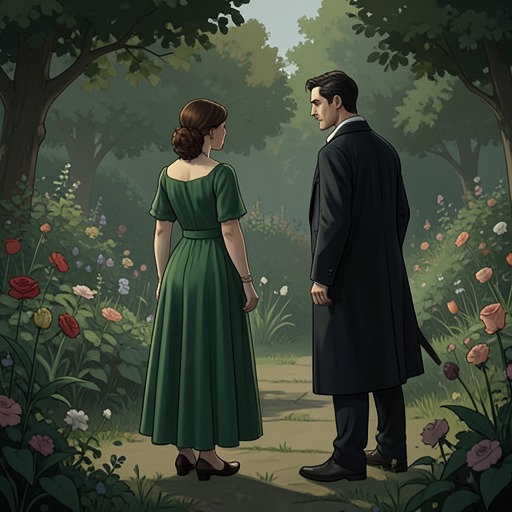
Darcy and Elizabeth reunite in London and begin courting
Just DesertsDarcy and Elizabeth reunite in London and begin courting after Elizabeth’s return from Grenadine Reef, where she has become Lady Pentland through her marriage to Sir David Pentland. The reunion is significant because it joins two identities that Elizabeth must keep publicly distinct: in London she is still generally known as Miss Bennet, while privately she is a wealthy widow whose history and security make concealment necessary. Their renewed relationship therefore begins not with a simple return to flirtation, but with an effort to build trust around altered circumstances, public misunderstanding, and the possibility of marriage.
Circumstances of the Reunion
Elizabeth’s changed position is inseparable from the history she has inherited and survived. Lady Radha Pentland had been born Radha Bhimani in Kutch, lost her mother in childbirth, and spent her childhood moving amid conflict involving the Mughals, the Marathas, and the British. At the age of eleven she was kidnapped for sale into slavery, rescued off the coast of the Arabian Peninsula, carried to Spain aboard a ship transporting priests, and forced into a nunnery outside Cadiz for six years. Later, while travelling from Cadiz to Cartagena with a religious mission, she was captured by pirates and left gravely wounded after the surviving members of the order continued onward.
Sir David Pentland’s care for Radha created the marriage and estate whose consequences now shape Elizabeth’s courtship with Darcy. He took Radha into his house in Bridgetown on Barbados, where a housekeeper and nurse helped him keep her alive through repeated infections. He later courted her after she had moved to the home of a widow for propriety, and accepted the truth of her pirate captivity without treating it as a reason to reject her. When Barbados subjected Radha to cruel judgments about the violence committed against her, Sir David resigned his naval commission; they returned to Britain, joined the Church of Scotland, married near Edinburgh, and eventually bought Grenadine Reef.
The estate’s wealth originated in Sir David’s naval career. In 1770, as captain of HMS Glory, he survived a hurricane and later salvaged treasure from a Spanish treasure galleon wrecked on a reef near the Grenadine Islands. The prize earned him a knighthood and provided the money to buy the estate, which was named for the reef. Decades later, Sir David and Radha’s quiet, frugal life and sustained investment of surplus income had expanded the property and generated the fortune Elizabeth inherited. Their wealth was not merely ornamental: it gave Elizabeth financial independence while also binding her to a history of imperial warfare, maritime danger, forced migration, and social prejudice.
The London Courtship
After Michaelmas, Elizabeth plans to return to Gracechurch Street so that she will not accidentally encounter Mrs. Bennet. She proposes continuing the courtship with Darcy in London through October and November, when she expects to be in half-mourning and able to attend suitable events. She imagines museums, bookshops, walks, and eventually the theatre, although the theatre outing is postponed until after their marriage. Darcy accepts the general plan, while warning that winter weather might delay his return with Georgiana Darcy from Pemberley.
Their London time is deliberately quiet and respectable. Elizabeth resumes volunteering at the Asylum for Female Orphans on Wednesdays and Fridays, while her association with Lady Maitland is interrupted because Lady Maitland is caring for her husband after his return from Spain. Darcy and Elizabeth spend their permitted social time on museums, bookshops, and walks in the less fashionable park near Gracechurch Street. These activities make the courtship visible enough to continue but restrained enough to accommodate Elizabeth’s half-mourning and protect her from unnecessary scrutiny.
The relationship is also practical rather than purely theatrical. Elizabeth and Darcy discuss the timing of their marriage, the possibility of winter delays, the arrangements for a small ceremony, and the attendance of Georgiana Darcy and one or both of Darcy’s guests. They plan to speak with the vicar at St Andrew’s about a suitable date. Their courtship consequently functions as preparation for a partnership: affection is present, but so are schedules, propriety, travel, mourning, household arrangements, and the need to control the conditions under which their union becomes public.
Identity, Secrecy, and Reputation
Elizabeth’s public name becomes a central complication. Because none of the Bennet sisters is in London, she is widely treated as Miss Bennet, the identity she used after leaving Longbourn. Although she is actually Elizabeth, Lady Pentland, she does not correct the mistake during the autumn. Correcting it would invite attention, and the additional scrutiny could threaten her safety. The apparent error therefore becomes a protective disguise: social misrecognition allows her to move through London without exposing the wealth, widowhood, and hidden life associated with Grenadine Reef.
This concealment explains Lady Catherine de Bourgh’s later confusion. Lady Catherine assumes that Darcy is courting a Miss Bennet because Darcy had courted Elizabeth before her return to Grenadine Reef. When Elizabeth came back to London after Michaelmas, however, she was no longer simply Miss Bennet; she was Lady Pentland. The change in title obscures the continuity of the relationship and allows Lady Catherine to interpret Darcy’s courtship through the wrong social identity.
Elizabeth ultimately insists that her sisters must tell their parents the truth about the courtship without discussing the Pentlands. They may say that Darcy and Elizabeth met again in London, renewed their acquaintance, that Darcy redeemed himself in Elizabeth’s eyes, and that they spent nine months courting before marrying. Elizabeth specifically reminds them that the renewed acquaintance began at the Asylum for Female Orphans. The instruction balances honesty against protective silence: her sisters must not lie, but neither must they disclose the information that could expose her to danger.
Consequences and Narrative Significance
The London reunion marks a value shift from guarded separation to chosen intimacy. Elizabeth’s return as a widow and heiress could have made the relationship impossible to interpret plainly, while Darcy’s earlier courtship and Lady Catherine’s investigation create the possibility of renewed conflict. Instead, the couple use London as a controlled space in which to test whether their acquaintance can survive changed names, altered rank, public rumor, and the demands of mourning. The courtship is therefore a second beginning, but not a return to the innocence of their first meetings.
The relationship also gains force from the example of the Pentland marriage. Elizabeth has learned from Lady Radha and from Madeline Gardiner that being a gentle-born lady consists less in display than in love and the practical responsibilities of daily life. Radha’s life joins cultures and geographies that British society prefers to keep separate: Kutch, the Arabian Peninsula, Spain, Barbados, and Britain. Her marriage to Sir David converts survival and social rejection into a durable household, while Elizabeth’s inheritance converts that household into the material basis for her own independence. Darcy’s renewed courtship consequently approaches Elizabeth not as a dependent young woman awaiting rescue, but as a person with experience, authority, money, obligations, and the capacity to choose.
The reunion leads to marriage, but its effects extend beyond the wedding. Elizabeth and Darcy later divide and plan their estates for their seven children, reserving Grenadine Reef for their daughter Helena Darcy rather than automatically giving it to a son. They divide the original estate into four portions, assign Pemberley to Bennet, lands at Grenadine Reef and the former Longbourn estate to David and Richard, and allocate other properties to Andrew, Michael, and Bartholomew. On the remaining land around the dower house they build St. Vincent Lodge, named after the island nearest the wreck where Sir David found the treasure. The future estate planning shows that the London courtship develops into a marriage capable of revising inherited succession patterns and carrying the Pentland legacy into a new generation.