Darcy and Elizabeth's courtship
Just DesertsDarcy and Elizabeth’s courtship is the decisive transition from mutual attraction and guarded acquaintance to an acknowledged relationship. Fitzwilliam Darcy offers Elizabeth Bennet a formal courtship after learning that she is intelligent, educated, experienced in estate management, and bound by a hidden history that includes her years with the Pentland family. Elizabeth accepts without hesitation, and the new relationship develops through shared work, regular visits, and an increasingly explicit recognition that their attachment is founded on partnership rather than social convenience.
Causes and Background
The courtship grows out of a relationship that has already moved beyond Darcy’s first impression of Elizabeth. His declaration is framed not as a romantic impulse alone but as a practical and ethical choice: he owns Pemberley, an estate of nearly 7,000 acres, as well as three smaller estates in Scotland, Essex, and Dorset, and wants a wife who will share the burdens and responsibilities attached to them rather than merely enjoy their advantages. Nothing Elizabeth has told him diminishes his regard; instead, he says that her disclosures have enhanced her appeal.
Elizabeth’s concealed history gives the courtship unusual moral weight. She has spent three years learning from Lady Radha Pentland, first in the feminine arts and the management of a household, and later, after Lady Radha’s death, as a practical substitute and companion for Sir David Pentland. Through that later role she learned estate management and investing. Her experience therefore makes her both socially vulnerable and unusually prepared to understand the responsibilities Darcy wants to share. The relationship is also shaped by Lady Radha’s life: born Radha Bhimani in Kutch, displaced by conflict among the Mughals, the Marathas, and the British, kidnapped when she was scarcely older than Elizabeth, and rescued before being sold into slavery, she was later forced into a nunnery outside Cadiz and transported toward Cartagena before pirates captured the ship. Sir David eventually sheltered her in Bridgetown on Barbados, cared for her through a nearly fatal infection, and married her after accepting the violence done to her without treating it as a moral stain.
The Formal Declaration
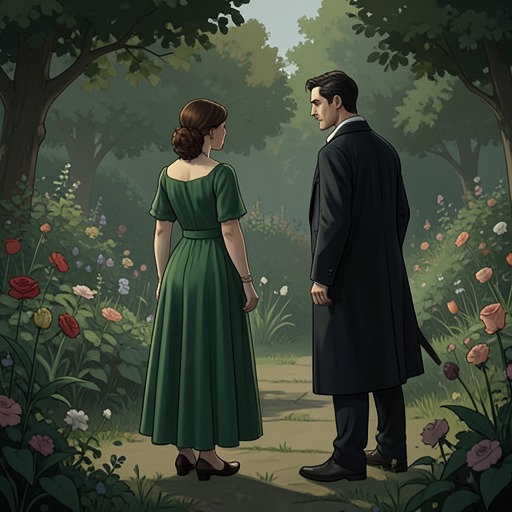
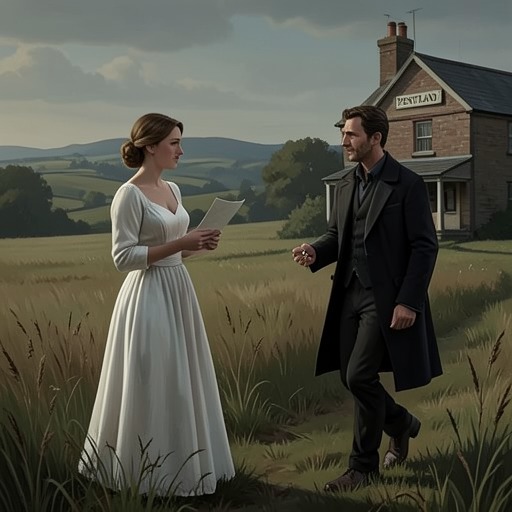
Darcy’s proposal takes the form of a request for courtship rather than an immediate marriage proposal. He asks Elizabeth to enter a relationship in which both parties may test their compatibility openly. Elizabeth accepts, explaining that she would be honoured to court him. The exchange changes the emotional value of their association from uncertain possibility to mutual commitment: Darcy’s desire is no longer merely inferred, and Elizabeth’s consent is no longer merely provisional.
The scene also preserves Elizabeth’s independence. She does not accept because Darcy’s wealth makes him advantageous, nor does she submit to a family arrangement. She listens to the terms he presents, understands the responsibilities behind them, and gives her own answer. Her uncle’s presence and mutual nod with her show the continuing force of social habit, but Elizabeth is of age and the decision is ultimately hers. The immediate physical response of both characters reinforces the reciprocity of the moment: Darcy smiles with unusual openness, while Elizabeth blushes and smiles shyly, and each becomes more conscious of the other’s attraction.
Candour and the Pentland Secret
The courtship obliges Elizabeth to decide how much of her past Darcy must know. When he asks what prompted her to tell him, she identifies two pressures. Her aunt has described their recent association as an unofficial or unacknowledged courtship and expected Darcy to declare himself; more importantly, Sir David Pentland urged Elizabeth to disclose the truth, judging from her description that Darcy was unlikely to be frightened away by an intelligent and educated woman. Sir David’s advice turns disclosure into a test of character: knowledge of Elizabeth’s life may repel a conventional suitor, but it should clarify whether Darcy can meet her as an equal.
That history connects the new courtship to an older marriage founded on protection, honesty, and acceptance. Radha’s passage from Kutch through the Arabian Peninsula, Spain, the Caribbean, and Britain exposes the forced migrations and religious pressures that have shaped the Pentland household. She willingly, though superficially, converted to the Church of Scotland before marrying Sir David near Edinburgh, after he resigned his naval commission because of the hostility directed at her on Barbados. Elizabeth’s bond with the Pentlands thus gives her a model of love that survives displacement, violence, illness, and social judgment. Darcy’s courtship is measured against that model rather than against a purely ornamental ideal of marriage.
Courtship as Shared Work
After Elizabeth accepts, Darcy’s visits and their time together become practical as well as romantic. He works with the steward to calculate what the farms can harvest after a winter and early planting season marked by insufficient investment, then spends his mornings trying to maximise the estate’s prospects. Three times a week he rides to Grenadine Reef to see Elizabeth. Much of their time there is spent riding over the estate while Elizabeth works with Sir David’s steward. Their courtship therefore takes place not only in fashionable settings such as Gunther’s or Rotten Row but also amid the responsibilities of land, tenants, harvests, and administration.
The arrangement makes visible the partnership Darcy said he wanted. Elizabeth’s routine mirrors his, though on a different estate, and their shared work creates a rhythm of intimacy based on competence and attention. They are not simply displaying affection; they are learning how each approaches obligation. The narrative presents this labour as emotionally generative: the more time they spend working together, the deeper their love becomes. Darcy also begins repairing his damaged reputation in Meryton and among the surrounding gentry through quiet apologies and substantial spending connected with his estate work, while Elizabeth’s presence and practical knowledge help give the courtship a social and administrative foundation.
Illness, Certainty, and Narrative Significance
The courtship unfolds under the pressure of Sir David’s terminal stomach cancer. Elizabeth drives herself hard and keeps busy partly to avoid facing the reality that the man who rescued and protected Radha, and who later became her own guardian and teacher, is dying. The happiness of the new relationship therefore coexists with bereavement already approaching. Darcy’s courtship cannot be separated from Elizabeth’s obligations to Sir David or from the inheritance and refuge work that the Pentland household represents.
When Elizabeth is asked whether she loves Darcy, her answer is unequivocal: she says that she does, without a doubt, and that she will accept when he proposes. The statement confirms that the formal courtship has not created feelings from nothing; it has given an existing attachment a recognised form. Its significance lies in that movement from guarded knowledge to chosen partnership. Against a social world that treats marriage as advancement, protection, or transaction, Darcy and Elizabeth begin by identifying the burdens they must share, testing one another through work, and allowing love to become a public and practical commitment.