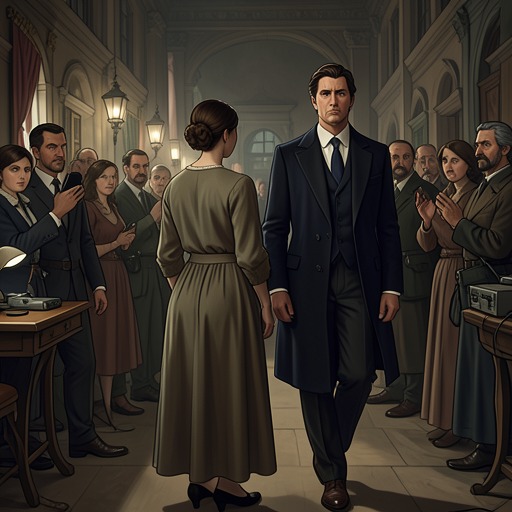
Darcy and Elizabeth's public rebuttal of the mistress rumour
Just DesertsDarcy and Elizabeth's public rebuttal of the mistress rumour is a calculated social counterattack in which a threatened reputation is defended by visibility, propriety, and controlled ambiguity. The rumour has already spread through selective hearing and sight, and Darcy has told the Gardiners that the associated letter is “full of lies” capable of harming others. Rather than expose its details or allow the gossip to dictate their movements, he proposes an outing so conspicuously respectable that the charge becomes difficult to sustain: Elizabeth and Madeline Gardiner will be seen in his company, alongside Georgiana Darcy and Richard Fitzwilliam, across several fashionable London locations. The event shifts the public meaning of Darcy and Elizabeth’s association from suspected illicit intimacy toward an unmistakable, if not yet formally announced, courtship.
Rumour and the Problem of Reputation
Darcy presents the gossip as a compound failure of observation and judgment. The story circulating about him and Elizabeth includes a letter, but he refuses to repeat its particulars; his concise account is that the letter consists of lies that could injure other people. This restraint matters because the rumour thrives on insinuation. A detailed defence might grant the accusation a seriousness it does not deserve, whereas refusing to rehearse the allegation keeps its falsehood from becoming the centre of the conversation.
The Gardiners nevertheless recognize that silence alone will not repair Elizabeth’s reputation. Madeline Gardiner asks what can be done to “salvage Elizabeth’s reputation,” making the event’s immediate stake explicit: the danger is not merely Darcy’s embarrassment but the social consequences attached to Elizabeth’s name. In a society where a woman’s respectability can be damaged by suggestion rather than proof, the burden of correction falls upon public appearances as much as upon truth. The response therefore treats reputation as something produced and contested in social space.
The Public Strategy
Darcy’s plan is intentionally bold. He points out that Georgiana Darcy was seated to Elizabeth’s left during the theatre performance, in full view of the audience and in the Earl of Matlock’s box. He reasons that anyone familiar with the supposed “correct” arrangement for a mistress would not place such a woman beside a fifteen-year-old sister in so prominent a setting. The argument uses the conventions of the very society that created the rumour: propriety, family presence, rank, and theatrical visibility become evidence against the accusation.
The proposed sequence extends that logic beyond the theatre. Darcy wants to escort Elizabeth and Madeline Gardiner to the British Museum, have lunch somewhere fashionable, stroll down New Bond Street, and finish at Gunther’s. Georgiana Darcy and Richard Fitzwilliam will accompany them, and Lady Maitland later joins the party, bringing its number to six. Each location is socially legible, and the accumulation is deliberate. A single appearance might be explained away; a whole day spent in reputable, public company makes the alleged clandestine relationship increasingly implausible.
Madeline Gardiner immediately understands the force of the performance. She observes that the outing will mostly destroy the rumour that Elizabeth is Darcy’s mistress, but will almost certainly create other rumours. The distinction is the event’s central irony: the plan cannot remove Elizabeth and Darcy from the gaze of society, because society’s gaze is the instrument they must use. It can replace one interpretation with another, not abolish interpretation itself. Elizabeth and Darcy’s inability to suppress their blushes confirms that the new speculation will concern their feelings and future intentions.
The Day in London
The outing follows a week in which distress spreads outward through the social circle. Lady Maitland is upset on Tuesday; Elizabeth learns of the rumour and becomes upset on Wednesday; Darcy and Madeline Gardiner are drawn into the disturbance on Thursday; Edward Gardiner is involved when he returns home. On Friday, however, the week’s events are symbolically cast into the fire and reduced to ash as the party carries out Darcy’s plan. The image marks a controlled reversal: private alarm is converted into a public demonstration.
The day is not presented as effortless pleasure. Elizabeth and Darcy generally avoid the fashionable Ton and its rituals, so the itinerary is described as a necessary evil that they nevertheless manage to enjoy. The British Museum provides an especially pointed beginning. Elizabeth remarks that she has sometimes felt like one of the exhibits under glass, exposed to scrutiny. Her comparison acknowledges that the outing is itself a spectacle, but it also gives her a position from which to observe the mechanics of being observed. The public gaze that threatens her is made visible, and therefore temporarily manageable.
The party’s success depends on more than Darcy’s intention. Colonel Richard Fitzwilliam and Lady Maitland belong to overlapping social circles and are known by many people; they facilitate the approach of most of those encountered during the day and take delight in helping the couple. Their participation supplies the outing with social authentication. Darcy and Elizabeth are not merely seen together; they are received within recognized networks of family, rank, and acquaintance. By the end of the day, the objective has been achieved, and even the members of the party are independently speculating that an official courtship will be announced on the Monday after Easter. Elizabeth alone does not anticipate the request.
Consequences and Narrative Significance
The event succeeds because it accepts the instability of public meaning instead of pretending to control it completely. Darcy and Elizabeth cannot persuade every observer to stop talking, but they can force the available story to change. The mistress rumour is answered by family proximity, fashionable public places, and sustained company; the same evidence that makes the original allegation absurd points toward a socially acceptable attachment. Reputation is shown not as a private possession but as a contested narrative assembled from arrangements, witnesses, and repeated appearances.
The scene also advances Darcy and Elizabeth’s relationship without making the courtship announcement itself occur during the outing. That delay preserves the difference between public evidence and formal declaration. The party’s six members can read the trajectory, and the Monday after Easter seems to them the natural moment for an official request, yet Elizabeth remains unaware of the plan. The event therefore closes one danger while opening the next stage of the romance: public rebuttal becomes the prelude to acknowledged courtship.
Its larger significance lies in the contrast between passive exposure and active presentation. Elizabeth has been treated as an object under glass, but she participates confidently in the countermeasure; Darcy does not hide her away or demand that she defend herself alone. Together they occupy the spaces where gossip operates and turn respectable visibility into a form of agency. The strategy does not overthrow the social order that judges Elizabeth, but it makes that order serve her by compelling its own codes—family, propriety, and public accountability—to contradict the accusation.