Darcy proposes to Elizabeth after Sir David's proposal
Just DesertsDarcy proposes to Elizabeth after Sir David’s proposal at the moment when Elizabeth’s private happiness is placed under an extraordinary public and familial obligation. Sir David’s terminal illness has made him ask Elizabeth to set aside her own wishes for a year and accept a marriage intended to protect Grenadine Reef after his death. Darcy therefore refuses to treat his love as a claim that can simply override her duty. His proposal acknowledges both the emotional cost of the arrangement and the future they may still build together.
Causes and Background
Sir David’s request arises from the sudden contraction of time. He had once imagined longer-term plans, but the discovery of cancer turns the prospective end of the year into summer, then into weeks. He has no family able to contest his intended arrangements, and he has prepared a new will, a marriage settlement, and a wedding witnessed by James, a doctor, and the local magistrate. His proposal to Elizabeth is thus not merely romantic: it is designed to preserve the estate and its responsibilities when he dies. The demand nevertheless places emotional pressure on both Elizabeth and Darcy, because it asks them to suspend personal happiness for the sake of Grenadine Reef and its future inhabitants.
Elizabeth’s readiness to consider Sir David’s plan is inseparable from the history he has shared with her. Born Radha Bhimani in Kutch, she was displaced by successive conflicts involving the Mughals, the Marathas, and the British, and was kidnapped for sale into slavery when she was only slightly older than Elizabeth. She was rescued off the Arabian Peninsula by a Spanish ship, forced into a nunnery outside Cadiz for six years, and later sent without consent on a mission to Cartagena. Pirates captured that ship, and Sir David eventually took her into his house in Bridgetown on Barbados while she recovered from wounds and infection. He later resigned from the British naval career after the hostile treatment directed at her, returned to Britain, married her, and bought the estate where they lived for thirty-two years. The proposal to Elizabeth therefore continues a life organized around rescue, protection, and the preservation of a refuge rather than around ordinary courtship alone.
What Happens
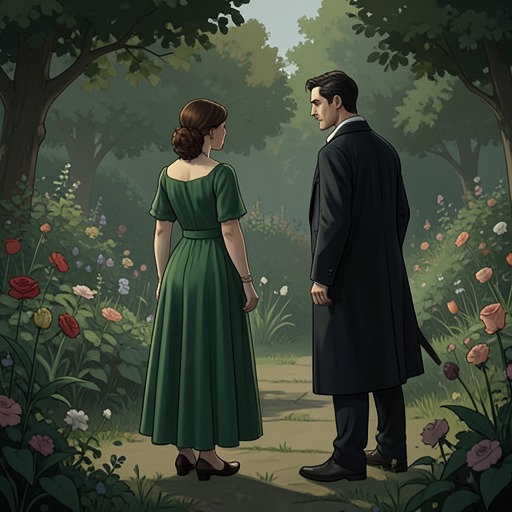
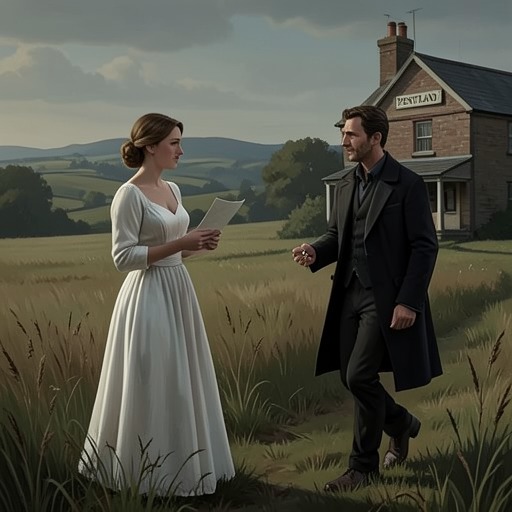
After hearing Sir David’s terms, Darcy leaves to find Elizabeth. Their meeting avoids the awkwardness of one person following the other, and their tentative smiles establish a moment of mutual reassurance before Darcy speaks plainly. He tells Elizabeth that he loves her and explains that he has been trying to determine the proper time to propose. He recognizes the cruel irony that she is unlikely to receive two proposals in one day, yet he does not present his own proposal as a contest with Sir David’s.
Darcy says that they could marry soon, and that doing so would be easy, but not right. He understands that Elizabeth will accept Sir David’s proposal because it is right for her, for the estate, and for Sir David, who needs confidence that his property will be in good hands after his death. Darcy asks only that she consider six months of mourning and agree to marry him on the day after Twelfth Night. His proposal consequently turns restraint into an expression of love: he does not ask Elizabeth to abandon duty, but asks whether their relationship can survive its delay.
Elizabeth responds with an action that carries unusual weight in their developing intimacy. She reaches out and takes Darcy’s hand, the first time she has made that gesture. She then observes that, just as it is abnormal to receive two proposals on the same day, it is even less normal to accept two proposals on the same day. Her reply confirms that she accepts Darcy while also accepting Sir David’s arrangement. The scene’s value shift is from apparent romantic postponement to shared certainty: love is not defeated by duty but given a future through it.
Immediate Consequences
Darcy experiences genuine happiness, although he knows he will chafe against the slow passage of time before the marriage can occur. He and Elizabeth return to the drawing room to explain the situation to Sir David and to tell Elizabeth’s aunt and uncle. The private exchange therefore becomes a family announcement, and its unusualness is openly acknowledged when Elizabeth later states that Darcy proposed on the same day as Sir David, that she accepted him, and that they will marry after six months of mourning in January, as soon after Twelfth Night as possible.
The announcement unsettles the household because the preceding two weeks have already violated ordinary social expectations. Elizabeth’s double acceptance makes the breach explicit, but it also clarifies the moral structure of the choice. Sir David’s proposal secures the estate’s continuity; Darcy’s proposal secures Elizabeth’s emotional future. Neither man is treated as a rival to be defeated. Instead, Darcy’s willingness to wait allows Elizabeth to honor a dying man without surrendering the possibility of marriage grounded in love.
Narrative and Thematic Significance
The event completes a distinctive romance pattern in which the obstacle is not a misunderstanding or a rival but the conflict between desire and responsibility. Darcy’s conduct marks a change from possessive or socially constrained courtship toward partnership: he states his love directly, identifies what is right for Elizabeth and Grenadine Reef, and accepts a timetable governed by mourning rather than impatience. Elizabeth’s handclasp gives physical form to a relationship that has reached mutual trust without erasing the claims of the vulnerable people dependent on the estate.
The proposal also gathers together the novel’s wider contrast between marriage as transaction and marriage as partnership. Elizabeth’s proposed union with Sir David is a marriage of convenience intended to protect a household and its refuge, while her union with Darcy represents the deepest love she has been able to choose. The event refuses to make those meanings mutually exclusive. Duty can be practical and costly; love can be patient and active. By accepting both proposals, Elizabeth turns what might have been a forced choice into a sequence of commitments, and Darcy proves that his love is strong enough to wait while she fulfills the obligation created by Sir David’s illness and impending death.