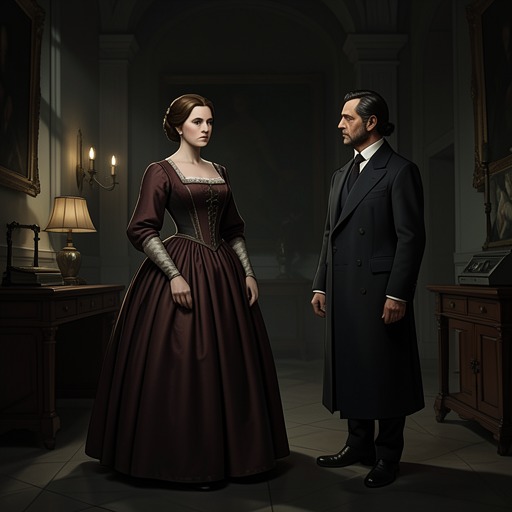
Darcy rejects the alleged engagement to Anne de Bourgh
Just DesertsDarcy rejects the alleged engagement to Anne de Bourgh in a confrontation at Matlock House, transforming a family demand presented as duty into a direct dispute over consent, evidence, inheritance, and personal independence. His refusal is decisive because he does not merely decline Anne as a prospective wife: he denies that any binding engagement was ever established and declares that the matter will no longer govern his life or his courtship of Elizabeth Bennet.
The Family Demand
The confrontation begins when Darcy’s aunt presents his courtship of someone in London as an outrage. She insists that he is betrothed to Anne and must immediately perform his supposed duty, invoking the wishes of Anne’s mother and Darcy’s own parents. The claim is reinforced by the suggestion that a marriage would unite two branches of the family, making the proposed match appear less a private promise than a dynastic arrangement intended to consolidate family relationships and property.
Darcy’s silence initially allows the older generation to continue defining the situation for him. The pressure is not framed as a question of mutual affection. Instead, it rests on inherited authority, family expectation, and the assumption that Darcy’s position obliges him to accept a decision allegedly made during childhood. The confrontation therefore places his emerging relationship with Elizabeth against a structure that treats marriage as an instrument of family management.
Darcy’s Rejection of the Alleged Engagement
Darcy answers by asserting that he is the head of his own family and is not subordinate to the Fitzwilliam branch from which his aunt derives her authority. When she insists that both he and Anne are Fitzwilliams because they are grandchildren of the previous Earl of Matlock, Darcy refuses to let ancestry settle the question. His point is not that family connections do not exist, but that they cannot manufacture consent or prove a marriage promise.
He states that he never heard either of his parents mention or confirm any childhood engagement. More importantly, he notes the complete absence of documentation or paperwork. The alleged arrangement was not discussed during the decade following his mother’s death and was raised only after his father had died. That timing makes the claim appear retrospective and politically useful rather than a reliable record of family intention. Darcy consequently rejects the engagement as an unsupported assertion, not as a valid obligation he is breaking.
Power, Money, and Estate Interests
Darcy identifies the supposed engagement as part of the ordinary machinery of power and money. He argues that if Anne married him, she would live at Pemberley, while her mother would gain freer control over Rosings Park. His accusation is strengthened by his knowledge of the estate’s finances: he points out that his aunt has exceeded her income and, during the current year, sold productive land not protected by the entail on the main estate.
The exchange reveals why the marriage is being pressed with such vehemence. Anne’s future residence and the management of Rosings Park are linked to Darcy’s household and oversight, while the proposed union would appear to offer a solution to financial and familial instability. Darcy refuses to accept a duty defined by consequences that chiefly benefit others. He even declares that he can produce paperwork supporting his allegations, turning the confrontation from a clash of temperaments into a contest over documentary proof and responsible estate management.
The Final Boundary
Darcy’s patience ends when his aunt and uncle challenge both his tone and his authority. He stands, making his physical withdrawal the culmination of the verbal refusal. Although he acknowledges that no public breach has yet occurred, he warns that the matter remains in their hands and hopes it will not reach that stage for the sake of himself, Georgiana Darcy, and Anne. His concern for those affected does not soften the boundary he has drawn; it shows that he distinguishes consideration for relatives from submission to their demand.
He then states that the ridiculous fantasy is never again to be discussed in his presence. The declaration functions as both refusal and prohibition. Darcy leaves while the family calls after him, and the scene closes with the unresolved question of the woman he is courting. That final question confirms that the real threat to the family arrangement is not merely Darcy’s abstract independence but his attachment to another woman in London.
Narrative Significance
The confrontation gives Darcy’s courtship of Elizabeth Bennet a formal obstacle rooted in family authority rather than uncertainty between the lovers. It also clarifies the moral basis of his choice. He does not reject family responsibility altogether: he remains attentive to Georgiana, Anne, and the public consequences of a breach. What he rejects is the conversion of ancestry, an alleged childhood promise, and financial convenience into a compulsory marriage.
The scene therefore marks a shift from inherited obligation to adult self-determination. Darcy’s strongest evidence is negative—the absent documentation, the unconfirmed promise, and the suspicious delay before the claim was raised—but that absence becomes powerful because the family demands obedience without proof. By standing, naming the arrangement a fantasy, and ending discussion of it, he makes his independence an action rather than a private feeling. The alleged engagement to Anne de Bourgh is consequently disarmed at its source: it survives only as a family assertion, while Darcy’s refusal becomes the governing fact of his future.