David Pentland
Just DesertsDavid Pentland’s life joins naval service and sudden wealth to a quieter legacy of care. Knighted after recovering treasure from a wrecked Spanish galleon, he used his fortune to establish himself at Grenadine Reef; his rescue and subsequent care of Radha Bhimani became the foundation of their marriage, while their estate’s refuge for women carried their responsibilities beyond their household.
Identity and Background
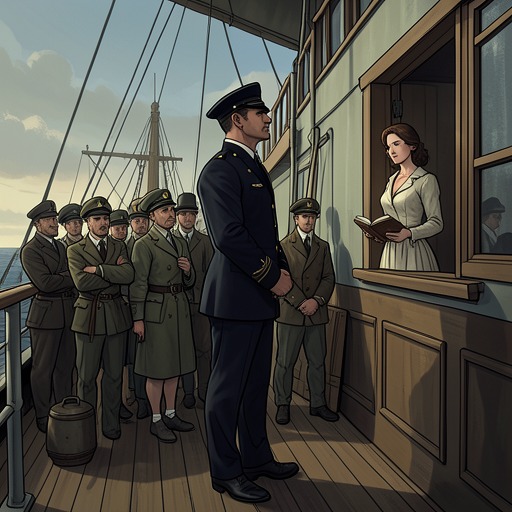
Pentland is introduced as a retired captain of the Royal Navy and the husband of Lady Radha Pentland. The account of their meeting reveals a career shaped by more than the celebrated prize for which he was knighted: in 1772, while commanding HMS Glory, he encountered pirates holding Radha and others captive. He and his crew engaged the pirates and freed the captives. During the fighting, Radha was stabbed by the pirate captain; as she fell, she saw Pentland kill him. The rescue was therefore both a naval action and the beginning of a personal bond, though Radha’s grave wound left her dangerously ill.
After the surviving members of Radha’s order continued their journey, she was too sick to be moved and remained behind. Pentland took her into his home in Bridgetown, Barbados, where his housekeeper and a nurse helped care for her. She nearly died twice before recovering. Once well enough to leave his household, Radha moved to the home of a widow he knew, so that their growing attachment could proceed with propriety; Pentland then courted her. When she told him about the abuse she had suffered during her captivity, he took her hand and assured her that it did not alter his regard for her. The episode establishes the personal attentiveness that later distinguishes his conduct from the public hostility Radha faced as a survivor.
Naval Career and the Making of Grenadine Reef
Pentland’s wealth and title came not from a long succession of celebrated exploits but from one dangerous salvage operation. In 1770, newly appointed captain of HMS Glory, he was sent to the West Indies after the ship’s refit at Plymouth. The Admiralty wanted the vessel on station despite the approaching hurricane season. HMS Glory met the edge of the first hurricane of the season: the ship lost some spars and suffered damage, but the crew escaped with bruises and a single broken leg.
Two days after the storm, Pentland and his crew came upon a Spanish treasure galleon that had tried to reach Havana ahead of the weather. It had run aground on a reef off one of the Grenadine Islands and broken apart; nearly all its crew had died in the wreck. Before the remaining hull was smashed completely and sank, HMS Glory’s crew recovered a substantial portion of its treasure. Pentland was knighted for the action, and his share of the prize financed the purchase of Grenadine Reef. The estate’s name preserves the maritime origin of the family fortune, although the property lay more than fifty miles from the sea.
Stewardship, Bereavement, and Elizabeth Bennet
From the first year of their residence at Grenadine Reef, David Pentland and Radha Pentland made the estate serve a purpose beyond their private comfort. They converted its dower house into a refuge for women harmed by men, many of them servants or daughters of tenants and tradespeople. Women could come there to recover and, when needed, address the consequences of what had happened to them. Radha’s way of receiving them was not to judge: she listened as they spoke, raged at injustice, or simply tried to unburden themselves. The refuge gave practical form to the care David had first shown Radha when she was ill and abandoned far from home.
That work also shaped David’s bond with Elizabeth Bennet. After Radha’s sudden death, Elizabeth visited Grenadine Reef for the first time in more than a month, grieving at Radha’s grave in the chapel before realizing that David, too, needed someone willing to listen. He was a retired Royal Navy captain, more than fifty years her senior, yet the bereaved man admitted that he did not know what to do with his life. Elizabeth immediately wanted to help him as he and Radha had helped her. Their relationship grew through this exchange of care, not through kinship: he became a trusted elder and, in effect, a grandfather to his young neighbour.
When Elizabeth’s father refused permission for her to travel to London with her aunt and uncle, David heard her account and helped her prepare to leave Longbourn. He had the carriage cushions reupholstered and new springs fitted, and arranged hot tea, food, hot bricks, rugs, and blankets for the journey. The careful provisions made his affection concrete: he did not merely encourage Elizabeth’s independence but attended to the physical risks and discomforts of the road. Later, while she lived in London, their twice-weekly visits had been the highlight of his week; in winter, when meeting was difficult, the Harkness sisters carried their letters between them. He dreaded her absence in spring and relied on her presence after Radha’s death, even as he maintained a proper, chaperoned distance.
David’s stewardship joined personal generosity to practical judgment. As his body grew slower and more easily tired, his mind remained sharp, and he continued to assess investments with Elizabeth and his household. When she gathered information about what working men liked to drink, surveying servants, tradespeople, and workers through her uncle’s employees, she identified breweries in Alton and Lewes and proposed acquiring nearby hops and barley acreage. David expanded the inquiry to Southampton and Portsmouth, asking that the same contacts investigate breweries there because merchant sailors and the Royal Navy consumed large quantities of beer. He admired how Elizabeth developed an initial observation into further investment possibilities, while Vivian Harkness and Violet Harkness helped communicate and record the work.
The scale of the estate’s wealth reflected the same habits of restraint and reinvestment. David’s share of the Spanish treasure prize had provided the capital to buy Grenadine Reef, while he and Radha lived quietly, spent little on London seasons or lavish entertaining, and had no children whose schooling, travel, or dowries would consume their surplus. Their excess income was invested year after year, and its returns enlarged the funds available for further investment. David transferred money to double the size of Grenadine Reef and purchase smaller estates. His will left £50,000 in Consols and a further £25,000 to his brother; after those payments, Elizabeth’s assets amounted to £400,000 and generated nearly £20,000 a year after tax. His fortune was thus not only the residue of a naval exploit: it was also the accumulated result of careful living and financial management.
David’s circle of responsibility extended beyond his own estate. He was a guardian and governor of the Asylum for Female Orphans, and his correspondence with Elizabeth offered a measured view of Fitzwilliam Darcy: David believed Darcy’s work demonstrated genuine humanity, even if his manners still required improvement. In recalling his own younger self, David acknowledged that after his knighthood and the public knowledge of his Caribbean wealth, he had become cynical and haughty amid fortune-hunters and threats of compromise. Radha’s bravery had helped change him. His advice therefore rested on experience rather than simple approval: he hoped Darcy would learn better conduct without needing a catastrophe to force the lesson.
David’s influence continued into the next generation through the arrangement of the family estate. After her marriage to Fitzwilliam Darcy, Elizabeth shared in planning the division of their properties among their children. The final 1,000 acres of the original Grenadine Reef estate, surrounding the dower house and women’s refuge, became the setting for St. Vincent Lodge, built by Elizabeth and Darcy and named for the nearest large island to the wreck David had discovered. Their family stayed there on visits; when Helena inherited, Edward Gardiner and Madeline Gardiner were to move into the lodge. The land around the refuge remained bound to care and stewardship, carrying Radha’s work and David’s legacy forward beyond the marriage that had founded their home.
Marriage, Public Prejudice, and Withdrawal from the Navy
Radha’s survival brought David into conflict with the society that celebrated him. Though he had been knighted for his naval actions, she was met on Barbados with barbed remarks and suggestions that it would have been better had she died. David understood that the hostility treated her survival as a source of embarrassment and blamed her for having lived near the coast where she was captured. The treatment of his wife became the final reason for his uncertainty about continuing his naval career: he resigned his commission, and the couple returned to Britain.
Radha converted to the Church of Scotland willingly, though only superficially, and David married her in his hometown outside Edinburgh. After their wedding trip they moved to London, where they heard that the estate was available and bought it. They had lived there for thirty-two years by the time Elizabeth first visited. David’s retreat from naval service was therefore not a rejection of public responsibility so much as a redirection of it: the home he built with Radha became both a place of refuge and the setting for a long, quiet life of care.