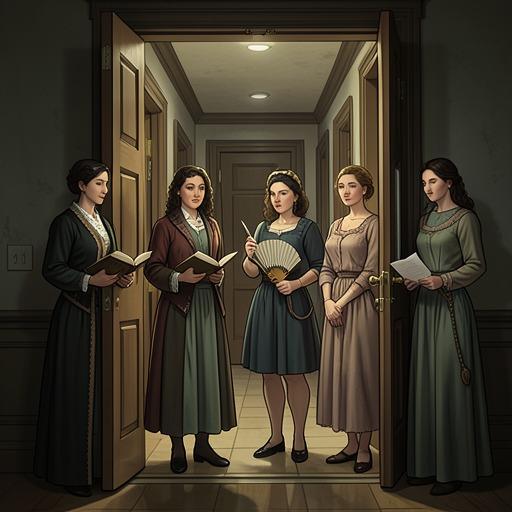
Eleanor Maitland
Just DesertsEleanor Maitland, usually addressed as Lady Maitland, is a forty-two-year-old woman whose presence in the novel joins military service, international experience, female education, charity, and aristocratic social influence. As a volunteer at the Asylum for Female Orphans, she recognizes that Elizabeth Bennet possesses unusual substance and becomes both her friend and a discreet advocate, including by testing whether Elizabeth might permit Fitzwilliam Darcy the opportunity to redeem himself.
Identity and Background
Eleanor Maitland is the wife of General Sir Thomas Maitland. Her husband served as Governor of Ceylon from 1805 to 1811, during which time Eleanor was able to accompany him because the posting presented no immediate threat of hostilities. When he received another military appointment, this time an active position on the staff of Lord Bentinck in Sicily, Eleanor chose not to follow him to Lisbon or Gibraltar. The likelihood that he might be ordered into battle made separation the more sensible course, and she remained in London instead.
Her family connections extend into the army. Eleanor’s brother is General Sir Ormsby Vandeleur, whom Elizabeth recognizes as one of the heroes of the Battle of Cuidad Rodrigo. Elizabeth knows that he took over the breach after General Crauford was killed and that he was seriously wounded. Eleanor’s response reveals both her anxiety about military news and her appreciation that Elizabeth has read beyond newspaper headlines closely enough to understand the details of the campaign and its casualties.
The Asylum for Female Orphans
The Asylum for Female Orphans, located in St George’s Fields south of the River Thames, is the setting in which Eleanor and Elizabeth become acquainted. The institution houses approximately 200 girls between the ages of nine and fourteen. Newly admitted children are cleaned and fed, sometimes after going without either for days, and are then given an education designed to lead to employment at the age of fourteen. Most are expected to enter domestic service, so practical training in household work is central to the curriculum; reading, writing, arithmetic, and needlework supplement it, and older pupils can undertake paid work that modestly supports the institution.
The Asylum is governed by a committee of nineteen gentlemen and has royal patronage, with Queen Charlotte as Patron and one of her sons as President. Eleanor’s own participation complicates that male administrative structure: she contributes time and practical attention rather than merely money. She had done comparable charitable work in Colombo, and from the beginning Elizabeth notices that the institution is not only forbidding but also filled with human hope and organized usefulness.
Eleanor is introduced to Elizabeth only after Elizabeth has spent several weeks volunteering. She immediately identifies Elizabeth as the youngest volunteer, by almost a decade, and values the fact that such a young woman has chosen service instead of concentrating solely on social advancement. The two women’s conversations deepen because Elizabeth has already learned from Lady Radha’s accounts of India and can ask intelligent questions about Ceylon. Eleanor therefore sees her not as an inexperienced girl to be patronized, but as a young woman whose knowledge and judgment may become an asset to the Asylum.
Friendship and Social Mediation
Eleanor’s friendship with Elizabeth is grounded in recognition. Elizabeth has no money to donate, but she gives her labor, attention, and intelligence. Eleanor understands the distinction and treats Elizabeth’s contribution as substantial. At forty-two, she is only two years older than Elizabeth’s mother, yet the relationship is not presented as a formal maternal supervision. Eleanor becomes a mature female ally who can appreciate Elizabeth’s arguments without demanding that she become a submissive or merely decorative young lady.
That alliance places Eleanor within Elizabeth’s wider network of female instruction. Elizabeth has already learned estate management and the practical responsibilities of a gentlewoman through Lady Radha and the Pentlands; from Madeline Gardiner she learns the management of a London household; at the Asylum she turns that education toward the support of orphaned girls. Eleanor belongs to the same system of female competence. The Asylum’s volunteers, the Gardiner household, the Pentland estate, and the women’s refuge at Grenadine Reef are connected by skills that include teaching, domestic organization, charitable administration, correspondence, and emotional care.
Eleanor also recognizes Elizabeth’s position in the social world. At a gathering in Eleanor’s townhouse in Cavendish Square, the guests are women who volunteer at the Asylum or assist other charitable ventures. They are fashionably dressed but understated, comfortable enough in their circumstances not to depend on conspicuous display. Elizabeth is praised because she gives her time to charity while remaining indifferent to the noise, posturing, and strategic positioning of the Ton. Eleanor’s circle thus offers Elizabeth a form of social legitimacy based on usefulness and character rather than ornament or marriage-market performance.
Eleanor and Fitzwilliam Darcy
Eleanor becomes an important intermediary when Elizabeth encounters Fitzwilliam Darcy at the Asylum. Darcy is there within the same charitable network, and his conversation with Eleanor includes an inquiry about her brother’s condition. The exchange allows Elizabeth to see Darcy in a setting different from the Meryton Assembly and gives Eleanor an opportunity to observe the tension surrounding their renewed acquaintance.
Eleanor does not excuse Darcy’s earlier conduct. Elizabeth tells her that women are obliged to listen to, defer to, and obey men, and that this dependence creates a corresponding expectation that men behave as gentlemen. In Elizabeth’s judgment, Darcy can act as a gentleman, but in Hertfordshire he was unpleasant, proud, and snobbish. Eleanor’s response is not to dismiss the criticism but to ask whether Elizabeth would allow Darcy the chance to redeem himself. Her intervention is therefore a measured one: she does not instruct Elizabeth to forgive him or manufacture a romance, but asks whether a change in conduct should be given an opportunity to prove itself.
Eleanor’s position makes that question consequential. She belongs to a world in which reputation, family, military service, charity, and social recognition overlap. Later, when Fitzwilliam Darcy cuts Caroline Bingley and announces that he will give her the cut direct, he intends to inform both the Countess of Matlock and Eleanor. Her name in that declaration shows that she is treated as an influential arbiter of social relations, not merely as a volunteer encountered at the Asylum. Caroline Bingley’s campaign of lies against Elizabeth and Georgiana Darcy is thus answered through the same network of female and aristocratic judgment that Eleanor helps maintain.
Narrative Role and Significance
Eleanor’s narrative function is that of a threshold figure and mediator. She stands between Elizabeth’s provincial family life and London’s more capable charitable and aristocratic circles; between military news from the Continent and domestic life in England; and between private moral judgment and public social consequence. Her questions help move Elizabeth and Darcy from hostility toward the possibility of renewed acquaintance, while her own charitable work gives Elizabeth a setting in which intelligence and labor matter more than fortune.
The novel also uses Eleanor to enlarge the meaning of women’s work. The Asylum depends on male governance in its formal structure, yet its daily educational and practical purposes require the sustained labor of women. Eleanor’s earlier work in Colombo and her London volunteering show that female usefulness travels across imperial and military circumstances even when wives cannot safely accompany husbands on active postings. Her life is not reduced to military marriage: separation from Sir Thomas Maitland creates the conditions for an independent public role.
Through Eleanor, Elizabeth encounters a model of mature female agency that does not reject domestic or marital responsibility but refuses to define womanhood by dependence alone. Eleanor’s friendship confirms that Elizabeth’s education in estate management, household administration, tenant welfare, and charitable work belongs to a coherent life of calm activity. In that respect, Eleanor helps make visible the social infrastructure behind Elizabeth’s later independence: women teach, organize, interpret reputations, sustain institutions, and connect people across class and professional boundaries. She is a supporting character, but her influence is structural, helping convert Elizabeth’s intelligence from a private quality into a resource with social and ethical force.