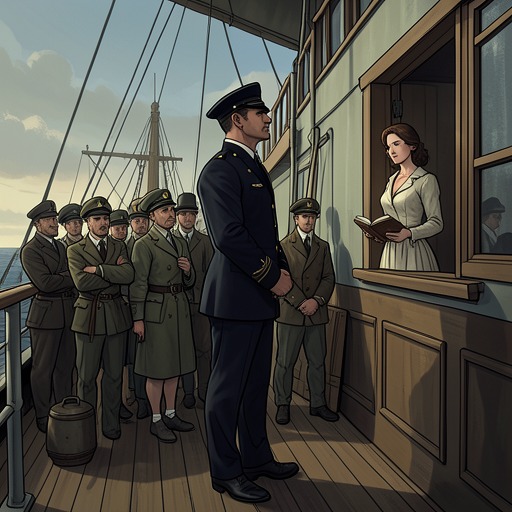
Elizabeth Bennet–Sir David Pentland relationship
Just DesertsThe Elizabeth Bennet–Sir David Pentland relationship is one of the novel’s most sustaining forms of affection: an intergenerational bond built not on blood or marriage, but on recognition, responsibility, and repeated acts of care. Sir David Pentland, fifty-one years older than Elizabeth Bennet, becomes a grandfather figure to her after the death of Lady Radha Pentland, while Elizabeth becomes the young companion whose energy, kindness, questions, and presence keep him from retreating into grief. Their attachment is emotionally intimate but consistently presented as proper, public-minded, and carefully protected by chaperonage.
Formation Through Grief
The relationship takes its decisive shape after Lady Radha Pentland dies suddenly in her sleep from apoplexy. Elizabeth stands in the chapel before Lady Radha’s final resting place, weeping at a death that has devastated the household; Sir David’s loss is even more visibly complete, since the light appears to have gone from his life. The scene establishes the unequal but mutually binding nature of their grief. Elizabeth has lost a beloved elder and mentor, while Sir David has lost his wife and the centre of his domestic world.
Sir David, a retired Captain in the Royal Navy, is described as lost and unable to speak freely to anyone except the sixteen-year-old daughter of his neighbour. Elizabeth immediately understands that she wants to help him because he and Lady Radha had previously helped her. The age difference does not deter her. Her offer, “I will help you, however I can,” is not a passing expression of sympathy but the governing promise of the relationship. Elizabeth’s care becomes a form of moral reciprocity: she answers the protection she received by refusing to leave Sir David alone with bereavement.
A Relationship Made Proper
Because Elizabeth is a young unmarried woman and Sir David is an older widower, the relationship must be made legible within the rules of Regency society. Elizabeth explains that she walks alone only on Longbourn grounds. When Lady Radha was alive, Radha collected her in a phaeton, and Elizabeth was never alone with Sir David. After Radha’s death, one of the Harkness sisters collects her instead. Meetings with Sir David take place in the drawing room, where one of the sisters or the housekeeper is always present.
The arrangement is not treated as a mere social technicality. It protects Elizabeth’s reputation, preserves Sir David’s dignity, and allows an emotionally important relationship to continue without becoming vulnerable to scandal. Their shared work takes place at a large table in the drawing room, where they review estate documents, discuss investments, and talk about books. The room therefore becomes both a domestic refuge and a controlled intellectual space: affection is permitted, but it is supported by visible boundaries and responsible household practice.
The correspondence between them follows the same pattern. When winter weather prevents Elizabeth from visiting, her letters to Vivian Harkness list the questions she intends to ask Sir David. Vivian repeats those questions to him, and he discusses his answers and his own questions with her; Vivian or Violet Harkness then writes back to Elizabeth. This “wafer thin veneer of respectability” allows the pair to remain in contact while maintaining the formal distance expected of them. The device also reveals how the Harkness sisters become active custodians of the relationship rather than passive witnesses to it.
Mutual Care and Education
Elizabeth’s role in Sir David’s recovery is explicitly acknowledged by him. He tells her that she has been vital not only to him but to the whole estate, because without her energy, kindness, and sheer presence he would have remained in melancholy and faded away. The statement defines her influence in practical as well as emotional terms. She does not merely comfort an old man; she helps restore his engagement with his household, his responsibilities, and the future of Grenadine Reef.
The bond is reciprocal because Sir David’s household educates Elizabeth in ways that Longbourn does not. Elizabeth says that over eight years she has learned what matters in being a lady chiefly through Lady Radha and Madeline Gardiner. Sir David and Lady Radha teach through example: courtesy is joined to competence, hospitality to responsibility, and social conduct to moral seriousness. Elizabeth passes these lessons on to Jane Bennet and the other Bennet sisters, making the relationship’s influence extend beyond the two people who formed it.
Elizabeth also values Sir David as an intellectual adviser. She turns to him when she needs judgment on difficult moral or social questions, including her dealings with Fitzwilliam Darcy and her dislike of him after their first meeting. Her instinct is to seek Sir David’s opinion through Vivian Harkness, showing that the relationship includes trust in his experience and discernment. His advice is not simply paternal authority; it is part of Elizabeth’s developing capacity to interpret power, reputation, and responsibility for herself.
Separation and Continuing Attachment
When Elizabeth relocates to London, physical distance becomes the principal threat to the relationship. Sir David listens to her first letter after the move, knowing that winter already makes visits difficult and dreading her absence in spring. Their twice-weekly visits had been the highlight of his week, even though they maintained a proper and well-chaperoned distance. He is approaching seventy-two, his mind remains sharp, but his body is slowing and aching in the cold. The letters therefore carry more than news: they preserve a routine of attachment at a time when age, weather, and geography are steadily narrowing his life.
The relationship remains active through delegated communication. Vivian reads Elizabeth’s letters aloud, Violet prepares notes for the reply, and the sisters sustain the exchange between the older man and the young woman. Their involvement shows that Elizabeth and Sir David’s bond has become part of a wider household structure. It is private in feeling but communal in maintenance, dependent on servants, companions, and relatives who understand that its continuance is beneficial rather than suspect.
Elizabeth’s visits retain a practical dimension as well. On one winter journey south, Sir David’s coach travels at a measured pace so that the horses will be fresh for the return trip that same day. The coachman and footmen, having spent four hours in the winter weather, are brought into the kitchen for food, hot drink, and warmth before returning to Grenadine Reef in good spirits. Elizabeth notices how Sir David treats the servants who accompany her, adding this to her rule that a person’s character can be judged by the way that person treats servants. His care for the people enabling her visit becomes another lesson in the moral responsibilities of authority.
Loss, Illness, and Lasting Meaning
Sir David’s later illness gives the relationship a new urgency. He tells Elizabeth that he is dying, that a doctor has diagnosed cancer, and that the doctor doubts he will last the year. Elizabeth’s immediate concern is concrete: she asks whether he is in pain and whether he is taking laudanum. Her response continues the pattern established after Lady Radha’s death. She meets suffering not with ornamental sentiment but with attention to the body, treatment, and the conditions of care.
The relationship is significant because it offers both characters something their surrounding families and institutions do not reliably provide. Elizabeth receives education, historical memory, protection, and an example of active moral adulthood. Sir David receives companionship after Lady Radha’s death, intellectual stimulation, and renewed reason to remain engaged with the estate. Their bond crosses age, origin, and social position without erasing those differences. It is repeatedly tested by bereavement, distance, weather, and terminal illness, yet its central form remains stable: Elizabeth acts as a granddaughter-like source of life and attention, while Sir David acts as an elder whose care enlarges her understanding of what a gentleman, a household, and a humane society can be.