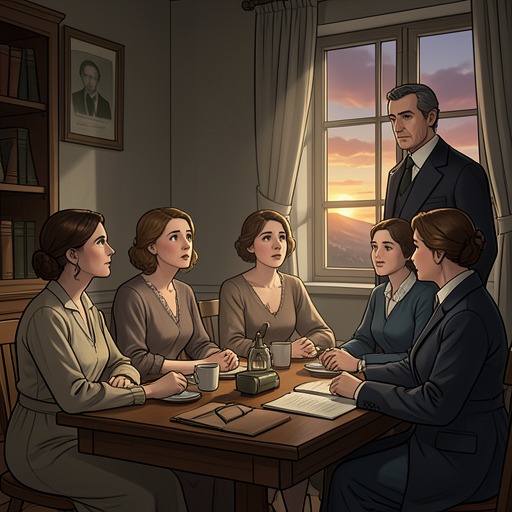
Elizabeth confesses her Pentland identity and hidden life to the Bennet sisters
Just DesertsElizabeth confesses her Pentland identity and hidden life to the Bennet sisters in the final days before her marriage to Fitzwilliam Darcy. The disclosure resolves more than eight years of concealment: it explains her absences, her unexpected authority and resources, her connection with Grenadine Reef, her first marriage to Sir David Pentland, and her status as a wealthy widow. It also tests the sisters’ loyalty, forcing Elizabeth to confront whether an act of secrecy undertaken to protect them can still be forgiven when it has excluded them from the truth.
Circumstances and Preparation
Elizabeth approaches the confession as both a duty and a risk. In the weeks before the wedding, she recognizes that her sisters may feel hurt or angry and fears that the revelation could rupture their relationships. She has corresponded with Jane Bennet, Mary Bennet, and Catherine Bennet on a three-week cycle, though the sisters share her letters, yet correspondence has not erased the central omission: they do not know the life she has lived beyond Longbourn. Elizabeth describes herself as having committed few sins of commission but many sins of omission, and the hidden Pentland life has weighed on her for years.
The timing gives the event particular pressure. Elizabeth’s marriage to Fitzwilliam Darcy is less than three weeks away, and her sisters are about to learn not only that she was previously married but that this marriage made her responsible for an estate and its people. The confession therefore stands between two identities: the sister they know as Elizabeth Bennet and the woman who has become Elizabeth, Lady Pentland. It is also linked to her efforts to secure each sister a dowry of £25,000, an act of practical protection whose scale they cannot understand until the secret behind it is disclosed.
The Confession at Grenadine Reef
When Jane Bennet, Mary Bennet, and Catherine Bennet arrive, Jane, ordinarily the most reserved and proper of the sisters, runs across the room and embraces Elizabeth so forcefully that Elizabeth’s feet leave the ground. Mary and Catherine follow with equally exuberant embraces, and the sisters talk over one another in their happiness at being reunited after 50 weeks. The warmth of the reunion establishes what is at stake before the disclosure begins: Elizabeth is not confessing to detached acquaintances but to sisters whose affection remains immediate even after a long separation.
Elizabeth announces that the story will last from lunch until dinner, and it does. Her account is lengthy enough to require repeated telling, and the sisters’ many questions make the scene an active examination rather than a one-sided speech. One question remains unasked but dominates the room: why Elizabeth did not tell them earlier. Elizabeth identifies the reason herself, observing the hurt in their eyes before any of them speaks. She explains that she did not want to force them either to lie to their parents or to reveal her secret. Her time with Sir David Pentland and Lady Radha Pentland had been precious, offering respite from Mrs. Bennet, and she would make the same choice again despite the guilt it caused her.
The confession includes Elizabeth’s formal identity. When asked for her official name, she answers that she is Elizabeth, Lady Pentland. She explains that the title had been deliberately concealed because a very rich widow would attract rakes and fortune hunters, making it safer to remain Miss Bennet in London. Yet prudence is only part of the explanation. Elizabeth does not emotionally claim the title as her own because Lady Radha Pentland had been married to Sir David for 35 years, whereas Elizabeth’s marriage lasted barely 35 hours. She considers Lady Radha the true Lady Pentland and regards her as the woman who changed Elizabeth’s life. Elizabeth therefore intends to relinquish the title within two days and become Mrs. Elizabeth Darcy.
The Life Behind the Secret
The sisters’ disclosure also opens onto Lady Radha Pentland’s history, which Elizabeth has inherited as both knowledge and moral instruction. Radha was born Radha Bhimani in Kutch in western India. Her mother died in childbirth, and she was raised by her paternal grandmother and aunts while her father served as a minor district official. Political and military conflict repeatedly displaced the family: they fled when the Mughal conquest threatened their Hindu community, returned after the Mughals were defeated, and were displaced again as British power arrived. Her childhood memories remain fragmented by the instability and danger of those years.
At an age only a year older than Elizabeth was when hearing the account, Radha was kidnapped for sale into slavery. She was rescued before the sale, but the rescue began another sequence of forced movements. A Spanish ship carrying priests took her from the coast of the Arabian Peninsula, taught her rudimentary Spanish, and carried her to Spain. There she was compelled to enter a nunnery outside Cadiz, where she remained cloistered for six years. At 21, she was selected, without meaningful choice, for a mission to South America and sailed from Cadiz toward Cartagena with 29 other members of her order.
That voyage ended in pirate capture. Radha suffered four days of pirate depredations and received a stomach wound that was considered nearly fatal. She was read the last rites, but continued fighting the infection after the surviving members of her order were landed under a white flag of neutrality. Too ill to be moved, she was left behind. Sir David Pentland took her into his large house in Bridgetown on Barbados, where his housekeeper and a nurse cared for her. She nearly died twice even under that personal care, but eventually recovered.
Radha’s survival did not protect her from social punishment. Although Sir David was a naval hero who had been knighted, Radha heard barbed comments almost as soon as her recovery appeared certain, including the claim that it would have been better if she had died. Her supposed fault was merely having lived near the coast in India and thereby becoming vulnerable to slavers. The treatment of her helped persuade Sir David to resign his naval commission. He and Radha returned to Britain, converted to the Church of Scotland, married near Edinburgh, and eventually bought Grenadine Reef, where they lived for 32 years.
Elizabeth presents Radha’s life not as distant biography but as a source of lessons. Alongside Madeline Gardiner, Radha taught Elizabeth what it meant to be a lady through practical care rather than social display. Radha was born in India, endured repeated kidnapping and pirate violence, could not bear children because of her injuries, and rarely appeared in society; Madeline Gardiner was the wife of a London tradesman, the mother of four children, and a frequent hostess supporting Edward Gardiner’s business. Their circumstances were radically different, yet Elizabeth learned from both that love was expressed through daily responsibilities. Tenant visits at Grenadine Reef helped her and Jane Bennet become more effective in caring for tenants at Longbourn, making estate welfare a concrete obligation rather than an abstract privilege.
Marriage, Widowhood, and Responsibility
Elizabeth’s first marriage is inseparable from the confession. Sir David, already in his sixties when Elizabeth entered his life, became increasingly concerned with what would happen to her after Lady Radha’s death and after Elizabeth reached adulthood. When his cancer was discovered, the longer-term plans he had considered could no longer be completed. The doctor doubted that he would live out the year; he suffered a constant ache, occasional spikes of pain, and a growing stomach lump, using a diluted laudanum solution at night to sleep.
Sir David proposed a marriage of convenience that would protect Elizabeth and preserve the estate’s future. He arranged for his brother James Pentland to witness the new will, the marriage settlement, and the wedding, while medical and magistrate statements established that Sir David remained of sound mind. The will and settlement directed almost everything, apart from specific bequests to James Pentland, his named children, his valet, and long-serving servants, to the widow. The arrangement depended on Elizabeth and Darcy putting their personal happiness on hold for a year, turning Sir David’s impending death into an emotional demand as well as a legal and financial one.
Six days after the proposal, Sir David married Elizabeth by common licence. He had to be carried into St. Andrew’s Church in a chair because he could no longer walk. Edward Gardiner escorted Elizabeth down the aisle, Lily served as maid of honour, James Pentland acted as groomsman, and Fitzwilliam Darcy attended with the Gardiner family. Servants and tenants filled the small church, making the ceremony a public declaration that Elizabeth was accepted as the new mistress of the estate. Sir David had converted to the Church of England after Lady Radha’s death so that he could worship locally, and the wedding was performed under its rites.
The wedding breakfast became more a tenant celebration than a conventional private wedding. Sir David, visibly suffering, soon withdrew to his room after taking a large dose of laudanum. He never left that bedroom alive. Elizabeth sat with him through long stretches of Friday and Saturday, reading aloud quietly, and woke on Sunday as his widow. He was buried beside Lady Radha in the small chapel, while Elizabeth reflected on the upheaval of her life and gave thanks for both lives that had shaped her. The inheritance did not simply enrich her; it placed the welfare of many tenants, servants, and dependants in her hands, making the concealed marriage a source of immediate governance and moral responsibility.
Family Response and Narrative Significance
Jane’s response converts the confession from a threatened family rupture into an affirmation of sisterhood. She reminds Elizabeth that Elizabeth rescued the family after Lydia Bennet nearly ruined it, covering Lydia’s stupidity without anyone knowing the extent of what she had done. Jane also learns that Elizabeth is working to obtain £25,000 dowries for each of the three younger sisters, a provision that, together with time in London, may allow them to marry well. Jane interprets Elizabeth’s life through the standard Elizabeth has long defended: Elizabeth is finally marrying for the deepest love, not merely for security or social advantage. The sisters embrace again, and the discussion turns from accusation toward the upcoming wedding.
The sisters also ask about Sir David’s death and the ceremony that preceded it. Elizabeth explains that she and Sir David married at the same church where she and Darcy are to marry, that he was carried there in severe pain, and that he became unconscious on Friday evening before dying early Sunday morning. The repetition makes the two marriages echo one another while preserving their essential difference: the first was a brief act of care and protection at the edge of death, while the second is the marriage Elizabeth openly chooses for love.
The event changes the sisters’ understanding of Elizabeth’s social identity. She has not merely been absent or unusually self-possessed; she has been a widow, an estate holder, a benefactor, and the successor to Lady Radha’s moral legacy. Her secrecy is shown as both protective and costly. Elizabeth wanted to spare her sisters from lying to their parents, yet the same choice deprived them of the chance to know the person she had become. Their forgiveness does not erase the tension. Instead, it recognizes that the concealment arose from loyalty, that Elizabeth’s hidden work benefited the family, and that she would still repeat the decision under the same circumstances.
As a narrative event, the confession gathers several delayed revelations into one sustained family scene. Lady Radha’s transcontinental history, Sir David’s terminal illness and last-minute legal arrangements, Elizabeth’s widowhood, her concealed wealth, and her impending marriage to Darcy all become legible at once. The long-held silence finally becomes speech, but not a simple confession of wrongdoing. It is an argument that love may require secrecy, that inherited titles do not necessarily define inner identity, and that a woman’s authority can be built through survival, care, estate management, and deliberate choice. Elizabeth emerges from the scene not by recovering the old identity of Miss Bennet, but by choosing openly which parts of her past will accompany her into marriage as Mrs. Elizabeth Darcy.