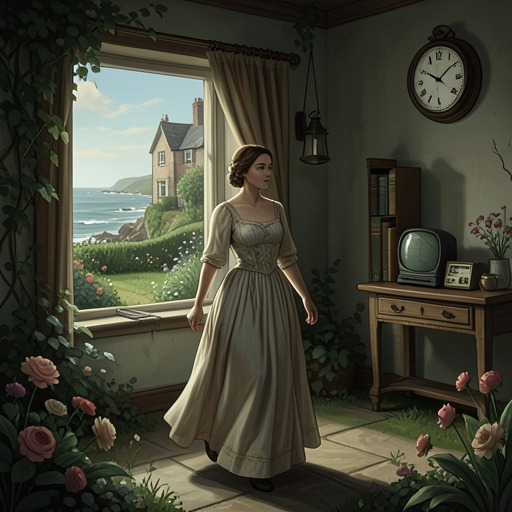
Elizabeth reveals her Grenadine Reef life to Darcy
Just DesertsElizabeth reveals her Grenadine Reef life to Fitzwilliam Darcy at the Gardiners’ residence, turning an incomplete acquaintance into a relationship founded on deliberate trust. Her disclosure includes the formative influence of her mother, her education through A Vindication of the Rights of Women, her understanding of estate management and marriage as shared responsibility, and the concealed fortune created by the Pentland legacy. The revelation does not diminish Darcy’s interest; it leads directly to his formal request for a courtship and Elizabeth’s acceptance.
The Setting and the Act of Disclosure
Elizabeth begins by admitting that she has previously given Darcy only an incomplete account of her life and now trusts him with more. The disclosure takes place over three hours and several cups of tea, while Mrs. Gardiner remains present to reassure Darcy that Elizabeth has always observed propriety and been properly chaperoned. The scene therefore combines intimacy with social safeguards: Elizabeth speaks personally, but the Gardiner household provides a public framework protecting the meaning of what she says.
The revelation is also an act of selection rather than a complete confession. Elizabeth has already learned from Lady Radha Pentland that a survivor may allude to what is too dark to recount without surrendering control over the story. Her account to Darcy similarly distinguishes between the truth of her life and the portions she is willing to expose. What changes is not simply the amount of information Darcy receives, but his recognition that the young woman he has been courting possesses a history far beyond the ordinary expectations attached to Miss Bennet.
Education and Intellectual Formation
One part of Elizabeth’s hidden life concerns the education that shaped her judgment. Her mother died when Elizabeth was twelve. Several years earlier, Elizabeth had repeated a commonplace that women were not rational enough to receive an education comparable to a man’s. Rather than punish her publicly, her mother gave her A Vindication of the Rights of Women to read. The book became a corrective to the belief Elizabeth had casually repeated and a foundation for her later understanding of women’s capacity and independence.
Elizabeth’s education was not confined to formal reading. She learned practical responsibility through the examples of Madeline Gardiner and Lady Radha Pentland, two women whose circumstances could hardly have been more different. Madeline was the wife of a London tradesman, the mother of four children, and a frequent hostess supporting Edward Gardiner’s household and business. Lady Radha was born in India, kidnapped three times, grievously abused by pirates, and left unable to bear children because of her injuries. Elizabeth presents both women as teachers of the same underlying lesson: a woman’s worth is expressed through love, judgment, work, and the practical realities of living responsibly.
That education also included estate administration. Elizabeth and Jane Bennet began visiting tenants when Jane was twelve and Elizabeth was ten. Their first efforts involved considerable trial and error, but the tenants themselves taught them how assistance could be made more effective. Elizabeth carried those lessons from Grenadine Reef into Longbourn, learning that the welfare of tenants is an obligation of estate ownership rather than a decorative expression of gentility.
The Pentland History Behind Grenadine Reef
Elizabeth’s account reaches back through Lady Radha’s extraordinary displacement. Radha Bhimani was born in Kutch in western India, lost her mother in childbirth, and was raised by her paternal grandmother and aunts. Conflict among the Mughals, the Marathas, and the British repeatedly forced her family to flee and return. When she was only a year older than Elizabeth was at the time of the disclosure, she was kidnapped for sale into slavery.
Radha was rescued off the coast of the Arabian Peninsula by a Spanish ship carrying priests. The rescue removed her from immediate enslavement but did not restore her freedom: she was compelled to enter a nunnery outside Cadiz and remained cloistered there for six years. At twenty-one she was sent, without meaningful choice, on a mission to Cartagena with twenty-nine other members of her order. Pirates captured the ship during the voyage, and Radha suffered a stomach wound that was nearly fatal before being rescued and carried to Barbados.
Sir David Pentland cared for her in his large house in Bridgetown with the help of his housekeeper and a nurse. After she recovered, he courted her and accepted the history of her abuse without treating it as a stain upon her. Social hostility toward Radha nevertheless helped drive him from the naval career in which he had earned distinction. He resigned his commission, returned to Britain, converted—willingly though superficially—to the Church of Scotland, and married Radha near Edinburgh. Their marriage eventually brought them to London and then to the estate they purchased in Hertfordshire, which they named Grenadine Reef after the reef where Sir David recovered Spanish treasure.
Wealth, Work, and Marriage as Partnership
The disclosure also explains why Elizabeth’s practical authority and financial position exceed what Darcy might expect from her family circumstances. Sir David’s reputation rested chiefly on his command of HMS Glory in 1770. During the hurricane season, his ship encountered a Spanish treasure galleon that had run aground on a reef near the Grenadine Islands. Sir David’s crew salvaged a substantial portion of the treasure before the wreck was destroyed and sank. He was knighted for the exploit, and his share of the prize funded the purchase of Grenadine Reef.
The Pentlands then preserved and expanded that wealth through restraint. They lived quietly, entertained little, did not maintain expensive London seasons, and had no children. Their surplus income was invested rather than consumed, and the resulting returns enlarged the surplus again. The investments later supported other investors and helped finance the expansion of Grenadine Reef and the purchase of smaller estates. Elizabeth’s understanding of money is consequently tied to stewardship: wealth is capital to be managed, used, and directed toward durable responsibilities.
Her commercial thinking is illustrated by her proposal concerning beer production. After asking the Gardiner household’s groom and male servants what beer they preferred, and arranging for Edward Gardiner to question warehouse employees and their acquaintances, she identified breweries in Alton and Lewes as possible sources. She then proposed acquiring acreage for hops and barley near those towns and investigating breweries in Southampton and Portsmouth, where merchant sailors and the Royal Navy created a substantial market. Sir David responds with admiration because Elizabeth turns a small observation about servants’ preferences into a chain of agricultural, brewing, and naval-market opportunities.
These details clarify why Darcy’s response is decisive. He has spent years considering what kind of wife could share the burdens of Pemberley, an estate of nearly 7,000 acres, as well as three smaller estates totaling another 4,000 acres in Scotland, Essex, and Dorset. He does not want a woman who merely enjoys the benefits of property; he wants a partner in its responsibilities. After hearing Elizabeth’s history, he asks for a courtship and explicitly states that nothing she has told him has lowered his opinion of her. Elizabeth accepts.
Consequences and Long-Term Significance
The immediate consequence is a value shift from guarded attraction to acknowledged partnership. Elizabeth’s hidden identity is no longer an obstacle that Darcy must interpret from fragments. Her experiences, education, and resources become reasons for greater respect, while Darcy’s response demonstrates that his courtship is directed toward an intellectually capable woman rather than toward a simplified image of Miss Bennet.
The revelation also makes later financial arrangements intelligible. The Pentland fortune ultimately leaves Elizabeth with roughly £400,000 in assets producing close to £20,000 annually after tax, following the distribution of Sir David’s Consols and other bequests. At Grenadine Reef, the remaining 1,000 acres around the dower house later support St. Vincent Lodge, named for the nearest large island to the site of the wreck. Elizabeth and Darcy use the estate not only as family property but as part of a carefully planned succession, dividing Grenadine Reef among their children and preserving the dower-house lands for a continuing family and charitable future.
As a narrative event, the disclosure is an analeptic revelation embedded in the forward movement of the courtship. The past is not offered as ornamental background: India, forced migration, piracy, naval salvage, investment, tenant welfare, and female education are all shown to have produced the woman Darcy is being asked to know. Elizabeth’s act of telling therefore does more than expose a secret. It establishes that her life has been shaped by survival and responsibility, and that any marriage worthy of her must recognize both.