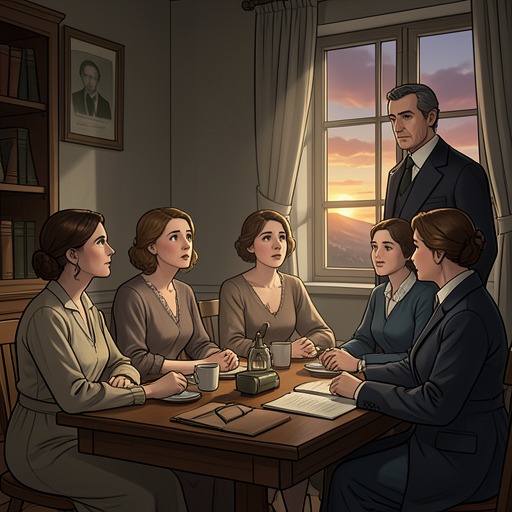
Elizabeth reveals her hidden life to her sisters
Just DesertsElizabeth reveals her hidden life to her sisters at the threshold of her second wedding, turning years of secrecy into an extended confession. The revelation discloses that she is Elizabeth, Lady Pentland, that her first marriage to Sir David Pentland was arranged during his terminal illness, and that her widowhood brought her substantial responsibility and wealth. It also explains why she remained publicly known as Miss Bennet and why she had protected her sisters from knowledge that might have forced them either to deceive their parents or expose her secret.
The Reunion and the Confession
When Jane Bennet, Mary Bennet, and Catherine Bennet saw Elizabeth for the first time in fifty weeks, Jane ran across the room and embraced her so forcefully that Elizabeth’s feet left the ground. Mary and Catherine followed with equally emphatic embraces, though without threatening Elizabeth’s ribs. Their reunion establishes the emotional setting for the disclosure: the sisters’ physical joy contrasts with the long absence and with the hurt that will surface once they understand how much Elizabeth has withheld.
Edward Gardiner and Madeline Gardiner joined the sisters, and the arrival of Fitzwilliam Darcy produced a second shock. The sisters had not expected him to be present, and Elizabeth announced that her account would occupy the afternoon, with lunch served in the room and questions answered as the story unfolded. She had already told the tale twice; this third telling is specifically shaped for the sisters, who must not merely learn the facts but understand why their sister kept them from them.
Elizabeth openly identifies the unasked question hanging over the room: why she had never told them. Her answer is not that the secret was insignificant, nor that she lacked affection for them. She says that she did not want to place them in the position of having to lie to their parents. Knowledge of her visits to Grenadine Reef and her connection with Sir David Pentland would have forced them either to participate in concealment or to betray Elizabeth by revealing it. The confession therefore presents secrecy as both a burden and a protective act.
The Hidden Life as Lady Pentland
The revelation includes Elizabeth’s official identity: “I am Elizabeth, Lady Pentland.” Her title derives from her marriage to Sir David, whom she married only six days after he proposed. By then, Sir David was dying of cancer. He told Elizabeth that the doctor doubted he would survive the year, described a growing lump in his stomach, and acknowledged a constant ache with occasional spikes of pain. He used a diluted solution of laudanum at night to sleep. His illness was not a distant possibility but a bodily fact that compressed every decision around him.
Sir David explained that he had begun considering Elizabeth’s future after Lady Radha Pentland’s death and after Elizabeth’s need to reach her majority so that she could escape Mrs. Bennet. Once cancer was diagnosed, long-term plans became impossible. He therefore proposed a marriage of convenience that would secure Elizabeth’s position, but he also understood that the arrangement demanded a year in which Elizabeth and Darcy would place their personal happiness on hold. His plan required a new will, a marriage settlement, witnesses, and a wedding, all organized while his strength was rapidly failing.
The arrangements were made with extreme speed. The will and marriage settlement placed almost everything, apart from specific bequests to James Pentland, his named children, Sir David’s valet, and other long-serving servants, in the hands of his widow. James Pentland agreed to witness the documents and the wedding, although the arrangement effectively required Sir David to secure his cooperation through substantial provision for him and his descendants. Elizabeth’s hidden life was therefore not merely a romantic secret: it was a legally structured transfer of responsibility, property, and social protection.
The wedding itself took place at St. Andrew’s Church under the rites of the Church of England. Sir David had to be carried into the church because he could no longer walk; Elizabeth was escorted down the aisle by Edward Gardiner, while Lily served as maid of honour. Madeline Gardiner’s family, Fitzwilliam Darcy, servants, tenants, and other members of the estate community filled the small church. The gathering functioned as a public acknowledgment of Elizabeth’s new position as mistress of the estate, even though the marriage lasted only about thirty-five hours.
Sir David never left his bedroom alive after the ceremony. Elizabeth sat with him for long periods, reading aloud on Friday and Saturday, uncertain whether he remained lucid enough to know that she was there. He died early on Sunday morning, leaving Elizabeth a widow almost immediately after becoming a wife. His death and burial beside Lady Radha Pentland made the title Lady Pentland inseparable from the memory of the woman who had held it for thirty-five years, and Elizabeth’s brief tenure explains why she refuses to treat the title as her essential identity.
Why Elizabeth Concealed the Truth
Elizabeth gives her sisters two reasons for continuing to appear in London as Miss Bennet. The practical reason is danger. As a very rich widow, she would have attracted rakes and fortune hunters, so remaining publicly identified as an unmarried Miss Bennet was safer. Because she had already been introduced under that name earlier in the year, people continued to address her as Miss Bennet, and neither she nor those around her corrected them.
The emotional reason is more complicated. Elizabeth does not think of herself as Lady Pentland. Lady Radha Pentland, who had been married to Sir David for thirty-five years, remains in Elizabeth’s mind the true Lady Pentland. Elizabeth had been married to Sir David for barely thirty-five hours, whereas Lady Radha’s long marriage defined the title and its memories. Elizabeth therefore regards the title as belonging morally and historically to Lady Radha, even though it belongs legally to Elizabeth after Sir David’s death.
Elizabeth tells her sisters that her years with Sir David and Lady Radha were precious and that the time at Grenadine Reef gave her respite from dealing with Mrs. Bennet. She also passed many of the lessons learned from them on to her sisters, often attributing those lessons to Madeline Gardiner. The secret life thus becomes part of the sisters’ shared history even before they knew its source: Elizabeth had been shaping their prospects and understanding from knowledge acquired elsewhere.
Her honesty does not erase her guilt. Elizabeth admits that the secrecy had tormented her for more than eight years and that she felt guilty for excluding her sisters from such a central part of her life. Yet the confession contains a firm refusal to renounce the decision. She would do it all over again, because protecting her sisters from the moral trap created by their parents mattered more to her than receiving their immediate understanding.
The Sisters’ Forgiveness and the Meaning of Love
Jane answers Elizabeth’s confession with forgiveness rather than accusation. She reminds Elizabeth that she is their sister and that she rescued the family when Lydia Bennet nearly ruined it. Elizabeth had not only concealed Lydia’s stupidity and redeemed the family’s position; she had done so without the sisters knowing the scale of her intervention. Jane also learns that Elizabeth is working to secure dowries of twenty-five thousand pounds for each of the three younger sisters, with time in London intended to give them opportunities to marry well.
This information changes the meaning of the confession. Elizabeth is not revealed as someone who escaped her family and left them behind. She is revealed as someone whose hidden life enabled her to protect and provide for them. The inheritance acquired through her marriage to Sir David becomes an instrument of sisterly responsibility, while the secrecy that caused pain is reinterpreted as the condition under which that protection could be carried out.
Jane also recognizes Elizabeth’s relationship with Darcy. She observes the way Elizabeth speaks of him and looks at him, and concludes that Elizabeth is about to do what Jane has always wanted for herself: marry “for the deepest love.” The phrase links Elizabeth’s first marriage and second marriage by contrast. Her marriage to Sir David was a necessary and protective arrangement made under the pressure of illness, succession, and time. Her marriage to Darcy represents the love that Elizabeth had postponed and is now free to choose.
The sisters’ repeated embraces, renewed tea, and practical questions about the approaching wedding restore the family bond without pretending that the secrecy caused no wound. Jane’s forgiveness makes room for both truths: Elizabeth acted lovingly, and Elizabeth’s actions still hurt those who were excluded. The disclosure is therefore not a simple unmasking but a negotiated recovery of intimacy.
Identity, Widowhood, and the New Marriage
Elizabeth explains that she will relinquish the title in two days and become Mrs. Elizabeth Darcy. The change is legally significant, but she presents it as emotionally appropriate. She does not claim Lady Pentland as a permanent self because her marriage to Sir David was brief and because Lady Radha’s life remains the title’s central memory. Her movement from Miss Bennet to Lady Pentland and then to Mrs. Darcy shows identity being shaped by protection, bereavement, and chosen partnership rather than by a single public name.
The confession also clarifies an earlier misunderstanding surrounding Darcy. Lady Catherine de Bourgh believed that Darcy was courting a Miss Bennet because he had indeed been courting Elizabeth before she returned to Grenadine Reef. When Elizabeth came back to London after Michaelmas, she was already Lady Pentland, though the public did not know it. Her continued presentation as Miss Bennet allowed the earlier social identity to remain in place and concealed both the marriage and the inheritance.
Elizabeth’s disclosure is consequently a final act of control over the narrative of her own life. She chooses the time, audience, and terms of the revelation, telling the sisters before her wedding to Darcy and explaining both the legal facts and the emotional logic behind them. The event converts a hidden history into family knowledge, secures Jane’s forgiveness, confirms the sisters’ material future, and prepares Elizabeth to enter her marriage to Darcy without allowing either her first marriage or her widowhood to be erased.