Elizabeth reveals the Pentland family history to the Gardiners
Just DesertsElizabeth reveals the Pentland family history to the Gardiners in a long, emotionally difficult disclosure that turns an apparently unusual friendship into the hidden framework of her intellectual and moral development. The account joins Elizabeth’s childhood meetings with Lady Radha to a much older history of forced migration, slavery, piracy, religious conversion, naval violence, marriage, and estate-building. It also shows why Elizabeth’s understanding of love and the social position of women cannot be separated from the example of the Pentlands.
Circumstances of the Revelation
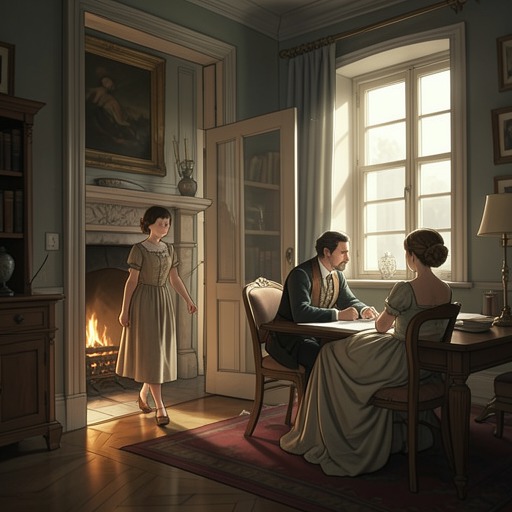
Elizabeth tells the Gardiners the complete story after arriving at Gracechurch Street in Sir David Pentland’s carriage. She first reassures Aunt Madeline that she is well but insists that the tale should wait until Sir David has returned, then sends word to Uncle Edward not to delay that evening. The disclosure is so extensive that Edward Gardiner does not attend his office the next morning. Elizabeth begins after an early dinner in the drawing room, and the Gardiners listen through a succession of emotions until she reaches the point at which she has arrived in London. She finishes close to midnight; Edward and Madeline continue discussing the account until nearly three in the morning before sleep overtakes them.
The conversation immediately exposes the social danger surrounding Elizabeth’s history. Madeline’s first question is whether Sir David took advantage of her, a possibility Elizabeth finds so offensive that she rises from her seat in anger. She distinguishes the adult woman speaking to her aunt and uncle from the thirteen-year-old child whose story began in 1804. Her objection is not merely personal: she invokes the principle that a person is innocent until proven guilty, while recognizing that society treats a young woman’s association with an older man as suspect regardless of the actual history.
At Madeline’s request, Elizabeth then agrees to supply not only facts and dates but also the feelings, intentions, and meanings that had been unavailable to her younger self. The resulting narrative is retrospective in both senses. Elizabeth remembers what she saw as a child, but interprets it with the knowledge acquired during the intervening years. She warns that the account may not remain fully linear, because her three central subjects—love, the conduct of a lady, and society’s unfairness toward women—are intertwined in memory.
Elizabeth’s First Meeting with Lady Radha
The story begins in the summer of 1804, when Elizabeth was thirteen. Mrs. Bennet was preoccupied with Jane Bennet’s social debut, and Elizabeth used the distraction to escape Longbourn. Her preferred route toward Oakham Mount could be seen from the parlour, so she deliberately went north instead of east to avoid being noticed and dragged back into the house. That small act of evasion led to her first meeting with Lady Radha.
Elizabeth is careful about the names used in recalling the relationship. For the first two and a half years she addressed Lady Radha as Lady Pentland; on Elizabeth’s sixteenth birthday, Lady Radha asked her to use the latter’s given name, and Elizabeth has thought of her as Lady Radha ever since. Sir David, by contrast, remained Sir David Pentland throughout Elizabeth’s acquaintance with him. She notices that social rank determines forms of address: knights may not easily be called by their given names, while unknighted men are addressed as Mr. Goulding or Mr. Long, even when their given names are unknown. The observation becomes an early example of the class conventions Elizabeth learned to perceive rather than simply obey.
From 1804 onward, whenever the weather allowed, Elizabeth visited Lady Radha once or twice a week for two or four hours. She describes the visits as gradual education rather than a single formal instruction. Lady Radha taught her about love, about how to be a lady, and about the unfairness society directed toward women. Elizabeth emphasizes that she did not understand the full subtext of Lady Radha’s explanations at thirteen. At the time she recognized that certain treatment had been unkind or wrong; only later did she grasp how deeply social judgments were shaped by gender, reputation, foreignness, and the assumption that a woman’s suffering was somehow her fault.
Lady Radha’s Transnational History
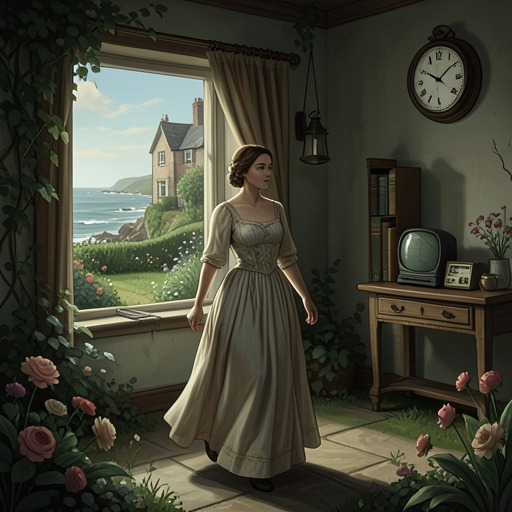
Lady Radha’s history gives Elizabeth’s private education a global and violent background. Born Radha Bhimani in Kutch in western India, she lost her mother in childbirth and was raised by her paternal grandmother and aunts. Her father was a minor district official, and the family moved repeatedly as power shifted among the Mughals, the Marathas, and the British. Because the family was Hindu and the district was conquered by Muslim rulers, they fled and later returned when those rulers were defeated; the subsequent arrival of the British created another period of instability. Lady Radha describes her childhood memories as fragmented, with the sequence of events difficult to reconstruct.
When she was only a year older than Elizabeth was at their first meeting, Lady Radha was kidnapped for sale into slavery. She was rescued before the sale took place, but the rescue removed her permanently from her birthplace. A Spanish ship carrying several priests found her off the coast of the Arabian Peninsula. The priests kept her safe during the remainder of the voyage and taught her rudimentary Spanish, but that safety came at the cost of another forced relocation: on reaching Spain, she was compelled to enter a nunnery outside Cadiz, where she remained cloistered for six years.
At twenty-one, Lady Radha was selected, without any say in the decision, to join a mission to South America. In the spring of 1772 she and twenty-nine other members of her order sailed from Cadiz toward Cartagena on the Spanish Main. The ship was captured by pirates during the voyage. Lady Radha alludes to what happened during four days in pirate hands rather than describe it fully, telling Elizabeth that some parts are too dark for a young listener and that she will not shatter Elizabeth’s innocence by narrating them directly.
Her account nevertheless establishes the scale of what she survived. She was not merely displaced once but carried across several imperial and religious worlds: Kutch, the Arabian Peninsula, Spain, the Spanish Main, Barbados, and Britain. She was an Indian woman who spoke Spanish, a forced nun left behind after a pirate attack, and a survivor of violence whose identity could not be contained by the categories available in British society. The disclosure therefore makes her life more than a piece of family background; it reveals the human cost concealed beneath imperial travel, religious institutions, naval power, and colonial wealth.
Rescue, Marriage, and Grenadine Reef
Lady Radha’s survival depended first on endurance and then on deliberate care. After being stabbed in the stomach during the pirate ordeal, she was given the last rites, yet continued to resist the infection that should have killed her. The surviving members of her order were put ashore under a white flag and continued their journey, while she was too ill to be moved and was left behind. When the survivors reached Barbados, Sir David Pentland took her into his large house in Bridgetown, where his housekeeper and a nurse helped care for her. She nearly died twice even under that personal attention, but eventually recovered from the wound and its final infection.
Lady Radha’s position remained precarious after her physical recovery. She moved into the home of a widow known to Sir David in order to preserve propriety, and Sir David began to court her. Before accepting his attentions, she disclosed what she could about the four days before her rescue. His response was that the past did not alter his regard for her. The marriage joined two people whose lives had been shaped by different imperial worlds, while refusing to treat Lady Radha’s victimization as a stain upon her. Sir David’s decision to leave the navy was prompted in part by the barbed comments directed at her on Barbados, including suggestions that it would have been better if she had died. They returned to Britain, married near Edinburgh after her willing but superficial conversion to the Church of Scotland, and moved to London after their wedding journey.
The estate they later purchased took its name from the event that made their wealth possible. In 1770, Sir David had commanded HMS Glory, newly appointed to the West Indies station after a refit in Plymouth. The Admiralty ordered the ship to sail despite the beginning of hurricane season. HMS Glory survived the storm with damaged spars, bruises, and one broken leg among the crew, but a Spanish treasure galleon attempting to reach Havana was wrecked on a reef near the Grenadine Islands. Two days later, Sir David’s ship found what remained of the hull and salvaged a substantial portion of its treasure before the wreck was destroyed and sank. The exploit brought him a knighthood and supplied his share of the prize money for the purchase of Grenadine Reef, an estate situated more than fifty miles from the sea.
Love and the Education of a Lady
Elizabeth’s disclosure is also an argument about what love looks like when sustained beyond the first years of marriage. In 1804 she viewed the Bennet household as a place where love had disappeared, while the Gardiners offered the example of a marriage still in its first and second decades. The Pentlands provided a longer test: they had already been married for thirty-two years, yet their affection remained visible, consistent, and more demonstrative than polite society usually permitted without becoming improper. Elizabeth’s childhood visits allowed her to observe not a performance for guests but a settled habit of mutual attachment.
That contrast gave substance to a phrase Elizabeth and Jane Bennet had repeated without understanding it. The Pentlands showed her what enduring love meant in practice, while the unhappy atmosphere at Longbourn showed her what marriage became when that bond was absent. Her later account therefore treats love not as an ornamental ideal but as a standard by which domestic life, future choices, and the conduct of husbands and wives could be judged. Lady Radha’s marriage was especially powerful as an example because it had survived displacement, bodily injury, public cruelty, and more than three decades of shared life.
Lady Radha’s instruction extended beyond romance. Elizabeth says that she learned how to be a lady through the examples of Lady Radha and Madeline Gardiner, despite their very different circumstances. Madeline was the wife of a London tradesman, the mother of four young children, and a frequent hostess who supported Edward Gardiner’s business as well as his social life. Lady Radha was a shy woman born in India, kidnapped three times, gravely injured by pirates, unable to bear children because of those injuries, and rarely present in society. Their similarity, in Elizabeth’s account, lay in the practical work of living: hospitality, judgment, responsibility, care for others, and the ability to act with dignity without allowing social approval to define one’s worth.
The lessons were reinforced by Elizabeth’s visits to the tenants of Grenadine Reef. Jane Bennet had begun accompanying tenant visits at twelve, and Elizabeth had joined her even earlier. Lady Radha’s example made those visits more efficient and humane, because Elizabeth learned to understand the estate’s tenants not as an abstract obligation but as people whose welfare belonged to its management. The education was cumulative and often indirect. Elizabeth absorbed innumerable small practices without recognizing each one as a lesson, then carried them back into Longbourn’s poorer and less effectively managed world.
Wealth, Management, and Continuing Influence
The Pentland history also explains why Grenadine Reef could support the expansive responsibilities later associated with it. Sir David’s salvaged Spanish treasure was described as one of the richest prizes ever taken by the Royal Navy. He used part of it to buy a substantial estate and placed the remainder in the Consols. The Pentlands then lived quietly and almost frugally: they entertained little, did not spend the London seasons in an expensive townhouse, had no children, and avoided the accumulated costs of additional horses, education, university, Grand Tours, and daughters’ dowries. Their surplus income was invested year after year, and the returns enlarged the capital available for further investment.
This financial discipline made the estate more than a monument to a naval exploit. Money was transferred from the original investments to double the size of Grenadine Reef and to purchase smaller estates. Elizabeth also learned to extend the same practical intelligence into new ventures. When servants and workers were asked what beer they preferred, the inquiry identified breweries in Alton and Lewes; she proposed acquiring acreage for hops and barley near those locations and investigating breweries in Southampton and Portsmouth, where merchant sailors and the Royal Navy created substantial demand. Sir David admired the way one question expanded into several connected investment opportunities, showing that Elizabeth’s education had prepared her to reason about labor, consumption, land, and commerce together.
Sir David’s later illness gives the family history a final, painful dimension. He tells Elizabeth that he is dying of cancer and that the doctor doubts he will survive the year. A growing lump in his stomach causes a general constant ache with occasional spikes of pain; he takes a diluted solution of laudanum before retiring to help him sleep. Elizabeth asks directly whether he is in pain and whether he is receiving laudanum, treating his condition as a reality to be discussed rather than concealed behind ceremony. His illness transforms the Pentland legacy from a story of survival and marriage into a question of care, succession, and what can be preserved after the founding generation is gone.
After Sir David’s death, the scale of the fortune becomes clear. He left £50,000 in the Consols and a further £25,000 to his brother, while Elizabeth received £400,000 in assets producing nearly £20,000 a year after tax. The inheritance reflected not only the original treasure but decades of restrained expenditure and reinvestment. In the next generation, Elizabeth and Fitzwilliam Darcy divided the estate into planned portions for their children: Helena Darcy was to receive 3,000 acres of Grenadine Reef, David 2,000 acres, Richard the former Longbourn lands, and the remaining children inheritances in Scotland, Dorset, and Kent. The final 1,000 acres around the dower house were retained as a distinct portion.
That last portion became St. Vincent Lodge, named after the nearest large island to the place where Sir David discovered the wrecked treasure ship. Elizabeth, Darcy, and their children used the lodge when visiting the estate, while Edward and Madeline Gardiner were intended to move there when Helena entered her inheritance. Annabel, Helena’s older cousin, had long helped run the dower house and showed no immediate wish to marry; the St. Vincent estate was eventually intended for her, with a niece or cousin of the next generation as heiress. The future arrangement extends the original revelation beyond private memory: Lady Radha’s and Sir David’s lives continue to shape property, refuge, family responsibility, and female inheritance long after their deaths.
Narrative and Thematic Significance
The revelation is structured as a remembered story rather than a simple chronological report. Elizabeth first gives the Gardiners the factual outline, ending with her arrival at Gracechurch Street, and only afterward returns to add feeling, intention, and retrospective interpretation. She openly acknowledges that later knowledge has altered the way she understands her childhood encounters. The account consequently moves between the thirteen-year-old who listened without grasping the social subtext and the adult woman who can identify the injustice directed at Lady Radha and at women more generally.
Its fragmented movement is appropriate to the history being recovered. Lady Radha’s own memories of Kutch are uncertain because war repeatedly displaced her family, while the most violent part of her pirate captivity remains deliberately unspoken. Elizabeth preserves that silence rather than converting suffering into spectacle. Yet the omission does not erase the event; it makes the limits of testimony part of the disclosure. The Gardiners are asked to become witnesses to a history whose full details cannot be safely or ethically narrated to the younger Elizabeth who first heard it.
The conversation therefore changes the meaning of Elizabeth’s relationship with the Pentlands. What might have looked like an eccentric friendship between a young country girl and an older couple becomes the foundation of Elizabeth’s education in love, social rank, estate management, global violence, and women’s restricted agency. It also explains why she resists the insinuation that Sir David exploited her: the revelation is not a secret romance but an account of long-term mentorship, friendship, care, and moral formation. By telling the Gardiners, Elizabeth converts a hidden life into shared family knowledge, while preserving the Pentlands’ history as an active inheritance rather than a closed chapter.