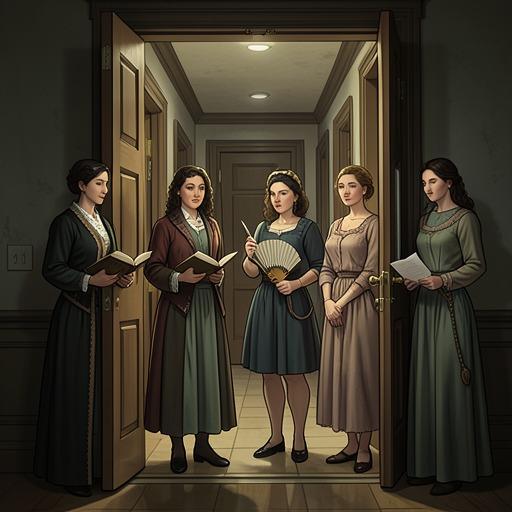
Fanny Bennet
Just DesertsFanny Bennet, known in the family as Mrs. Bennet, is the mother of five daughters and one of the principal forces shaping life at Longbourn. Her character combines genuine fear, social insecurity, emotional volatility, and a relentless determination to secure her daughters through marriage. Because the estate is entailed away from the female line and she can bear no more children, she treats the prospect of being thrown into the hedgerows as an ever-present catastrophe. Her panic gives domestic marriage strategy the force of an emergency, but her methods turn the home into the very place from which Elizabeth Bennet and, eventually, other daughters seek distance.
Identity and Domestic Position
Fanny Bennet is the daughter of a country solicitor and is described as not gentle born. Her position within Longbourn is therefore insecure in both class and inheritance terms. She has not produced a son who could break the entail, and this fact becomes central to her sense of failure and vulnerability. Since the birth of Lydia Bennet, her youngest daughter, eight years before the opening events, her anxiety has become progressively more nervous, shrill, and panicked. The entail is not an abstract legal arrangement to her: it determines whether she and her daughters will retain a home and social standing.
That insecurity shapes her understanding of motherhood. She projects the repair of her own perceived failures onto the daughters, expecting them to accomplish through advantageous marriages what she could not accomplish through childbirth or property. Jane Bennet, whose beauty and modesty make her appear the most promising candidate, is repeatedly presented as the family’s saviour. Fanny Bennet’s refrain is that Jane Bennet cannot be so beautiful for nothing and will marry a rich man who will save them. Elizabeth Bennet, by contrast, is judged against Jane Bennet and found wanting, not because she lacks beauty or intelligence, but because she resists the conduct Fanny Bennet believes marriage prospects require.
Temperament and Emotional Rule
Fanny Bennet governs Longbourn through noise, complaint, and emotional escalation. On one morning, her voice has already become shrill for what seems like the tenth time, prompting Elizabeth Bennet to seize her spencer and escape through the kitchen. The cook’s warm roll and Elizabeth Bennet’s bright smile offer a small counter-image to the maternal atmosphere: practical kindness from below stairs is more comforting than the attention available from the mistress of the house.
Her nerves function as both a bodily distress and a social instrument. Fanny Bennet invokes them to express outrage, recruit sympathy, and make the whole household respond to her state. When Elizabeth Bennet leaves Longbourn for the Gardiners’ household in London, Fanny Bennet is simultaneously outraged and pleased, an unstable combination that takes days to subside. Once the immediate crisis passes, her attention returns to the remaining daughters and the hedgerows again dominate her conversation. Her emotional intensity is therefore not incidental to the family’s operation; it allocates attention, sets the household’s mood, and determines which daughter must manage the next disturbance.
This emotional economy places much of the burden of regulation on Jane Bennet. Jane Bennet calms her mother, settles bruised egos and perceived slights, mediates quarrels among the sisters, and helps Kitty Bennet endure Lydia Bennet’s behaviour. Elizabeth Bennet learns a different strategy. She eventually decides that fighting with Fanny Bennet achieves nothing, that appealing to Thomas Bennet merely encourages his sport at his wife’s expense, and that Fanny Bennet will not listen or change her opinion. By internally dismissing her mother’s judgments and ceasing to react to every provocation, Elizabeth Bennet makes Longbourn somewhat calmer while also recognising the limits of filial influence.
Conflict with Elizabeth Bennet
Fanny Bennet’s relationship with Elizabeth Bennet is defined by mutual opposition but unequal power. Elizabeth Bennet is the most academically gifted and intellectually curious of the daughters, sharing with Thomas Bennet a bond through books and curiosity about the world. Fanny Bennet interprets these qualities as liabilities. She berates Elizabeth Bennet for reading with her father, walking about the countryside like a hoyden, and appearing unladylike. After Elizabeth Bennet’s social debut, Fanny Bennet also repeatedly tells her that she is not as pretty as Jane Bennet, a comparison Elizabeth Bennet later recalls as nearly daily.
Elizabeth Bennet is not Fanny Bennet’s favourite child. The two have disagreed for as long as Elizabeth Bennet can remember, and harsh words have become habitual. Yet the hostility is not simply personal dislike. Fanny Bennet wants Elizabeth Bennet to become an instrument of rescue, while Elizabeth Bennet insists on being treated as a person whose marriage must involve consent and love. When William Collins proposes, Elizabeth Bennet rejects the idea that a bride can be forced to marry or that she should be sold for Longbourn’s sake. She states that the refusal has nothing to do with affection for William Collins and everything to do with refusing a transaction imposed by her mother.
The conflict sharpens because Elizabeth Bennet comes to doubt whether Fanny Bennet has ever loved her. Elizabeth Bennet can identify the love of Jane Bennet and Mary Bennet, the supportive familial affection of Madeline Gardiner, and the grandfather-like love of Sir David Pentland. Her parents’ love, however, becomes qualified by the absence of respect and by the sense that Fanny Bennet values Longbourn more than the daughter whose marriage is supposed to preserve it. Elizabeth Bennet’s withdrawal is therefore not a sudden rebellion but the conclusion of years in which maternal protection has been experienced as criticism, pressure, and control.
Marriage Pressure and Family Blame
Fanny Bennet’s fixation on marriage produces a pattern of misplaced blame. She directs William Collins away from Jane Bennet because Charles Bingley is attending Jane Bennet, but when William Collins quickly becomes engaged to Charlotte Lucas and Charles Bingley leaves the neighbourhood, Fanny Bennet treats the result as Elizabeth Bennet’s fault. Jane Bennet repeatedly explains that she herself chose to refuse William Collins, yet Fanny Bennet refuses to accept the explanation. The mother’s fear requires a culprit, and Elizabeth Bennet is the daughter most available for punishment because she will not submit quietly.
Fanny Bennet also interprets Elizabeth Bennet’s independence as selfishness. After Elizabeth Bennet has endured more than eight weeks of being called selfish, including on Christmas Day, Elizabeth Bennet begins to wonder whether she must accept the identity her mother has imposed. The accusation reveals the moral reversal at the heart of Fanny Bennet’s conduct: the daughter who refuses to surrender her future is called selfish, while the mother who demands that her children solve the family’s property crisis is treated as desperate but understandable.
When Elizabeth Bennet leaves Longbourn permanently, the household appears calmer on the surface, but Jane Bennet and Mary Bennet sense that tension remains. Jane Bennet’s recollections expose the asymmetry of Fanny Bennet’s treatment: she cannot remember her mother being kind to Elizabeth Bennet, while she can remember being told continually that her own beauty would save the family. Fanny Bennet has thus distributed different forms of pressure among the daughters. Elizabeth Bennet receives reproach for failing to conform; Jane Bennet receives idealisation and the obligation to redeem everyone.
Estrangement and Final Significance
Fanny Bennet’s inability to change becomes the reason Elizabeth Bennet chooses separation over reconciliation. Elizabeth Bennet tells her sisters that the secrecy surrounding her visits to Sir David Pentland and Lady Radha Pentland protected them from having to lie to their parents or reveal her secret. She also explains that the Pentlands’ company gave her a respite from dealing with Fanny Bennet and supplied lessons that she later passed on to her sisters, often giving Madeline Gardiner credit. The contrast is decisive: the older women outside Longbourn educate Elizabeth Bennet through conversation, care, and responsibility, whereas Fanny Bennet attempts to educate through surveillance, criticism, and fear.
After Elizabeth Bennet’s marriage to Fitzwilliam Darcy, she states that she no longer thinks of or calls Fanny Bennet “mother” and has not done so for more than a year. She refuses to knowingly be in Fanny Bennet’s company again and excludes her parents from the wedding, choosing Madeline Gardiner to walk her down the aisle while her sisters attend. This is not presented as an impulsive punishment but as a boundary formed after prolonged emotional injury. Elizabeth Bennet wants the wedding to be joyful and free from Thomas Bennet’s sardonic comments, Fanny Bennet’s attempts to make the day about herself, and her inappropriate remarks.
The later family history confirms that Fanny Bennet’s conduct drives her children outward while leaving her unaware of the cause. She asks about the social debut of a child who is not yet fourteen, and Elizabeth Bennet concludes that Fanny Bennet has driven her children away without seeing that she has done so. Catherine Bennet’s marriage to Nicholas Charrington, an heir to a substantial brewing fortune, produces another rupture when Fanny Bennet tries to forbid the match because he is in trade; the relationship is poisoned until the birth of grandchildren brings mother and daughter back into one another’s company. Fanny Bennet therefore remains a figure of recurring family pressure rather than completed moral transformation.
Fanny Bennet’s narrative significance lies in the way private emotion is joined to property law, class insecurity, and the unequal labour of family survival. Her fear of the entail is materially grounded, but it becomes destructive when translated into coercive marriage expectations and relentless emotional demands. Jane Bennet’s calming labour, Elizabeth Bennet’s refusal to react, and the daughters’ eventual departures expose the hidden cost of her campaign. Fanny Bennet wants marriage to preserve the household; instead, her methods help make the household uninhabitable for the daughters she intends to save.