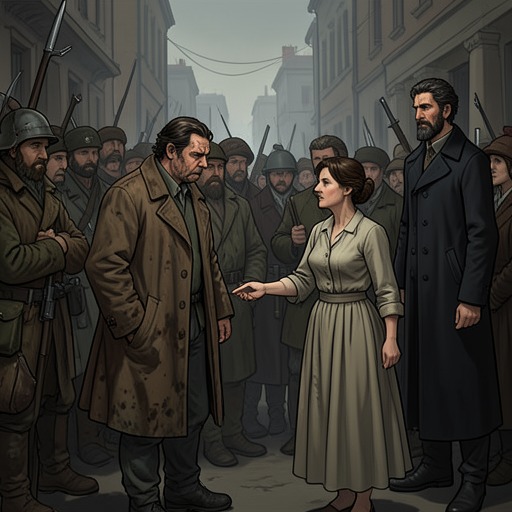
George Wickham
Just DesertsGeorge Wickham is presented as a handsome, socially fluent officer whose charm functions as a mask for deception and exploitation. His short appearance in Hertfordshire drives several major conflicts: he revives Fitzwilliam Darcy’s unresolved enmity, attracts Lydia Bennet through flattering attention, forces Elizabeth Bennet to confront Darcy’s failure to protect the neighbourhood, and becomes the object of a posthumous argument between formal law and natural justice. Wickham’s death ends his immediate threat, but it does not erase the damage caused by the men and institutions that enabled him.
Arrival in Meryton and Social Persona
George Wickham enters the local story when he joins the militia stationed near Meryton as a lieutenant. He is introduced while walking with Lieutenant Denny, and his handsome appearance, easy conversation, and apparent charm make him a welcome relief to Elizabeth Bennet after the stiffness and self-importance she associates with William Collins. His social success depends on speed and polish: he presents himself as agreeable before anyone has time to test the substance beneath his manners.
That persona changes sharply when Fitzwilliam Darcy encounters him. Darcy’s face becomes red with loathing, and he turns his horse away rather than greet the group. Wickham, although visibly pale, responds with an insolent sneer and tips his hat. The exchange gives Elizabeth an immediate sign that Wickham and Darcy share a serious history, while Wickham’s composure suggests that he already understands how to turn a hostile encounter into a story in which he can appear wronged.
Wickham soon asks after Darcy and remains socially available to the Bennet circle. He and Lieutenant Denny are invited to cards at the Philips household, placing him within the informal network through which information, courtship, and reputation circulate in Meryton. His military uniform and conversational ease amplify his attractiveness, especially to the younger Bennet sisters, while also increasing the danger created by his proximity to inexperienced women.
The Fabricated Tale and Elizabeth’s Suspicion
Wickham recounts a tale of personal injury that appears to confirm Elizabeth’s existing prejudices against Fitzwilliam Darcy. She is initially willing to listen because the story offers an apparently coherent explanation for Darcy’s hostility. Yet as Wickham continues, she notices lies, contradictions, and missing pieces. The account is too polished and too rehearsed, and she nearly interrupts him repeatedly before deciding that continued listening will reveal more than an immediate challenge.
Elizabeth’s suspicion is not merely intuitive. She proposes introducing Wickham to her uncle, Edward Gardiner, an attorney in Meryton, so that a legal remedy might be explored if Wickham has genuinely suffered the wrongs he claims. She also suggests William Collins as a possible guide if Wickham truly wishes to take orders. The proposal quietly tests whether Wickham wants evidence, law, and accountability rather than sympathy alone. His story is therefore placed against institutions capable of examining it, and his apparent grievance begins to look like a rehearsed instrument of manipulation.
The deception has a wider moral cost because Fitzwilliam Darcy knows that Wickham is a liar, a cheat who leaves debts with shopkeepers, and a practiced seducer, yet has not warned the people of Meryton. Darcy later admits enough of Wickham’s conduct to confirm the danger, but his silence leaves local tradesmen and young women exposed. Elizabeth’s anger is directed at both men: Wickham for the harm he causes, and Darcy for allowing inherited privilege and concern for private reputation to protect him.
Predation and the Threat to Lydia Bennet
Elizabeth becomes especially concerned that Wickham may exploit Lydia Bennet. Wickham is nearly twice Lydia’s age, while Lydia has only recently turned fifteen and repeatedly declares that she wants to be the first of her sisters to marry. Elizabeth recognizes that Lydia’s fantasies of early marriage may make her complicit in her own endangerment, not because the responsibility belongs to her, but because Wickham can use precisely what she longs to hear against her.
Elizabeth’s knowledge of the women assisted by the refuge at Grenadine Reef sharpens this judgment. She has heard of young women seduced by smooth-talking men who promise love, take what they want, and abandon them. The woman is then labelled fallen and unsavoury, while the man walks away with his reputation largely intact. Wickham is not conclusively identified as the author of every such injury, but Elizabeth considers his lying enough to make trust impossible. His danger lies less in open violence than in the persuasive social performance that makes exploitation resemble romance.
The militia setting magnifies the risk. A large body of unfamiliar officers has entered the district, and Elizabeth has been warned that merely walking unescorted now carries greater danger. Wickham’s uniform, mobility, and access to young women give him opportunities that ordinary local scrutiny might not immediately restrain. His military identity therefore operates as both attraction and protection: it grants status while making his movements seem respectable.
Death by Drowning
Wickham is found dead after falling into the river. Evidence at the bank indicates that he slipped down the bank: fabric from his uniform coat was caught on a branch and matched the torn sleeve found on his body. A half-drunk bottle of brandy, stolen from the inn beside the river, was also discovered. The public explanation is thus accidental drowning brought on by drunkenness and theft rather than a formal act of violence.
The news initially produces shock but little surprise among the older Bennet sisters. Given Wickham’s habits, Elizabeth imagines that fathers and brothers may have been seeking revenge for the women he harmed. His death appears to be a fitting end for a debauched man who had become a local blight, and Elizabeth struggles to conceal her satisfaction. The scene places his fate within the language of deserved punishment even while the available evidence supports an accident.
Later, Elizabeth’s satisfaction becomes less secure. During a journey with Vivian Harkness, she begins to wonder whether the circumstances conceal a deliberate killing. She cannot find a polite way to ask whether Vivian or someone connected with the refuge killed him, and the question remains unspoken. The law and her religious upbringing conflict with her sense of natural justice: Wickham had fathered three children with three different mothers and ruined more than ten other women, including women who had not freely consented to what he did. The possibility that his death was vengeance therefore troubles Elizabeth without making her regard him as deserving of protection from all consequences.
Legacy and Narrative Function
Wickham’s death also exposes Fitzwilliam Darcy’s moral failure. Darcy had known the truth about Wickham for years and had allowed him to continue operating behind a façade of goodness. When Elizabeth confronts Darcy, she makes clear that her real accusation is not that he failed to refute every lie, but that he did nothing to protect people who lacked the power to defend themselves. Darcy is stunned by her judgment that he is no gentleman, and his fascination with her intensifies precisely because she identifies the social responsibility he has evaded.
After Wickham dies, Darcy is surprised when Elizabeth says that no action is required because the lieutenant is dead. His death has not resolved the underlying problem: the debts, ruined women, natural children, and endangered reputations remain part of the community’s burden. The story later confirms that Wickham’s conduct had been worse than public gossip suggested, since Caroline Bingley’s private letter contains material that could have caused severe consequences for Fitzwilliam Darcy’s innocent sister, Georgiana Darcy, had it been believed or misused. Wickham’s power lies in the circulation of damaging stories as much as in direct seduction.
Wickham therefore serves as a contrast to the women and men who respond to abuse through protection, refuge, and practical responsibility. The Grenadine Reef household supports women recovering from violence, while Elizabeth’s later concern for disabled former soldiers extends that ethic of care beyond the immediate victims of Wickham’s conduct. Against this network of repair, Wickham represents predation without accountability: a man who converts charm, rank, and mobility into instruments of harm, and whose accidental or retaliatory death cannot restore what his manipulation has taken from others.