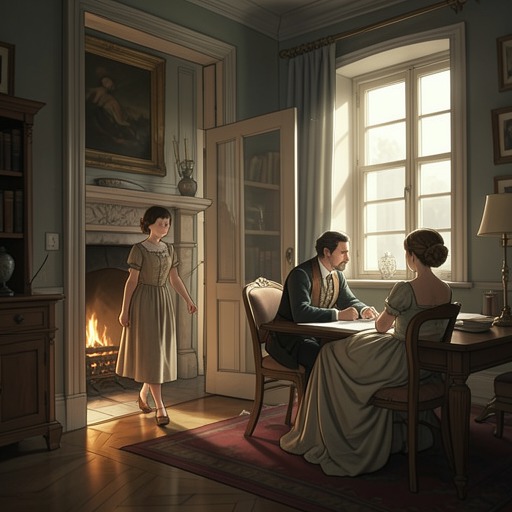
Gracechurch Street
Just DesertsGracechurch Street is the London residence of Edward Gardiner and Madeline Gardiner, but in the course of the narrative it becomes much more than an address. It is the place where Elizabeth Bennet escapes the instability of Longbourn, finds familial protection without coercion, establishes a disciplined routine of charity and learning, and continues her courtship with Fitzwilliam Darcy under careful supervision. The house therefore functions as a refuge and as a staging ground for independence: a private domestic space from which Elizabeth can enter public London while preserving her safety, reputation, and concealed wealth.
Refuge from Longbourn
Elizabeth decides that she cannot return to Longbourn after leaving it. She tells Edward Gardiner and Madeline Gardiner that she wishes to accompany them back to London, initially presenting the move as a temporary winter arrangement but admitting that she must face the possibility of never returning. Although she offers to find work as a companion or governess so that she will not burden them, Edward refuses the proposal. He points out that she will soon reach the age of majority, that his business is prospering, and that the household is large enough to accommodate her; he also reminds her that she can help with the children and that they will welcome their favourite cousin.
The emotional importance of this offer is immediate. In the Gardiner household Elizabeth experiences a form of familial love that she has not received from Thomas Bennet and Fanny Bennet. She loves Jane Bennet and Mary Bennet, and recognizes that Sir David Pentland loves her as though she were his granddaughter, but the Gardiner home makes her distinguish affection from parental protection. She concludes that her parents have provoked and failed to protect her so consistently that she neither respects nor trusts them. Gracechurch Street thus represents not merely physical removal from conflict but a redefinition of what a safe family can be.
Elizabeth initially plans to leave Longbourn by post-stage, carrying her money for a hackney cab from London and leaving a note with Uncle Philips in Meryton. Sir David Pentland rejects this as unnecessarily dangerous. Instead, Vivian Harkness is to meet Elizabeth near the estate boundary with a phaeton; Elizabeth will then transfer to Sir David’s coach, accompanied by Vivian and Violet Harkness, the coachman, and two footmen. The dated but comfortable carriage takes her the less-than-thirty-mile journey to London, where Gracechurch Street becomes her new home.
Domestic Order and Letters
Life at Gracechurch Street quickly settles into the routine Elizabeth had hoped for but could not have created at Longbourn. Her first letter after arriving thanks Sir David for transporting her directly to the house and notes that, despite four children under twelve living under its roof, the atmosphere is calmer than at Longbourn. The first days are occupied by extensive conversations with Madeline and Edward, particularly about Elizabeth’s life and her connection with Sir David and Lady Radha Pentland. The house gives her enough emotional steadiness to think about her sisters without being overwhelmed by the constant disorder she has left behind.
The correspondence arriving at Gracechurch Street makes the contrast with Longbourn sharper. Elizabeth receives five letters soon after her arrival. Jane Bennet and Mary Bennet write with love, while Kitty Bennet sends a short letter that strengthens her relationship with Elizabeth; their correspondence remains irregular, but the act of writing matters even when the letters contain little news. Lydia Bennet does not write. Fanny Bennet’s letter is so vitriolic that Elizabeth drops it before finishing it, and Edward, after receiving permission to read it, burns it. Thomas’s letter is more regretful: he makes no demands and accepts much of the blame, yet Elizabeth knows that his remorse will not alter the conditions at Longbourn. Gracechurch Street therefore becomes a controlled point of contact with the Bennet family, allowing Elizabeth to preserve selected sisterly bonds while refusing renewed exposure to parental hostility.
Her free time does not remain empty. Elizabeth discovers that the household’s needs, social obligations, charitable visits, and occasional shopping trips leave only limited openings during the week. Rather than becoming an assistant governess to her cousins, she becomes an active participant in the wider work of the household and in the charitable networks introduced through Madeline. The residence is domestic, but not secluded from the city; its order makes sustained activity possible.
Charity and Public London
Gracechurch Street is the base from which Elizabeth begins volunteering at the Asylum for Female Orphans. On her first visit she crosses the River Thames for the first time, traveling west to Blackfriars Bridge before turning south and then west toward St. George’s Fields. The route places her outside the familiar geography of the Gardiner warehouses and into an institution housing about two hundred girls between nine and fourteen years old. The Asylum cleans, feeds, and educates girls who may otherwise have gone without food for days, while preparing most of them for employment in domestic service.
Elizabeth’s work at the Asylum eventually becomes a regular part of her London life. Later, after Michaelmas, she returns on Wednesdays and Fridays. The service also expands her social understanding. She learns to see the circumstances of servants, tenants, tradesmen’s daughters, and women without a secure home, and she brings that knowledge into her conversations about Lady Radha Pentland and the women sheltered at Grenadine Reef. The calm of Gracechurch Street is therefore not an escape into indifference: it enables Elizabeth to move outward, toward institutions and people whom the polished society of Meryton tends to reduce to gossip.
The residence also supports Elizabeth’s continuing intellectual and practical education. She has already learned from Madeline, a tradesman’s wife and mother, and from Lady Radha, an Indian woman whose history includes kidnapping, slavery, pirate violence, and forced religious confinement. At Gracechurch Street, Elizabeth can compare those different models of womanhood and incorporate their lessons into her own understanding of how a gentle-born woman should live. The house becomes a place where social position is examined through daily responsibility rather than merely displayed.
Courtship, Secrecy, and Protection
During the autumn, Gracechurch Street becomes the principal setting for Elizabeth’s renewed courtship with Fitzwilliam Darcy. Elizabeth remains publicly known as Miss Bennet after leaving Longbourn, even though she is in fact Elizabeth, Lady Pentland. She does not correct the mistaken identity because doing so would attract scrutiny and increase the danger to her. The residence consequently serves as a protective screen: it permits her to participate in London life while concealing both her title and the scale of her wealth.
Darcy’s courtship proceeds under the conventions of propriety. He and Elizabeth are not left alone, and their public movements are watched by companions and relations. The arrangement culminates in their theatre outing, when Elizabeth enters the theatre on Darcy’s arm and is placed in the centre seat of the front row of the Earl’s box, with Darcy and Georgiana Darcy beside her and Madeline and Edward behind. Gracechurch Street is the domestic counterpoint to this conspicuous public appearance. From the house Elizabeth can prepare for public scrutiny while remaining within a network of chaperonage and family oversight.
When Elizabeth returns to the residence after her engagement plans are arranged, Vivian and Violet Harkness accompany her as companions and chaperones, and Edward insists that four additional bodyguards travel with her. He explains that Elizabeth is one of the richest women in the country, although the fact is not widely known, making the possibility of exposure, kidnapping, or compromise too serious to ignore. Elizabeth accepts his judgment and helps interview candidates. She specifically requires two disabled former members of the Royal Navy, each of whom has lost an arm in battle and struggled to find employment. All four guards receive pistols and are instructed to practice regularly. The household’s protection is thus practical and organized, combining social propriety with employment for men whose disabilities have narrowed their opportunities.
Continuing Role and Significance
Gracechurch Street remains important as Elizabeth and Darcy continue their courtship in London during October and November. Elizabeth proposes returning there rather than risk an accidental encounter with Fanny Bennet after her uncle delays announcing the family’s assumption of the Grenadine Reef lease until after Michaelmas. She expects to be in half-mourning by then and plans to attend suitable events, while postponing the theatre until after marriage. Her London life with Darcy consists of serious, socially acceptable entertainments: museums, quiet visits to bookshops, and walks in an unfashionable park near the residence.
The house therefore mediates several transitions at once. It receives Elizabeth when she leaves her childhood home, shelters her while she becomes legally and socially more independent, connects her to charitable work, safeguards her hidden identity, and provides a respectable setting for her relationship with Darcy. Its significance lies in the contrast between confinement and agency. Unlike Longbourn, where domestic proximity produces daily provocation without reliable protection, Gracechurch Street turns domestic space into a platform for movement, work, education, and chosen relationships. It is the first place in the narrative where Elizabeth’s safety and freedom are treated as compatible rather than mutually exclusive.