Grenadine Reef
Just DesertsGrenadine Reef is the Pentland estate in Hertfordshire, and its importance extends far beyond its acreage or manor house. Bought with the proceeds of Sir David Pentland’s share in salvaged Spanish treasure, it becomes the home of Sir David Pentland and Lady Radha Pentland, the setting of Elizabeth Bennet’s formative relationship with them, and a deliberately secluded refuge where women harmed by men can recover. In the later story, its farms, household, dower house, and inheritance arrangements make it the clearest institutional expression of the Pentlands’ values: practical work, private loyalty, protection, and a woman’s capacity to exercise authority.
Estate and Setting
Grenadine Reef first appears to Elizabeth Bennet as a place close enough to Longbourn for a carefully managed journey, yet socially and psychologically separate from it. When she is brought there by carriage, the manor house surprises her because it does not appear much larger than Longbourn, although only two people live there rather than the seven members of the Bennet household. The house’s apparent modesty is significant: Grenadine Reef’s power does not rest chiefly on display. Its resources are held in productive land, organized labor, privacy, and the freedom to conduct a life beyond the scrutiny of Meryton.
The estate’s name records the origin of that wealth. Sir David Pentland was knighted after an action in which the Spanish treasure ship he engaged was destroyed and sank; his share of the captured treasure enabled him and Lady Radha Pentland to purchase the property. Grenadine Reef therefore carries the memory of maritime danger and imperial movement into the English countryside. Its foundation is connected to a wrecked ship, but its later identity is built through farming, household management, and shelter.
The property is substantial rather than ornamental. Grenadine Reef is described as a misshapen rectangle extending three miles from north to south and two miles from east to west, with additional bulges along its eastern and western borders, and comprising slightly more than 4,000 acres of highly productive farmland. Elizabeth Bennet participates in decisions concerning the estate and its investments, learning to treat the land not as a passive possession but as an active system requiring judgment, planning, and sustained attention.
The Pentland Household and Elizabeth Bennet
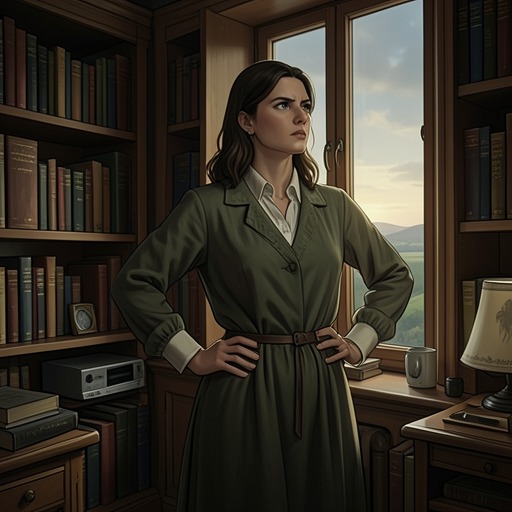
Lady Radha Pentland’s invitation draws Elizabeth Bennet into a household whose privacy initially makes it an object of curiosity around Meryton. Elizabeth deliberately seeks another meeting with Lady Radha at the watering place because little is known locally about how an Indian woman came to live in Hertfordshire. Lady Radha responds directly to Elizabeth’s curiosity, and she and Sir David Pentland eventually invite the girl to Grenadine Reef. What begins as an unusual acquaintance develops into a relationship lasting more than seven and a half years.
The estate becomes the place where Elizabeth sees a model of enduring marriage. In 1804, when Elizabeth was thirteen or fourteen, Sir David Pentland and Lady Radha Pentland had already been married for thirty-two years, yet their affection remained visible and consistent without becoming socially inappropriate. Their example gives Elizabeth an alternative to the loveless or merely expedient marriages surrounding her. Grenadine Reef is thus not only where she hears Lady Radha’s history; it is where she witnesses marriage as a continuing partnership.
Lady Radha’s life gives the estate a cross-cultural and cross-imperial history. Born Radha Bhimani in Kutch, she lost her mother at birth and was raised by her paternal grandmother and aunts amid repeated displacement caused by conflict involving the Mughals, the Marathas, and the British. She was later kidnapped, rescued off the Arabian Peninsula by a Spanish ship carrying priests, forced into a nunnery outside Cadiz for six years, and sent without meaningful choice on a mission toward Cartagena. After being abandoned as fatally ill, she was taken into Sir David’s house in Bridgetown, Barbados, where he, his housekeeper, and a nurse cared for her through repeated infections. Sir David eventually resigned his naval commission, returned with her to Britain, and married her after her willing, though superficial, conversion to the Church of Scotland. Grenadine Reef preserves all these histories within an English estate that is never simply English in origin.
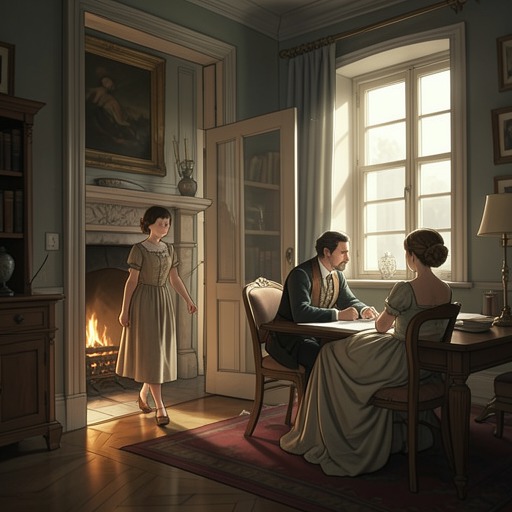
Elizabeth’s access to the estate is structured by the restrictions placed upon an unmarried gentlewoman. She cannot be alone with an unrelated man or correspond with one, so Vivian Harkness and Violet Harkness serve as her long-term companions, chaperones, and communication intermediaries. Vivian and Violet had themselves been helpers at the dower house after Vivian escaped an employer who had treated her improperly; rather than return to service, they worked under Mrs. Perkins and managed the dower house’s daily affairs. The estate’s organization consequently turns the conventions of chaperonage into a practical network that permits Elizabeth to maintain meaningful relationships and acquire experience otherwise denied to her.
Refuge and Agricultural Institution
From the first year of their residence at Grenadine Reef, the Pentlands provide a refuge for women treated badly by men. Most residents are servants or daughters of tenants and tradesmen. They may come to recover, and, when necessary, to deal with the consequences of what has happened to them. The refuge is not presented as a charitable ornament to the estate but as one of its operating purposes, supported by the land and integrated into its management.
Sir David Pentland runs the estate so that it can feed the women while still producing a modest surplus for sale at market. Lady Radha corresponds with a select group of other women to help residents move forward with their lives. The arrangement joins material provision to personal advocacy: crops, food, transport, staffing, correspondence, and future employment all form part of the institution’s work. The estate’s social isolation is therefore converted into safety rather than mere withdrawal.
The dower house remains busy even when residents leave. In one later account, four young women decide against going to London and travel north in search of positions with newly wealthy families in the industrial cities. They agree to report their success to one of the Harkness sisters, creating an informal chain of information for the women who remain. Grenadine Reef consequently offers more than temporary concealment; it provides alternatives to dependence on London and preserves contact after departure.
The refuge’s physical design reinforces its purpose. It is self-contained, invisible from the main house and neighboring farms, and described as a refuge in the fullest sense. Later plans confirm that its funding, food, provisions, transportation, and administration will continue after Sir David’s death. Its separation from the manor protects privacy, while its connection to the estate supplies the resources necessary for recovery.
Loss, Continuity, and Inheritance
Lady Radha Pentland dies suddenly after going to bed one night and never waking; an apoplexy carries her off in sleep. The chapel at Grenadine Reef becomes the site where Elizabeth stands in tears before Lady Radha’s final resting place, while Sir David Pentland is left visibly bereft, as though the light has gone from his life. The estate therefore changes from a shared home into the setting of widowhood and threatened emotional collapse, but it does not lose the purposes that Lady Radha helped establish.
Elizabeth’s continued connection with Grenadine Reef becomes essential to Sir David’s survival. Although their meetings remain proper and closely chaperoned, twice-weekly visits from his unrelated granddaughter are the highlight of his week after Lady Radha’s death. When Elizabeth moves to London, their communication continues through letters read aloud by Vivian Harkness, with Violet Harkness taking notes for the reply. The estate’s network of women thus carries intimacy across distance when ordinary social contact is difficult.
Sir David later asks Elizabeth Bennet to return and help him run the estate, recognizing the authority she has already acquired through years of work. She has learned about crop rotation, harvests, tenants, investments, and the estate’s finances; the estate’s agricultural success is inseparable from her intellectual and practical development. During Elizabeth’s courtship with Fitzwilliam Darcy, Darcy rides to Grenadine Reef three times a week and spends part of that time accompanying Elizabeth as she works with Sir David’s steward. Their relationship grows through shared agricultural activity rather than fashionable leisure alone.
After Sir David’s death, Elizabeth insists that the women’s refuge continue. She plans to consult Mrs. Perkins, Vivian Harkness, Violet Harkness, and the woman then handling day-to-day organization, while preserving the established arrangements for funding, provisions, and transportation. Grenadine Reef consequently survives its founders not as a memorial emptied of purpose but as a functioning institution whose principles are deliberately transferred to the next generation.
The estate also becomes tied to the settlement of the Bennet inheritance. The investigation into the Longbourn entail establishes that there are no male heirs in any line descending from Martin Bennet, whose royal grant had included the deed to Longbourn and its attendant lands. Once the entail is broken, the former Longbourn lands can enter a new succession structure connected with Grenadine Reef and the Darcy estates. The change transforms the estate from a private Pentland possession into part of a wider plan for distributing property among daughters and sons rather than allowing an inflexible male line to determine every outcome.
Later Division and Narrative Significance
Elizabeth Bennet and Fitzwilliam Darcy eventually divide their estates among their seven children. Their only daughter, Helena Darcy, is designated to receive 3,000 acres of Grenadine Reef, while Bennet, the family’s second-born son, becomes heir to Pemberley. The twins, David and Richard, each receive 2,000 acres: David receives land from Grenadine Reef, and Richard receives the lands formerly belonging to Longbourn. The Essex estate is sold, and its proceeds augment the other three estates. Grenadine Reef is therefore used to construct a deliberate, gender-conscious succession rather than simply perpetuating inherited convention.
The remaining 1,000 acres around the dower house acquire a further future. Elizabeth and Darcy build a lodge there and name it St Vincent Lodge after the nearest large island to the site where Sir David Pentland discovered the wrecked treasure ship. The family stays there during visits to the estate, and when Helena comes into her inheritance, Edward Gardiner and Madeline Gardiner are to move into the lodge. Helena’s older cousin Annabel, already deeply involved in running the dower house, is eventually intended to inherit the St Vincent estate, with a niece or cousin of the next generation as her heiress.
Grenadine Reef’s narrative function is therefore architectural as much as geographical. Its boundaries regulate secrecy and safety; its manor permits Elizabeth’s education in estate management; its farms finance a refuge; its chapel witnesses bereavement; and its later subdivisions turn family inheritance into an instrument of continuity. Against the social world that treats women’s work as invisible or places property under male control, Grenadine Reef offers a counter-model in which care, land, expertise, and succession can be organized around women’s survival and authority.