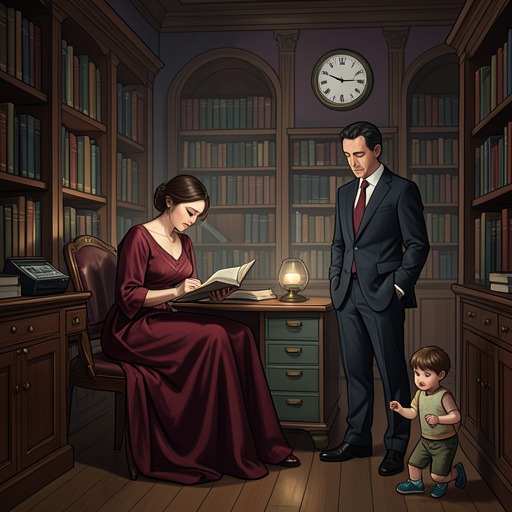
Helena Darcy
Just DesertsHelena Darcy, the only daughter of Elizabeth and Fitzwilliam Darcy, occupies a decisive position in the epilogue: she is both the intended successor to Grenadine Reef and the child through whom Elizabeth examines inheritance, family estrangement, personal choice, and the consequences of action. Her inheritance is material, but her deeper legacy is intellectual and moral. She has been raised to understand that privilege creates options rather than a single prescribed destiny, and that those options must be exercised with accountability.
Family Position and Inheritance
Helena is the eldest of seven children born to Elizabeth and Fitzwilliam Darcy during the first ten years of their marriage. The birth of their youngest son, Bartholomew, was difficult and ended the possibility of further children, making the existing family structure the basis for a long-term succession plan. Elizabeth and Fitzwilliam Darcy deliberately rejected the expectation that the principal estate should automatically pass to the second-born son. Instead, they chose Helena as the heir to Grenadine Reef, giving their daughter 3,000 acres of the estate.
The arrangement divided the original holdings rather than allowing one child to absorb everything. Bennet, known as Ben within the family, was designated heir to Pemberley. The twins David and Richard were assigned 2,000 acres each: David received land from Grenadine Reef, while Richard received the lands formerly belonging to Longbourn. The Essex estate was sold, and its proceeds were used to strengthen the other three estates. Andrew was associated with the Scottish lands, Michael with the Dorset estate, and Bartholomew with the Kent estate. The plan therefore makes Helena’s inheritance part of a carefully distributed family structure rather than an isolated privilege.
A final 1,000 acres of the original Grenadine Reef estate surrounded the dower house. Elizabeth and Fitzwilliam Darcy built a lodge there and named it St. Vincent Lodge after the nearest large island to the place where Sir David Pentland had discovered the wrecked treasure ship. When Helena comes into her inheritance, Edward and Madeline Gardiner are to move into the Lodge. Her older cousin Annabel, already deeply involved in managing the dower house, is expected eventually to inherit the St. Vincent estate. Helena’s succession thus preserves both the main estate and the refuge associated with Grenadine Reef while assigning responsibility across generations.
Formation Through Choice
Helena’s conversation with Elizabeth presents her as a young woman capable of recognizing the magnitude of this planned change. She says that it feels like a great deal of alteration, and Elizabeth confirms that it is, explaining that the arrangements have been prepared for a decade. The exchange establishes Helena not as a passive recipient of property but as someone invited to think about what succession will require and what it may displace.
Her concern is especially directed toward Edward and Madeline Gardiner, whose eventual move from their home could seem like a cost imposed by Helena’s inheritance. Elizabeth answers that the Gardiners understand the arrangement and will move to St. Vincent Lodge when Helena marries and relocates to Grenadine Reef with her husband. The inheritance therefore carries an awareness of dependence and obligation: Helena’s future position is connected to the rearrangement of other people’s lives, not merely to her own comfort.
Elizabeth also insists that inheritance will not determine the children’s entire futures. If Michael prefers spending time with Edward and John and shows little interest in country life, he will not be forced to run an estate. Elizabeth says that any of the seven children may choose differently, including joining their cousins in trade, and that the family’s unusual good fortune gives them options. Helena is consequently formed within a household where wealth is treated as a means of preserving freedom, not as a command to reproduce a fixed social role.
Relationships and Moral Education
Helena’s closest recorded relationship is with Elizabeth, who speaks to her as both daughter and future adult. Elizabeth explains that she and Fitzwilliam Darcy have guided all seven children but will not run their lives. The children have been taught that actions have consequences, a principle Elizabeth still follows herself. Helena understands this lesson through the family’s silences as much as through its explanations.
Elizabeth tells her that the children have never met their grandmother, Fanny Bennet, although she lives at Longbourn only four miles away. Elizabeth has not seen Fanny since Thomas Bennet’s funeral in 1815 and has not spoken to her since reaching legal adulthood in 1812. Helena does not regret the separation. She says that learning the reason when she was older made the outcome of harmful actions visible without exposing her to every detail. The estrangement is therefore presented to Helena as a consequence that must be understood rather than sentimentalized.
Helena also knows that her Aunt Jane is the most forgiving member of the family and is the relative most likely to maintain contact with Lydia Bennet, yet Jane has heard nothing from Lydia for a decade after Lydia’s husband’s regiment went to India. Helena’s knowledge of these fractured relationships gives the principle of consequence a concrete family history. Her education includes not only estate management and social privilege but an awareness that reconciliation is not always available and that family ties do not erase the results of conduct.
Her relationship with her brothers is lively and competitive. Elizabeth observes that Helena is the shortest of the seven children, while her six brothers tower over both their mother and sister, but there is never doubt about who is in charge when the siblings are together. On one birthday, Andrew gave Helena a miniature of herself fixed inside a dictionary at the word “feisty.” She responded by chasing him through the halls of Pemberley while the family laughed. The incident remains a recurring birthday story, turning Helena’s forcefulness into an affectionate family emblem rather than a defect requiring correction.
Independence and Character
Helena openly claims that she has inherited Elizabeth’s “ruthless streak,” and Elizabeth is uncertain whether to feel proud or dismayed. Helena answers that Elizabeth should be proud, adding that having six younger brothers strengthened whatever she received from her mother. The exchange gives Helena a self-conscious understanding of character as inheritance: temperament passes through the family, but experience sharpens and directs it.
Her confidence is balanced by reflection. Helena sits beside her mother in the small chapel at Grenadine Reef, which is actually a crypt and a place of remembrance rather than a place of worship. She asks whether Elizabeth’s thoughts have changed over the years, and Elizabeth describes reflecting on the randomness of life and marveling at the divine plan. Helena’s presence in this intimate memorial setting places her within the family’s history of death, survival, and chance. She does not merely inherit a property associated with Sir David Pentland; she participates in the act of remembering how that property and its obligations came to exist.
The family’s examples of different adult lives further shape Helena’s sense of independence. Elizabeth contrasts Lily, whose elevation to a viscountess’s position came through chance after the death of a dissolute heir, with Georgiana Darcy, who lived with Elizabeth and Fitzwilliam Darcy for more than three years, observed their marriage, and deliberately chose a more traditional aristocratic life. Georgiana later married a Viscount who became a Marquess, while Catherine Bennet married a man in trade. Helena is taught that neither choice is automatically superior: the important point is that both women selected lives they could accept and that both are happy, even though they move in different social circles.
Narrative Significance
Helena functions as the epilogue’s test of whether Elizabeth’s convictions can survive beyond Elizabeth herself. Earlier generations were constrained by the entail, by gendered dependence, by forced marriage, by family authority, and by the social belief that women must fit the futures arranged for them. Helena inherits within a different structure. Her parents distribute estates to sons and daughter according to a deliberate plan, preserve economic alternatives, and refuse to dictate that every child must become a landowner.
At the same time, Helena is not presented as free from obligation. Grenadine Reef carries the memory of Radha Bhimani Pentland’s violence and survival, Sir David Pentland’s protection of her, Elizabeth’s life-changing connection with the Pentland household, and the refuge established for abused women. Helena’s inheritance therefore joins privilege to historical responsibility. Her position makes her the custodian of a place whose meaning exceeds acreage and title.
Her final exchange with Elizabeth defines the character’s emerging identity. Helena takes her mother’s hand, accepts her own determination, and recognizes that six younger brothers have helped make her formidable. The family joke about the dictionary miniature becomes a small but telling image of her future: Helena is not simply the daughter who receives Grenadine Reef, but the person expected to occupy that inheritance with enough independence to make it her own. In her, the family’s succession plan becomes a promise that inheritance can preserve memory while still allowing a woman to choose her direction.