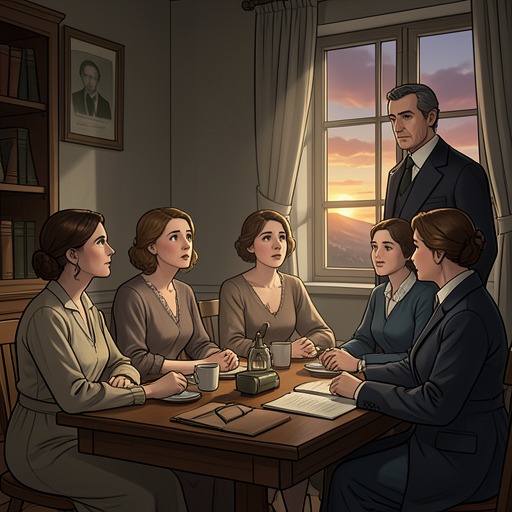
I will only marry for the deepest love
Just Deserts“I will only marry for the deepest love” is a defining marriage principle for Jane Bennet and a phrase that transforms from youthful ideal into a test of adult choice. First heard a decade earlier, it has inspired and tormented her in equal measure; by the time she is twenty-two, she believes that Fitzwilliam Darcy embodies the deepest love the phrase promised, even as another proposal forces her to confront the material pressures that romantic language cannot erase.
Origin and Emotional Force
The phrase has governed Jane Bennet’s imagination for ten years. It is not treated as a casual preference but as a durable standard against which she measures the possibility of marriage. Its power lies in the way it joins emotional absolutism to fairy-tale expectation: marriage should arise from a love profound enough to justify the whole of the commitment, rather than from convenience, social pressure, or financial calculation.
That ideal has also tormented her. The phrase keeps alive an expectation that may be difficult to satisfy, making ordinary arrangements appear morally and emotionally insufficient. Its long afterlife shows how a single maxim can become part of a person’s inner structure: it inspires hope while imposing a demanding condition on the future.
Jane Bennet and Fitzwilliam Darcy
By the time Jane Bennet is twenty-two, she knows that she has found the “physical manifestation” of the deepest love in Fitzwilliam Darcy. The judgment follows three months in which they have spent significant amounts of time together, enough for her to recognize both her own love and his love for her. The phrase therefore moves from abstraction into lived relationship: what once sounded like a distant ideal is now attached to a particular person and a reciprocal bond.
Her decision is correspondingly certain. When Fitzwilliam Darcy asks her, she will say yes, because accepting him would mean marrying for the deepest love rather than merely claiming to do so. The fairy-tale formula is presented as having become real, not because marriage has escaped circumstance, but because the emotional condition at its center has been fulfilled.
The Phrase Against Marriage as Transaction
The ideal becomes most sharply ironic when Jane Bennet considers Sir David Pentland’s proposal. Her love for the Pentland family is genuine. Lady Radha had been an anchor during Jane’s formative early teenage years and a more important mother figure to her than her own mother; after Lady Radha’s death, Jane’s relationship with Sir David Pentland deepened, although both carefully observed propriety. Sir David’s proposal gives voice to feelings that had long remained unspoken.
Yet the proposal is also an “ultimate business transaction.” If Jane Bennet refuses, Grenadine Reef will be sold when Sir David dies, placing Vivian Harkness and Violet Harkness, her constant companions, at risk and threatening the people who depend on the estate. James Pentland’s presence now appears meaningful because he may have agreed to an arrangement designed to preserve the property. Jane is thus offered marriage not only as an expression of affection, but as a means of protecting a household, an estate, and its dependent community.
This produces the phrase’s central paradox. Jane Bennet has always condemned the treatment of women as commodities and has argued that marriage is too often nothing more than a business transaction. Now she confronts a proposal in which her own marriage could preserve Grenadine Reef. The irony humiliates her because she recognizes that an arrangement she would criticize in principle may nevertheless serve people she loves. The phrase does not abolish material responsibility; it gives Jane a standard by which she can feel the cost of compromising it.
Romantic Ideal and Moral Responsibility
The expression ultimately separates two kinds of love without treating either as false. Fitzwilliam Darcy represents the love that fulfills Jane Bennet’s personal ideal: mutual, embodied, and chosen for its own sake. The Pentland claim represents love as loyalty, guardianship, memory, and responsibility toward an estate and the people sustained by it. Jane’s dilemma is therefore not simply love versus money. It is one form of love versus another, with the economic structure of the estate making the distinction impossible to ignore.
The phrase’s significance lies in the pressure it places on Jane’s agency. She refuses to pretend that a duty-driven marriage is identical to the marriage she has imagined, even while acknowledging that economic circumstances can make marriage consequential for many lives beyond the couple. Its eventual fulfillment with Fitzwilliam Darcy preserves the principle as more than adolescent fantasy: Jane can marry for the deepest love, but only after confronting the social and financial systems that make such freedom exceptional.