Jane Bennet–Charles Bingley relationship
Just DesertsThe Jane Bennet–Charles Bingley relationship is a promising attachment undone by disappointment. Charles Bingley is immediately drawn to Jane’s beauty and gentleness, while Jane initially sees him as charming and attentive. Yet the relationship cannot survive the difference between being admired as a pretty woman and being recognized as an intelligent person. Jane’s eventual judgment that Charles Bingley is not worthy of the title of gentleman gives the connection its decisive meaning: attraction is present, but respect is not.
First Attraction at the Assembly
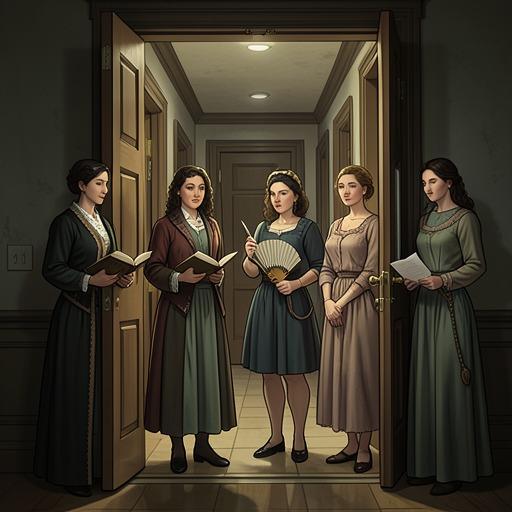
At the dance, Jane Bennet waits to dance with Charles Bingley and responds shyly to his eager entreaties. From Elizabeth Bennet’s observation at the doorway, the moment appears tender and straightforward. Charles Bingley seems pleasant, enthusiastic, and genuinely pleased to be near Jane, establishing the relationship through visible attentiveness rather than calculated reserve.
Their public manner also contrasts sharply with the conduct of the rest of the Netherfield party. Charles Bingley goes directly to Jane with almost boyish excitement, remaining oblivious to the superior airs and deliberate offensiveness of his companions. His eagerness suggests that Jane is not merely one social possibility among many; she is the person toward whom his attention instinctively turns. That spontaneous preference gives the courtship its initial warmth, even as the surrounding company introduces the class pressures that will later damage it.
Courtship and Its Limits
Charles Bingley continues visiting Longbourn to speak with Jane, and Jane’s family treats his interest as evidence of a serious romantic prospect. When Jane becomes ill, Charles Bingley’s presence remains central to the situation: he is the gentleman whose visits have helped create her mother’s expectations, and he readily accepts Elizabeth Bennet’s decision to stay at Netherfield Park to care for her sister. He also asks after Jane’s recovery and, when she leaves Netherfield, brings an invitation to the ball at Netherfield Park.
His care is not wholly false. At Netherfield, Charles Bingley makes sure that Jane is warm by the fire and repeatedly addresses her in admiring terms. His attention is affectionate in manner, but its repetition exposes its narrowness. Jane receives praise, yet she does not receive sustained conversation. The relationship therefore moves from apparent promise toward an uncomfortable distinction between tenderness and understanding.
Jane’s Intellectual Disillusionment
Jane Bennet’s private question, “Am I dull Lizzy?”, reveals the wound beneath her composed exterior. She has been told for twenty years that she is pretty, but she wants Charles Bingley to recognize that she is more than a pretty face. When she tries to discuss items from the newspaper or ideas gathered through conversations with Elizabeth Bennet and Edward Gardiner, Charles Bingley shows little interest. He is not openly patronizing, but the conversation repeatedly returns to superficial compliments, especially his calling her an angel.
This failure is more consequential than a single awkward evening. Charles Bingley’s attention makes Jane visible as an object of admiration while leaving her intellectual self unacknowledged. The courtship thus exposes a social pattern in which a woman’s beauty is welcomed but her mind is not necessarily engaged. Jane’s disappointment is not caused by his lack of politeness; it arises because politeness proves insufficient. She wants companionship, not merely repeated confirmation that she is attractive.
The Netherfield sisters deepen the injury by questioning Jane about her family, her uncles in trade, the location of Cheapside, and the size of the Bennet sisters’ dowries. Their contempt makes Charles Bingley’s superficiality appear connected to a broader social environment. Even if he does not share their deliberate snobbery, he belongs to the party whose standards reduce Jane and her family to beauty, commercial origins, and marriage value. Jane can tolerate Charles Bingley’s roots in trade, but she cannot overlook his failure to behave as a gentleman in the fuller moral and intellectual sense.
Reversal and Consequence
After the two evenings at Netherfield, Jane tells Elizabeth Bennet that she has become disillusioned. She had found Charles Bingley charming, but the new evidence has changed her assessment. The reversal is precise: she does not deny that he was pleasant, attentive, or attractive; she denies that these qualities amount to gentlemanly worth. Her judgment separates social charm from character and makes clear that affection cannot compensate for an absence of depth.
The relationship’s disappointment also becomes part of the wider emotional strain surrounding Longbourn. Elizabeth Bennet’s anger at Thomas Bennet and Fanny Bennet, especially their inadequate concern for Jane’s illness, is intensified by the fact that Jane’s health and courtship have been treated as opportunities for family advancement. Charles Bingley’s visits and the prospect of marriage become entangled with maternal matchmaking, paternal indifference, and the judgment of a socially superior household. Jane is therefore not simply losing confidence in one man; she is recognizing how easily her feelings have been placed inside a marketplace of beauty, dowry, family connections, and status.
At the next meeting, Charles Bingley politely asks whether Jane has fully recovered, and she answers that she has. The exchange is civil but emotionally diminished. Jane’s earlier shy pleasure has been replaced by formal composure, while the invitation to another Netherfield ball carries an irony absent from the first attraction: the social machinery of courtship continues even after Jane has begun to doubt the man at its center.
Significance
The Jane Bennet–Charles Bingley relationship tests whether romantic attention can become genuine partnership. Charles Bingley supplies warmth, eagerness, and conventional admiration, but Jane requires recognition of her intelligence and judgment. Her withdrawal is consequently not capricious. It is the result of learning to distinguish kindness of manner from depth of character.
The relationship also establishes a contrast between social performance and emotional truth. Charles Bingley appears more agreeable than the proud and distant Fitzwilliam Darcy, yet Jane’s experience shows that agreeable behavior alone does not guarantee respect. The courtship begins in the hopeful language of beauty and attentiveness, passes through the pressure of family and class scrutiny, and ends in Jane’s clearer knowledge of what she will not accept. Its failure gives Jane a form of agency: she refuses to be satisfied with being admired when she cannot also be heard.