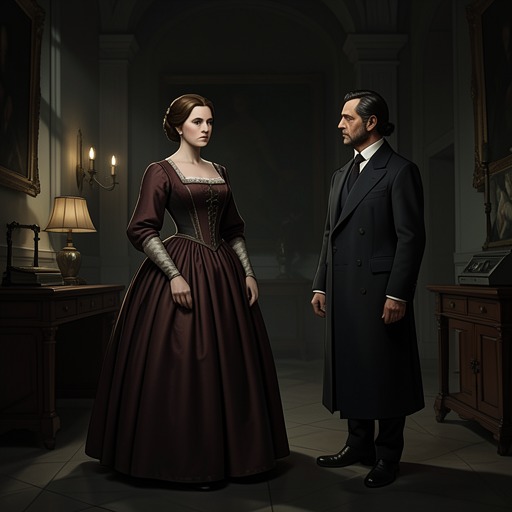
Lady Catherine de Bourgh dies of pneumonia
Just DesertsLady Catherine de Bourgh dies of pneumonia after a snowbound journey leaves her stranded at an inn and a worsening cough develops into a life-threatening infection. Although she survives the immediate illness, pneumonia permanently weakens her lungs, turns her accustomed anger into physical exhaustion, and confines the last fifteen months of her life to frailty, frustration, and declining authority.
Illness and Interruption
At first Lady Catherine refuses to accept the indignity of staying at an inn roughly thirty miles from London. A snowstorm makes further travel by carriage impossible, however, and even reaching the inn is difficult. When the weather warms, the roads become mud tracks rather than usable routes, prolonging her confinement. She remains there when William Collins dies, and the worsening of her own cough finally requires medical attention.
By the following Monday, a doctor diagnoses pneumonia. The illness is presented as an intrusion into Lady Catherine’s plans and self-conception: she regards herself as a fighter who will not surrender to something she considers plebeian. Her determination allows her to recover sufficiently to be transported to London for Christmas, where Anne de Bourgh is summoned from Rosings Park and the family observes the season together.
The Lasting Damage
Survival does not restore Lady Catherine to health. Her lungs have been seriously weakened, leaving her short of breath with very little exertion. The physical consequences alter the expression of her personality. Attempts to become annoyed or launch into one of her former rants produce coughing fits instead, so that the voice that once commanded rooms is reduced to little more than a wheeze.
After Twelfth Night, Lady Catherine and Anne return to Rosings Park. When news arrives that her disobedient nephew, Fitzwilliam Darcy, has married Elizabeth Bennet, Lady Catherine is confined to bed by persistent coughing and breathlessness. Her illness therefore coincides with the collapse of her ability to intervene directly in the marriage she opposed.
Isolation and Death
Reduced to writing vicious letters, none of which receives a reply, Lady Catherine can no longer convert indignation into effective social action. The letters preserve her hostility but also emphasize her isolation: the old mechanism of command has become a one-sided act performed from a sickbed. Her survival of pneumonia thus prolongs, rather than resolves, the conflict surrounding her, while depriving her of the physical strength to pursue it in person.
The final fifteen months of her life are miserable. She is frail, highly susceptible to colds, and unable to recover the forceful public presence associated with her earlier conduct. Lady Catherine dies in the winter of 1814. The event closes an arc in which medical recovery proves temporary and incomplete: pneumonia does not kill her immediately, but it permanently reshapes the remaining years of her life and leaves her authority diminished before death.
Narrative Consequences
Lady Catherine’s death follows a broader pattern in the narrative, where illness exposes the limits of social power and compels changes in family arrangements. Her decline contrasts with Sir David Pentland’s terminal stomach cancer, whose diagnosis leads directly to urgent decisions about his will, marriage settlement, and marriage to Elizabeth Bennet. Lady Catherine’s illness produces a different kind of consequence: it blocks intervention, narrows communication to unanswered letters, and leaves the marriage of Elizabeth Bennet and Fitzwilliam Darcy beyond her control.
Her death also gives physical form to the book’s interest in the consequences of accumulated history. Radha Bhimani’s life is marked by forced movement from Kutch through the Arabian Peninsula, Spain, Barbados, and Britain, while Lady Catherine’s final years move in the opposite direction—from public mobility and verbal dominance into confinement and bodily limitation. Against these contrasting trajectories, pneumonia becomes more than a medical incident: it is the decisive condition that turns Lady Catherine from an active antagonist into an increasingly powerless witness to changes she cannot prevent.