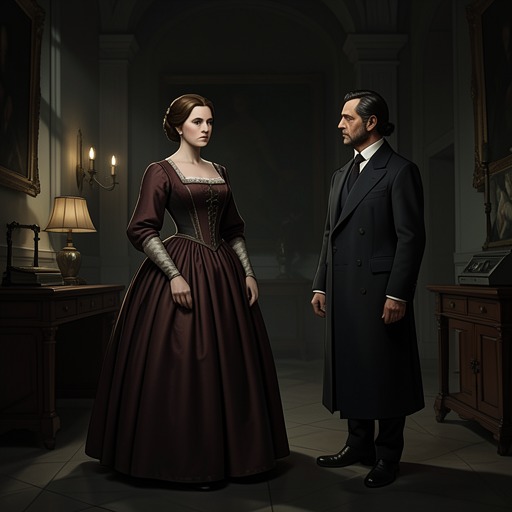
Lady Catherine travels to Hertfordshire to investigate Miss Bennet
Just DesertsLady Catherine travels to Hertfordshire to investigate Miss Bennet after learning that Jane Bennet recovered at Netherfield Park and that Fitzwilliam Darcy had also met Elizabeth Bennet there. What begins as an aristocratic inquiry driven by jealousy and assumptions becomes a carefully staged examination of Darcy’s prolonged return to the neighbourhood, his sister’s presence, and the Bennet family’s access to him.
The Suspicion That Initiates the Journey
Lady Catherine’s information is indirect and incomplete. During a conversation at Matlock House, the Earl of Matlock hears that Miss Bennet accompanied Darcy’s party to the theatre and to several other events, although he remembers little of the discussion on returning home. He does, however, pass the name to his sister. The report that matters to Lady Catherine is that the eldest Miss Bennet became ill and recovered at the house where her nephew was staying, and that Darcy had probably met the second daughter, Elizabeth.
Lady Catherine immediately converts this limited evidence into certainty. She decides that Jane Bennet has used her “arts and allurements” to seduce Darcy, and treats the supposed danger as intolerable. Her reaction reveals the event’s central value shift: ordinary social contact is reclassified as a threat to aristocratic control over Darcy’s marriage. Rather than waiting for fuller evidence, she orders William Collins to return to Hunsford and accompany her, announcing that they will leave as soon as daylight permits.
A Journey Made Difficult by Weather and Rank
The journey from Rosings Park to Hertfordshire is repeatedly delayed by winter conditions. Freezing rain slows the first stage, and Lady Catherine is forced to spend a night at a coaching inn far from London, a discomfort she voices to every servant who enters her room. The following day brings little improvement. Although the travellers eventually reach Matlock House, they cannot continue the next day because it is the Sabbath.
When travel resumes, the weather is again cold and miserable. Lady Catherine’s anger at these obstacles becomes part of the journey’s character: her authority can command servants and relatives, but it cannot command roads, seasons, or the calendar. The Earl of Matlock finally sees her off while her fulminations still ring in his ears. Four days after leaving Kent, she reaches Meryton. The trip has taken three days of hard driving to cover the seventy miles between Rosings Park and Meryton, turning her investigation into a physically arduous assertion of social will.
The Inquiry at Lucas Lodge
William Collins has sent an express ahead to request accommodation from his in-laws, so the carriage arrives at Lucas Lodge as the last winter daylight fades. Lady Catherine remains outwardly controlled, avoiding outright rudeness, but reserves her interrogation of Sir William Lucas for dinner. Her first demand is to hear about Elizabeth Bennet’s behaviour while she was recovering at Netherfield Park.
The inquiry quickly expands. Sir William explains that Darcy took over the remainder of the Netherfield Park lease from the middle of April until Michaelmas. Darcy had been occupied with estate matters during the spring, but Georgiana Darcy joined him in June, after which Jane Bennet and other local ladies became regular visitors. Maria Lucas, Sir William’s youngest daughter, learned much while in the company of Georgiana Darcy. Lady Catherine is rendered briefly speechless by this account: Darcy had returned to what she considers an insignificant neighbourhood for more than five months and had brought his sister with him.
Her silence does not signal doubt. It marks the moment when her suspicion acquires a second target. She has long disliked Georgiana Darcy’s guardianship being entrusted to two young gentlemen, and now imagines that the girl’s presence in Hertfordshire may provide an opportunity to correct what she sees as an intolerable arrangement. Yet Lady Catherine postpones that matter and returns to Elizabeth, ordering Maria Lucas to describe every occasion on which she visited Georgiana Darcy.
Evidence, Misreading, and the Wider Context
Maria’s stammering account establishes that Elizabeth and Darcy were never alone together on the visits at which Maria was present. It also indicates that many local ladies visited Netherfield Park in various groups during the months the Darcys lived there. The evidence therefore weakens the charge of secret intimacy, but Lady Catherine’s method is not neutral fact-finding. She begins with a conclusion and treats each new detail as material to be arranged around it. The investigation is driven less by what Elizabeth has done than by Lady Catherine’s conviction that Darcy’s choice must remain subject to family supervision.
The event also gains force from the history Elizabeth has learned from Radha Bhimani Pentland. Radha was born in Kutch in western India, lost her mother in childbirth, and grew up amid repeated displacement caused by conflict involving the Mughals, the Marathas, and the British. At an age only a year older than Elizabeth was during the disclosure, she was kidnapped for sale into slavery. Rescued off the coast of the Arabian Peninsula by a Spanish ship carrying priests, she was taught rudimentary Spanish and then forced into a nunnery outside Cadiz for six years. At twenty-one she was sent without consent toward Cartagena with twenty-nine other members of her order; pirates captured the vessel, and Radha suffered a stomach wound that nearly killed her.
Radha’s later life exposes the inadequacy of the social judgments that Lady Catherine represents. Sir David Pentland cared for her in Bridgetown on Barbados when she had been left behind as too ill to travel, and he continued nursing her until she recovered. Despite the crimes committed against her, she was subjected to hostile comments and treated as though her survival were an embarrassment. Sir David eventually resigned his naval commission, returned to Britain, converted with Radha to the Church of Scotland, married her near Edinburgh, and settled with her in England. Elizabeth later identifies Radha, alongside Madeline Gardiner, as one of the two principal sources of her understanding of what it means to be a lady: not birth alone, but love, practical responsibility, and the daily care of others.
Narrative Significance
Lady Catherine’s expedition is therefore both an investigation and a collision between competing definitions of female worth. She approaches Elizabeth as a socially dangerous girl whose presence near Darcy must be explained, while Elizabeth’s moral education has taught her to judge women through endurance, responsibility, and action rather than pedigree. The journey’s delays, the interrogation at Lucas Lodge, and the testimony about Netherfield convert rumour into a public sequence of questions, but they do not give Lady Catherine the control she expects.
The event prepares the larger confrontation between Lady Catherine’s possessive model of family authority and Elizabeth’s insistence on independent judgment. Its irony lies in the contrast between the evidence Lady Catherine seeks and the history the novel places beside it: a woman who survived forced migration, enslavement, piracy, religious coercion, and social shunning is remembered by Elizabeth as a model of genuine gentility, while Lady Catherine’s inherited rank produces suspicion, interrogation, and attempted control. The investigation thus makes social power visible precisely by showing how quickly it mistakes ordinary association for transgression.