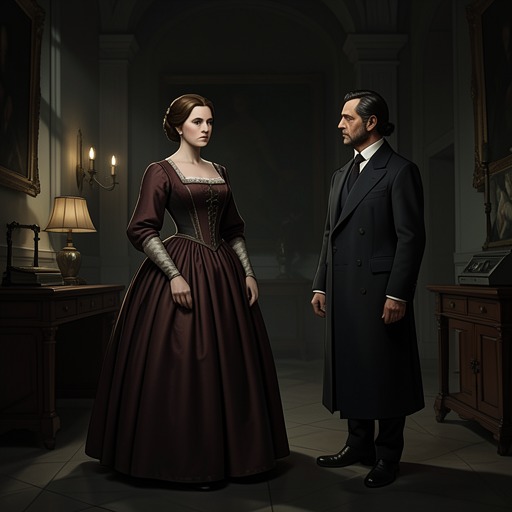
Lady Catherine's post-pneumonia frailty
Just DesertsLady Catherine's post-pneumonia frailty is the prolonged bodily consequence of the pneumonia she contracts during a forced winter delay at an inn. Although Lady Catherine survives the infection, the illness seriously weakens her lungs, leaving her persistently short of breath, vulnerable to colds, and unable to command others with her former physical force. Her decline turns a woman accustomed to imposing herself through movement, volume, and anger into one confined by breath, coughing, and the limits of her own body.
Illness and Recovery
Lady Catherine's illness begins after a snowstorm makes travel from the inn, thirty miles from London, impossible. She had resisted staying there, but the conditions make an attempted carriage journey imprudent; reaching the inn is itself difficult, and the subsequent thaw turns the roads into mud tracks. While she remains stranded, William Collins dies. When Lady Catherine's cough worsens, a doctor is summoned and diagnoses pneumonia by the following Monday.
The illness is presented as an acute medical crisis but not as an immediate death sentence. Lady Catherine fights the infection and recovers sufficiently to be transported to London for Christmas. She celebrates the season with Anne de Bourgh, the Earl of Matlock, and his family, but recovery does not restore her former health. The narrative marks a decisive distinction between surviving pneumonia and escaping its consequences: Lady Catherine lives, yet her lungs have been seriously weakened.
Bodily Limits and Loss of Authority
After Twelfth Night, Lady Catherine returns to Rosings Park with Anne de Bourgh. There, ordinary exertion becomes difficult. She gets out of breath extremely easily, and attempts to rant or express anger as she once did trigger coughing fits rather than obedience or fear. Her voice, formerly loud and demanding, is eventually reduced to little more than a wheeze.
This physical change alters the practical meaning of her authority. Lady Catherine remains socially entitled to issue judgments and objections, but the body through which she habitually enforced them can no longer sustain the performance. Her frailty therefore works as more than a medical detail: it exposes the dependence of her domineering identity on stamina, volume, and access to other people. The illness does not make her conciliatory. It makes her anger less effective and more visibly costly to herself.
The Marriage and the Final Fifteen Months
News of Fitzwilliam Darcy's marriage to Elizabeth Bennet reaches Lady Catherine while she is confined to bed with persistent coughing and breathlessness. The marriage is precisely the kind of defiance she had tried to prevent, yet her post-pneumonia condition leaves her unable to confront it in person. Reduced to writing vicious letters, she receives no replies. The letters preserve her hostility, but the unanswered correspondence also records her increasing separation from the people and decisions she seeks to control.
The same period contrasts Lady Catherine's decline with other forms of serious illness and bodily vulnerability in the narrative. Sir David Pentland describes his terminal stomach cancer as a growing lump, a constant ache with occasional spikes of pain, and a condition managed partly through diluted laudanum before sleep. His cancer accelerates a will, marriage settlement, and wedding, while Lady Catherine's pneumonia produces a slower confinement and erosion of capacity. Both illnesses reorganize relationships and succession, but Lady Catherine's weakened lungs chiefly strip authority from a figure who had relied on command.
Death and Narrative Significance
Lady Catherine's last fifteen months are miserable. She is frail, susceptible to colds, and unable to sustain the loud, demanding voice that once characterized her social presence. She dies in winter 1814, after surviving the original pneumonia but not escaping the long-term damage it caused.
The condition gives bodily form to a broader reversal in Lady Catherine's plot. Her earlier power depends on the assumption that her rank, certainty, and force of personality can overrule other people's choices; after pneumonia, the physical instrument of that power steadily fails. Her refusal to accept Fitzwilliam Darcy and Elizabeth Bennet's marriage continues in letters, but the silence that answers them makes her final resistance private, ineffective, and isolated. The illness thus produces neither moral conversion nor reconciliation. Its consequence is a diminished life in which social command remains imaginable but can no longer be fully enacted.