Longbourn
Just DesertsLongbourn is the Bennet family estate, a landed property whose legal history and daily management shape nearly every major question of security in the family. It is the house from which Elizabeth Bennet repeatedly escapes, the domestic space in which Fanny Bennet’s anxiety about poverty becomes oppressive, and the estate whose decline exposes how much unrecognized work Elizabeth had been doing. Its eventual sale to Fitzwilliam Darcy breaks the old succession pattern, protects the Bennet parents, provides dowries for Jane Bennet, Mary Bennet, and Catherine Bennet, and incorporates Longbourn’s lands into the expanding Grenadine Reef estate.
Estate, Boundary, and Domestic Setting
Longbourn lies south of Grenadine Reef and less than four miles from it; the distance is short enough to make the estates part of the same social and economic geography. Its eastern side leads toward Oakham Mount, Elizabeth’s favourite destination when she needs to leave the house. Because the path to Oakham Mount can be seen from the parlour window, Elizabeth avoids the visible route and instead circles north from the kitchen door, following flatter land toward the northern boundary, where a narrow brook separates Longbourn from the estate beyond it. The geography gives her an escape route, but it also reveals how closely movement is watched within the house: the important danger is not merely being seen, but being stopped.
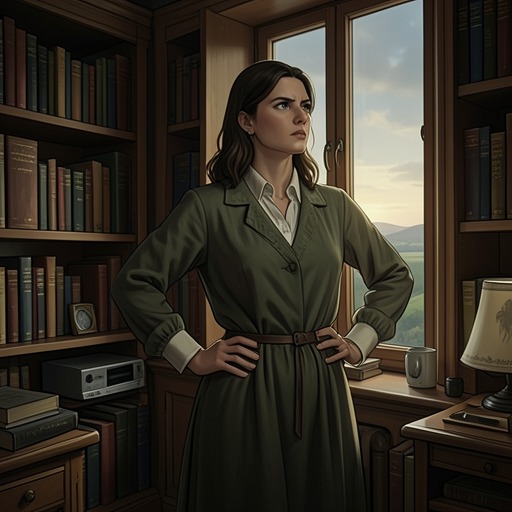
The house is organized around the family’s unequal access to privacy and authority. Mr. Bennet’s study is a sanctuary of books, while Elizabeth has no equivalent refuge within Longbourn. She has often curled up in the chair beside his fire, but his retreat into reading leaves the rest of the household under Fanny Bennet’s unchecked pressure. When Elizabeth finally leaves, Mr. Bennet recognizes that the sanctuary she once found in his study has been replaced by a new one twenty-four miles away in Gracechurch Street, where Edward Gardiner and Madeline Gardiner take her into their household.
Longbourn is also a working household, not merely a country-house backdrop. Its food, servants, tenants, maintenance, and household routines require continuous supervision. Elizabeth’s later education with Madeline Gardiner includes maintenance and cleaning schedules, weekly menus, meetings with a housekeeper and cook, and the practical management expected of a mistress of an estate. This education makes visible the domestic labour that had previously been treated as instinctive or incidental. At Longbourn, Fanny Bennet is known locally for setting a good table and maintaining the manor, yet her instruction of the daughters is inconsistent because her constant hovering makes them afraid of mistakes rather than capable of assuming responsibility.
The Entail and the Fear of Dispossession
The central legal fact governing Longbourn is its entail away from the female line. Fanny Bennet can bear no more children, and the birth of Lydia Bennet eight years earlier has been followed by increasing fear that no son will appear to preserve the estate for the immediate family. The prospect of being thrown into the hedgerows turns Longbourn from a home into a looming financial threat. Fanny Bennet’s obsession with Jane Bennet’s early entrance into society is therefore driven by the belief that marriage is the family’s only defence against losing its position.
The entail also converts the daughters’ futures into a household emergency. Fanny Bennet presses for early marriages even when Jane Bennet is only fifteen, while the three younger daughters remain exposed to the same insecurity. Her conduct is oppressive, but the property system gives the anxiety a material basis: if Thomas Bennet dies while the entail remains intact, his wife and daughters cannot simply inherit Longbourn. Marriage becomes the prescribed solution to a legal problem that the women did not create and cannot directly control.
The estate’s history reaches back roughly 150 years. The property was granted to the Bennet family after the Restoration in recognition of Martin Bennet’s support for the King against Parliament, with the grant dating from the period between 1651 and 1660. By the time the succession is investigated, the family can identify no male heir in any line descending from Martin Bennet. The original basis of the family’s landed status thus becomes the foundation for a legal conclusion that unexpectedly releases the estate from the entail.
Elizabeth’s Departure and the Hidden Work of Longbourn
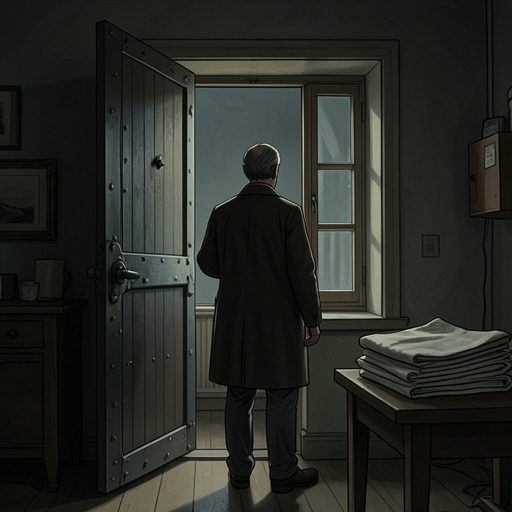
Elizabeth leaves Longbourn shortly after reaching adulthood, following a period in which she has endured repeated verbal chastisement and uncertainty over whether Thomas Bennet will permit her to visit the Gardiners in London. She does not flee theatrically. On a bright morning after an overnight frost, she walks out through the kitchen by her usual brisk route, looks back only once at the diminishing house and its chimney smoke, then rounds the hedge until Longbourn disappears. The controlled movement makes the departure more decisive: the house is not temporarily abandoned but relinquished as a place in which she can safely live.
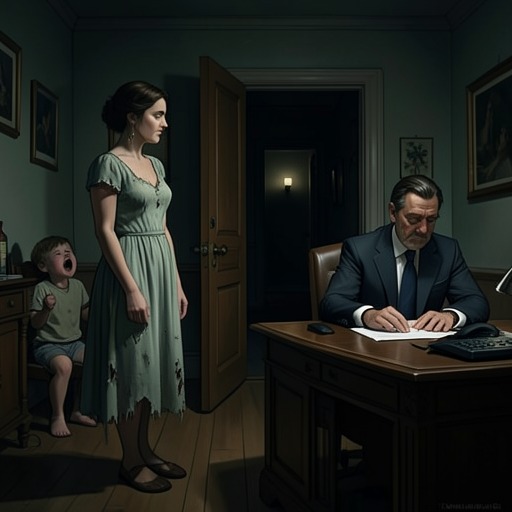
Her absence exposes the extent of her previous contribution. Jane Bennet, Mary Bennet, and sometimes Kitty Bennet continue visiting tenants, but Longbourn becomes more difficult to operate because Elizabeth’s behind-the-scenes labour had never been fully acknowledged. There are still enough provisions for the reduced household, yet the estate produces less than it should, and the prevailing impression is one of insufficiency. Longbourn reflects its master: Thomas Bennet has always neglected the practical responsibilities of an estate, and without Elizabeth’s supervision his indolence becomes more consequential.
The contrast with Grenadine Reef is a contrast in governance as much as in wealth. Sir David Pentland has an academic bent and regards books as his first love, but he does what is necessary for his estate. Lady Radha Pentland possesses the stronger head for business and investment, and her attention is credited with the family’s prosperity. Longbourn, by contrast, lacks consistent oversight at the level where domestic management, tenant relations, and financial stewardship meet. Elizabeth’s education by Lady Radha, Edward Gardiner, and Madeline Gardiner supplies her with a model of active estate management that Longbourn had failed to provide.
The Breaking of the Entail and Sale
After William Collins dies, the presumed succession through the Collins branch no longer governs Longbourn. The family establishes that there is no remaining male heir, and the matter is documented and filed with the Court of Chancery. The legal consequence is explicit: the entail is broken, and Thomas Bennet may leave Longbourn to any of his children, divide it among them, or sell it outright.
The decision is not to fragment the property among the daughters. Elizabeth argues that division would leave several members of the family with small pockets of land, the very problem that entails were intended to prevent. A sale to Fitzwilliam Darcy offers a compromise between family continuity and economic consolidation: Longbourn remains intact, passes to a former Bennet by marriage, and becomes part of the wider Grenadine Reef holding.
The proposed valuation uses a comparable purchase by Sir David Pentland: approximately 2,000 acres had cost £100,000. On that basis, the sale of Longbourn can provide £25,000 dowries for each of Jane Bennet, Mary Bennet, and Catherine Bennet, with the remaining £25,000 retained as principal to support the Bennet family. Thomas Bennet and Fanny Bennet receive a life tenancy in Longbourn manor, so they can remain in the house without retaining the burdens of managing the entire estate.
The arrangement also gives the land a new administrative future. The fields and estate lands are added to Grenadine Reef, while Mr. Case’s eldest son is prepared to serve as assistant steward. Elizabeth expects the income from the former Longbourn lands to double within five years. The transaction therefore answers several problems at once: the parents gain lifelong security, the unmarried daughters receive substantial marriage portions, the estate is protected from division, and management is transferred into a system expected to produce more reliable returns.
Later Significance and Succession
Longbourn’s transformation is part of a broader reconsideration of inheritance within Elizabeth’s marriage to Fitzwilliam Darcy. Darcy’s marriage settlement protects Elizabeth’s control over Grenadine Reef and the smaller estates by requiring her explicit written permission for decisions concerning them. The eventual treatment of Longbourn extends that concern with ownership and management: legal title, practical control, income, and family security are treated as separable questions rather than as automatic consequences of male inheritance.
In the next generation, Elizabeth and Darcy have seven children in their first ten years of marriage. They restructure their holdings into four portions: Helena Darcy receives 3,000 acres of Grenadine Reef; Bennet Darcy becomes heir to Pemberley; David Darcy receives 2,000 acres from Grenadine Reef; and Richard Darcy receives 2,000 acres comprising the lands formerly belonging to Longbourn. The Essex estate is sold and its proceeds are used to strengthen the other three estates. Longbourn therefore survives geographically and economically, but no longer as the undivided Bennet inheritance that once governed the family’s fears.
The estate’s final emotional meaning is more complicated than its financial settlement. Elizabeth’s family can remain at Longbourn, yet the property is no longer theirs to shape as before. Thomas Bennet is happy to sell it, although the family sees what the sale does to him. For Elizabeth, the transfer represents both repair and separation: the house that failed to protect her becomes the property whose value helps protect her sisters and parents. Longbourn’s arc moves from inherited security that produces anxiety, through domestic neglect and female overwork, toward a reorganized estate in which continuity depends on deliberate management rather than on an unquestioned male succession.