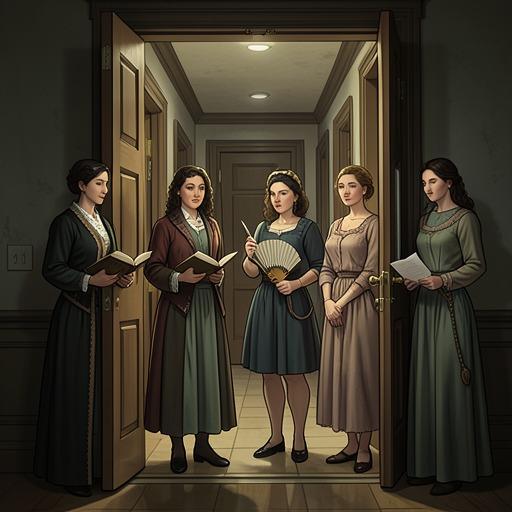
Lydia Bennet's forced marriage and departure for Canada
Just DesertsLydia Bennet's forced marriage and departure for Canada is the decisive containment of Lydia Bennet's social crisis: Lieutenant Cyrus Denny is compelled to marry her, receive a purchased commission in the 41st Regiment of Foot, and leave Britain for Canada. The arrangement preserves the appearance of respectability while functioning as punishment and exile. Lydia Bennet gains a husband and a formal status, but loses the protected domestic life she had known at Longbourn and is sent into the precarious world of a junior military officer's family.
Causes and Background
The immediate cause is Lydia Bennet's attempted elopement with Lieutenant Cyrus Denny. When Mr. Bennet and Colonel Foster are summoned to the Militia headquarters, the senior officers disclose that Lieutenant Denny has made a proposal of marriage to Lydia Bennet. The proposal is not presented as the result of a settled romantic decision. It is the institutional answer to a scandal that could otherwise damage Lydia's reputation and expose Lieutenant Denny to military punishment.
The arrangement is shaped by a wider history of coercive displacement. Lady Radha Pentland had been kidnapped as a child in Kutch and intended for slavery, rescued near the Arabian Peninsula, forced into a Spanish nunnery outside Cadiz, and later carried across the Atlantic after being assigned to a mission without meaningful consent. Her eventual marriage to Sir David Pentland followed years of captivity, injury, and social condemnation. That history gives the Denny marriage a grim contrast: formal marriage may offer protection, but the narrative repeatedly distinguishes genuine partnership from a transaction imposed on a vulnerable woman.
Elizabeth Bennet understands the issue in precisely those terms. In discussing her refusal of William Collins, she insists that she refused to be sold and argues that a bride cannot be forced to marry. Lydia Bennet's case is different in its immediate mechanics, but not in its underlying exposure of women's limited agency. The family and the authorities seek a solution to a public problem; Lydia's own wishes are absorbed into that solution rather than treated as its governing principle.
Military Pressure and the Marriage Settlement
Mr. Bennet explains that someone has purchased a commission for Lieutenant Denny, probably Edward Gardiner, at an estimated cost of between £500 and £1,000. The commission is the carrot. The stick is the threat that, if Lieutenant Denny does not complete the stated marriage plan, he will be court-martialled for desertion. If convicted, he could be shot. The officers describe the punishment as an example intended to enforce discipline within the Militia, making the marriage part of a military disciplinary mechanism rather than a private family reconciliation.
The arrangement also directs Lydia Bennet's future geographically and socially. Lieutenant Denny will join the 41st Regiment of Foot in Canada, and the marriage must take place quickly before the couple's departure. Mr. Bennet travels to Longbourn to obtain a common licence; the wedding is fixed for Friday, followed by departure a week later. Lieutenant Denny is to be escorted to Meryton by another officer of the regiment, and the newly married couple will then travel north to Liverpool for embarkation. Military administration therefore determines the timetable, route, employment, and destination of the couple's married life.
The threat is not merely symbolic. Lieutenant Denny offers immediately when confronted with the uncertainty of a court martial, the possibility of execution, and the opportunity to secure a commission in a regular Army regiment. The result is a forced choice between marriage and potentially fatal military consequences. The carrot-and-stick structure makes clear that the settlement protects public order and institutional discipline before it protects Lydia Bennet's happiness.
The Wedding at Longbourn
The wedding of Lydia Bennet and Lieutenant Cyrus Denny takes place on Friday, July 3, at Longbourn Chapel. Mrs. Bennet must be sedated to prevent her reaction from disrupting the ceremony, and the disorderly beginning remains unknown to the residents of Meryton. Friends and neighbours attend both the church service and the wedding breakfast, allowing the event to acquire the outward form of an ordinary respectable marriage.
The speed of the ceremony attracts speculation. Some guests suspect that the haste indicates something disreputable, but confirmation that Lieutenant Denny and Lydia Bennet are leaving immediately for Canada quiets most of the comments. Departure becomes the public explanation for urgency. It does not erase the scandal; it supplies a socially acceptable narrative that permits the community to stop asking questions.
Lydia Bennet responds with delight when she first hears that Lieutenant Denny has proposed. Her squeal of happiness and subsequent congratulations from Jane Bennet reveal her immediate excitement, but that excitement does not cancel the coercion surrounding the arrangement. The narrative holds both facts together: Lydia Bennet wants the marriage at the moment it is announced, while Lieutenant Denny has been driven to offer by the threat of military prosecution and death. Her emotional response is genuine, yet the circumstances governing the marriage remain forcibly arranged.
Departure and Exile
On Monday, July 6, 1812, Lydia Denny leaves Longbourn after stopping to say farewell. It is the last time any member of her family sees her. The departure is therefore more than a journey to a new posting. It is a permanent severing of Lydia Bennet from her family, her familiar home, and the social world in which her behaviour had produced the crisis.
Letters arrive only infrequently, and each contains a demand for money. Apart from Mrs. Bennet, no one sends additional funds. The material conditions of the marriage quickly replace the excitement associated with its announcement. Lydia Denny must live on the pay of a junior officer, reduced by deductions, with little entertainment and meagre rations. Longbourn had not been luxurious, but it had offered warmth, plentiful food, and a modest allowance. Canada thus becomes an imposed education in deprivation rather than a romantic adventure.
Lydia Denny does not blame herself for the resulting hardship. She believes that her family should have been more supportive and generous with money, and she does not change her view of her own conduct. This refusal of self-criticism prevents the marriage from becoming a conventional moral reform story. Lydia is not transformed into a more prudent or reflective woman by poverty; instead, the consequences confirm the family's judgment that she must be managed while also revealing how little protection the family was willing to provide.
Consequences and Narrative Significance
The 41st Regiment of Foot is assigned to India after the war with the Americans, extending Lydia Denny's displacement from Canada into another imperial posting. She has at least two children who survive infancy, but Lydia Denny and her family eventually disappear after reaching India. The marriage therefore produces a family line without restoring Lydia Bennet to the emotional or social network from which she was removed.
The event exposes several competing systems of power. Family reputation demands a rapid public settlement; military discipline threatens Lieutenant Denny with court martial and execution; purchased commissions determine social and professional mobility; and imperial deployment carries the new household across the Atlantic and ultimately to India. Lydia Bennet's life is redirected by these systems, yet none of them provides lasting security. Marriage supplies a legal form, military service supplies a destination, and family money supplies only limited relief.
Set against Lady Radha Pentland's history, Lydia Bennet's departure also sharpens the book's distinction between rescue and recovery. Lady Radha was carried across continents by kidnapping, piracy, religious authority, and colonial transport before Sir David Pentland offered care and partnership. Lydia Bennet is carried away through scandal, military coercion, and family management. Both stories show women moved by institutions and men, but the outcomes differ: Lady Radha's later life becomes associated with refuge and protection, while Lydia Bennet's marriage leaves her isolated, materially strained, and finally lost from the family's view.
The event consequently serves as a critique of social double standards and women's lack of agency. Lydia Bennet is given the appearance of respectability only after her choices have become dangerous to others, and the price of that appearance is removal. The marriage closes the immediate scandal, but it does not repair the family relationships or create a humane future. Its final image is not reunion but disappearance: a bride sent abroad, letters reduced to requests for money, and a family line that fades into the imperial distance.