Marriage as partnership
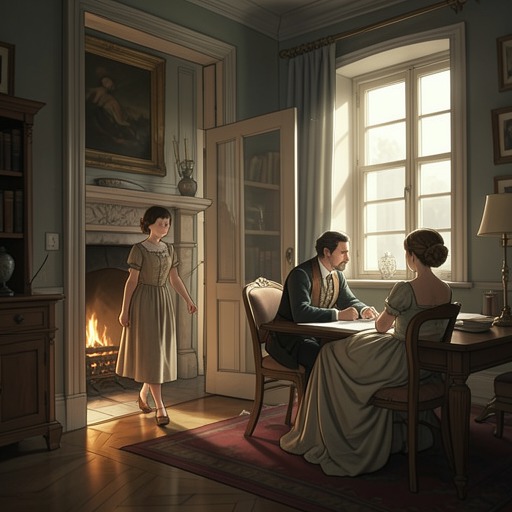
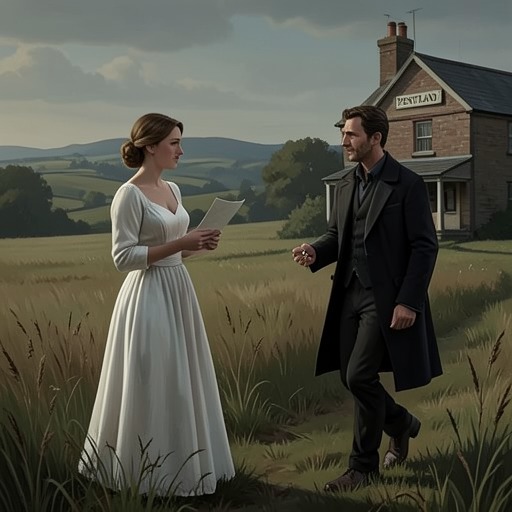
Just DesertsMarriage as partnership is one of the book’s clearest standards for judging intimate life. It contrasts a marriage built through sustained affection, mutual labor, and shared responsibility with unions organized around property, coercion, reputation, or inheritance. The model becomes visible to Elizabeth Bennet through Sir David Pentland and Lady Radha Pentland, and it shapes her understanding of what marriage should make possible: not merely security, but a life in which two people remain active participants in one another’s welfare.
The Pentland Model
Elizabeth’s education begins with Lady Radha Pentland’s account of her rescue and recovery. After Radha had been abandoned after enslavement, forced religious confinement, and four days in pirate hands, Sir David Pentland took her into his house in Barbados, where a housekeeper and nurse helped care for her through repeated infections. He continued to care for her even after learning what had happened to her before her rescue. When she disclosed the experience to him during their courtship, he took her hand and made clear that it did not alter his regard for her. Their relationship therefore begins not with an untouched reputation or a convenient social match, but with care, truth, and an acceptance of the whole person.
Elizabeth later observes that the Pentlands’ partnership extends far beyond romantic feeling. Lady Radha sets household menus and assists Sir David across the estate, while Sir David and Lady Radha continue to seek one another’s company after more than thirty years together. Their childlessness and limited social life do not diminish the marriage; instead, the narrative emphasizes their shared enjoyment of ordinary existence and presents them as a couple in the fullest sense. For Elizabeth, their daily companionship supplies a living answer to the question of whether love can endure beyond courtship.
Love Against Marriage as Transaction
The Pentlands’ example changes the terms by which Elizabeth interprets other marriages. She pities Charlotte Lucas because Charlotte’s marriage to William Collins appears to be concerned chiefly with material considerations rather than romantic or emotional attachment. Elizabeth consequently concludes that marriage should be about the other person, not merely about the things a marriage can provide. Jane Bennet’s declaration that she will marry only for the deepest love becomes especially significant because Elizabeth has secretly encountered a marriage that appears to embody that ideal rather than merely express it as a hope.
Elizabeth also compares the Pentlands with Edward Gardiner and Madeline Gardiner. The Gardiners are much younger and their household is occupied by children, business, and domestic demands, yet Elizabeth sees secure foundations in their affection and hopes that they will remain as happy after thirty years as Sir David and Lady Radha. The comparison prevents partnership from becoming a privilege available only to an unusually secluded or childless couple. Different circumstances produce different forms of shared life, but the underlying measure remains mutual regard.
The principle also governs Elizabeth’s refusal of William Collins. She insists that she cannot be forced into marriage and rejects the idea that a bride can be sold in order to preserve Longbourn. Her resistance separates love from obedience to family pressure: the issue is not simply whether Collins is personally unappealing, but whether marriage can be imposed as a property solution. Mrs. Bennet’s greater attachment to Longbourn than to Elizabeth makes the conflict a struggle over whether a daughter is to be treated as a person or as an instrument of estate preservation.
Partnership as Labor and Stewardship
The book gives partnership a material dimension through estate and household management. Elizabeth learns from Lady Radha how a wife can act as a helpmate in the administration of an estate, and she learns from Madeline Gardiner how household maintenance depends on schedules, staff coordination, and decisions about food and domestic resources. At the Gardiners’ house she sits in meetings with the housekeeper and cook, learning about cleaning, maintenance, and weekly menus. This education makes visible the practical labor that supports family life and social stability, much of which is conventionally treated as women’s natural duty rather than as expertise.
Elizabeth’s lessons also return to tenant welfare. She and Jane Bennet had begun visiting tenants when Jane was twelve and Elizabeth was ten, and Elizabeth explains that the knowledge gained through Lady Radha and the Grenadine Reef estate made their later visits at Longbourn more efficient and more useful. The master of an estate bears responsibility for tenants’ welfare, but the narrative shows that such responsibility is realized through repeated observation, conversation, care, and work. Partnership therefore joins affection to stewardship: spouses share not only private feeling but the obligations created by property, household, dependants, and community.
Elizabeth’s own development follows the same principle of active usefulness. Her time with the Pentlands teaches her to live “calmly active,” giving her the feeling of being valued while allowing her intelligence and kindness to contribute to Sir David’s recovery. Their connection benefits both sides. Elizabeth channels her energy into estate questions and correspondence, while Sir David receives her youth, enthusiasm, questioning nature, and practical sympathy. The relationship demonstrates that care need not produce dependence in only one direction; each person can sustain the other through different forms of contribution.
Inheritance, Mortality, and Difficult Choices
The ideal of partnership is tested when Sir David’s age and frailty make succession urgent. When Vivian Harkness asks what will happen to the estate after Sir David’s death, the question is improper for a servant but exposes the practical danger surrounding his household. Sir David recognizes that his mortality and Elizabeth’s vulnerability are connected, particularly because Elizabeth needs a means of escaping Mrs. Bennet before she reaches the security of legal adulthood.
After Sir David Pentland’s terminal stomach cancer is discovered, long-term plans become impossible. He explains that he has considered Elizabeth’s future since Lady Radha’s death and that the urgency increased after the previous autumn’s events. His proposed marriage arrangement involving Elizabeth Bennet and Fitzwilliam Darcy is deliberately troubling: it could protect Elizabeth and secure the estate, but it asks the young couple to suspend their personal happiness for a year. Sir David understands that the demand is emotional as well as financial. Darcy is torn between supporting Elizabeth and resenting interference in their lives, showing how easily protection can approach coercion even when its purpose is benevolent.
Inheritance law provides another pressure against which the partnership ideal must work. The Bennet family investigates the history of Longbourn from Martin Bennet, whose royal grant included the estate, through legal documents, parish records, and the Bennet Family Bible. The absence of a surviving male heir eventually breaks the entail. This legal development matters because it removes one of the principal forces that has made marriage appear necessary as a property transaction. Once the inheritance structure changes, Elizabeth can be treated less as a vehicle for preserving Longbourn and more as an adult capable of determining her own domestic and emotional future.
Refuge, Continuity, and Ethical Limits
The partnership model extends beyond marriage into institutional care. After Sir David’s death, Elizabeth insists that the dower house at Grenadine Reef continue as a refuge. She plans to consult Mrs. Perkins, Vivian Harkness, Violet Harkness, and the woman responsible for daily organization, while preserving the existing arrangements for food, provisions, transport, and funding. The refuge is self-contained and deliberately kept out of sight, making it a practical place of safety rather than a symbolic charitable gesture. Marriage, in this broader structure, supports recovery and independence instead of absorbing vulnerable women into another household under male authority.
The contrast with Lydia Bennet’s forced marriage is decisive. Denny’s offer is secured by both an inducement and a threat: he is promised between five hundred and one thousand pounds, but failure to carry out the marriage ruse would expose him to court-martial for desertion and potentially execution. The arrangement prevents immediate scandal and gives Lydia a legal husband, yet it is not a partnership formed through free mutual choice. By placing this coercive settlement beside the Pentlands’ care and the hoped-for unions based on love, the narrative distinguishes social containment from marital fulfillment.
Marriage as partnership consequently functions as both an emotional ideal and a critical instrument. It recognizes that affection must be enacted through daily work, that domestic and estate labor carry moral weight, and that legal or financial security cannot by itself create companionship. The book does not deny the force of inheritance, illness, reputation, or economic necessity; rather, it asks whether those pressures will be allowed to purchase a woman’s consent. The strongest marriages are those in which practical obligation and deep affection reinforce one another without reducing either spouse to property, caretaker, heir, or bargaining piece.