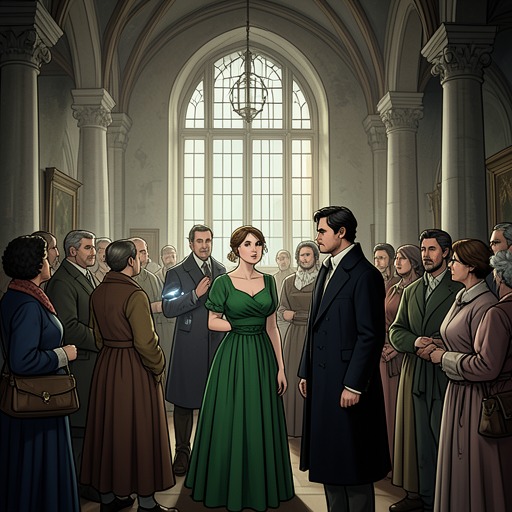
Meryton Assembly Rooms
Just DesertsMeryton Assembly Rooms function as both a physical gathering place and a social testing ground. In this crowded public room, introductions become consequential, dancing operates as an accepted form of courtship, and a single overheard judgment can establish a lasting antagonism. The assembly therefore gives visible form to the rules of the local marriage market while exposing the pride, vanity, and unequal social power beneath those rules.
Setting and Social Function
The assembly takes place at the beginning of autumn during an unusually warm spell. The weather, combined with the mass of bodies inside the building, makes the rooms stiflingly hot and creates a torpid, sweaty atmosphere. This physical discomfort is not incidental: the crowded room compresses the community into one space where everyone can see who has arrived, who is dancing, and who is being overlooked.
For the unmarried residents of Meryton, the rooms offer one of the few reliable opportunities to encounter eligible newcomers. The local supply of single gentlemen is limited, partly because travellers heading toward London generally do not wish to stop twenty-five miles short of the capital, while London residents seeking escape prefer to go farther than southern Hertfordshire. The continuing war on the continent further reduces the number of available men. Elizabeth Bennet has already danced with virtually every man in the neighbourhood over the preceding four years, so the arrival of the Netherfield party gives the assembly an unusual charge.
Introductions and Observation
At the assembly, Sir William Lucas introduces Mrs. Bennet, Jane Bennet, Elizabeth Bennet, and Mary Bennet as the Bennet family, whose estate is Longbourn and whose home lies close to Netherfield Park. Charles Bingley responds to the introduction and presents his party: Louisa Hurst, Mr. Hurst, Caroline Bingley, and his friend Fitzwilliam Darcy. The exchange places the Bennets and the newcomers within the same visible social field, allowing their manners, rank, appearance, and connections to be assessed at once.
Charlotte Lucas explains the practical meaning of such an occasion to Elizabeth. An assembly is a chance to see and be seen, and dancing is virtually the only proper way for an unrelated man and woman to spend sustained time together. Several dances may allow a prospective couple to learn about one another, while the event also lets people present themselves differently from the way they appear in ordinary daily dealings. The rooms thus turn social performance into a recognized mechanism of romantic selection: courtship begins not through private declaration but through public movement, repeated observation, and communal interpretation.
Darcy’s Insult
The location’s decisive incident occurs when Elizabeth hears Fitzwilliam Darcy remark that there is no other woman in the room with whom it would not be a punishment for him to dance. Although she initially regards Darcy as the most handsome man she has ever seen, his indifference quickly changes her response. He looks directly at her and dismisses her as “She is tolerable, but not handsome enough to tempt me; I am in no humour at present to give consequence to young ladies who are slighted by other men. You had better return to your partner and enjoy her smiles, for you are wasting your time with me.”
Because the words are spoken in the assembly’s public setting, the insult carries more than a private rejection. Elizabeth has barely been introduced to Darcy, yet he reduces her to an object of comparison and social consequence, implying that her value depends on whether other men have already favoured her. She keeps a composed outward appearance, but the dismissal first makes her sad and angry, then hardens into contempt. The room consequently becomes the birthplace of the antagonistic understanding that will govern the early relationship between Elizabeth and Darcy.
Narrative Significance
Meryton Assembly Rooms establish the novel’s central contrast between appearance and knowledge. The assembly promises that dancing and conversation can reveal character, but Darcy’s first public performance makes him appear arrogant and Elizabeth’s wounded intelligence turns the moment into a lasting verdict. The same social environment that presents courtship as orderly and respectable also enables humiliation, gossip, and rank-conscious exclusion.
The room’s importance extends beyond one evening. It introduces the principal local families, makes the scarcity of eligible men part of the social background, and demonstrates how quickly a public gathering can convert an impression into reputation. For Elizabeth, the assembly is the place where attraction is overturned by offense; for Darcy, it is the scene whose careless words help create the resistance he must later overcome. As a setting, it is therefore less a neutral hall than the first arena in which the book’s social rules, romantic misunderstandings, and struggles over judgment become visible.