Mr. Hurst
Just DesertsMr. Hurst is a minor but revealing member of the Netherfield Park party: Louisa Hurst’s husband, Charles Bingley’s brother-in-law, and a man whose social position does not translate into moral authority. He is most significant not for an independent quest or transformation, but for the way his passivity helps make the conduct of the Netherfield household visible. In the scenes surrounding Elizabeth Bennet’s stay there, Mr. Hurst belongs to a group of socially privileged men who watch bad behavior, permit it, and are forced into silence when Elizabeth demands that they answer for it.
Identity and Place in the Netherfield Party
Mr. Hurst accompanies Charles Bingley to Netherfield Park with his wife, Louisa Hurst, Bingley’s older married sister. Elizabeth Bennet describes the household as a party of five: Charles Bingley, his two sisters, Louisa’s husband, and Fitzwilliam Darcy, Bingley’s Cambridge friend. Mr. Hurst therefore enters the story as part of an affluent visiting circle whose occupation of a leased country estate gives its members temporary local prominence.
His position is socially dependent as well as socially comfortable. Charles Bingley is the leaseholder and is experiencing the role of estate master for the first time, while Mr. Hurst is attached to that household through marriage. The arrangement places him among people able to command attention in Meryton and to expect deference, yet it does not make him an active decision-maker. His importance lies in the contrast between the authority suggested by his class position and the weakness of his conduct when that authority is tested.
Conduct at Meryton and Netherfield
At the Meryton Assembly, Mr. Hurst is part of the evening’s disordered social tableau. Elizabeth Bennet recalls that Kitty Bennet and Lydia Bennet became intoxicated, flirted with officers in red coats, and that Lydia waved a sword; meanwhile, Mrs. Bennet quarrelled loudly with Lady Lucas over the supposed imminent engagement of Jane Bennet and Charles Bingley. Mr. Hurst’s own prominence in the account is less a dramatic action than an atmosphere of indulgence: he belongs to the company in which impropriety, drink, boasting, and family embarrassment are allowed to accumulate.
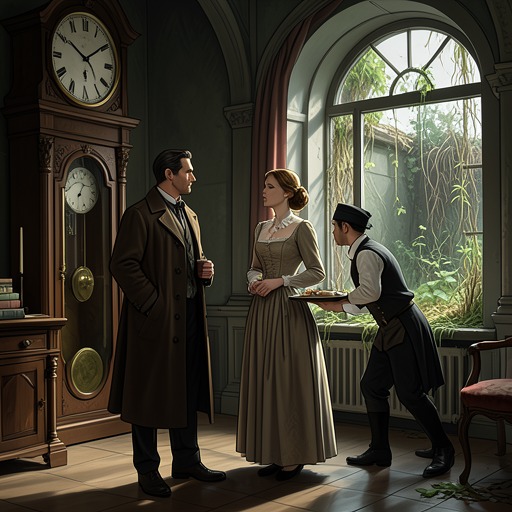
His more specific failing appears at Netherfield Park. When Caroline Bingley insults Elizabeth Bennet, Mr. Hurst is initially asleep or incapacitated with drink on a sofa, described as being passed out drunk “as usual.” That detail makes his negligence habitual rather than exceptional. His condition removes him from the conversation at the precise moment when an adult gentleman might be expected to restrain Caroline or defend a guest.
The Confrontation with Elizabeth Bennet
After Elizabeth Bennet rebukes Caroline Bingley as uneducated, inhospitable, and socially presumptuous, she turns on the men who have allowed Caroline to behave that way. Jane Bennet reports that Elizabeth challenges Charles Bingley, Fitzwilliam Darcy, and Mr. Hurst for failing to act as gentlemen toward a guest. Mr. Hurst is awake by then, unlike during the earlier part of the scene, but wakefulness does not produce a defence or an apology.
The three men are stunned and say nothing. Their silence is consequential: it confirms Elizabeth’s accusation that they have not behaved as gentlemen. Fitzwilliam Darcy later recognizes that he and the others had offered Caroline tacit encouragement by remaining silent, and he understands Elizabeth’s judgment as deserved. Mr. Hurst thus functions as one member of a collective masculine failure. He does not originate Caroline’s attack, but his inaction helps sustain it, and his inability to answer Elizabeth leaves the men morally exposed.
Social Function and Characterization
Mr. Hurst is drawn through repeated signs of appetite, leisure, and passivity rather than through articulated principles. His habitual drunkenness makes him a comic and degrading presence within an otherwise polished household, while his silence during Caroline’s attack reveals how privilege can operate through non-intervention. The men do not need to insult Elizabeth themselves; by allowing Caroline to do so, they participate in the social exclusion she attempts.
The contrast between Mr. Hurst and Elizabeth Bennet sharpens the scene’s reversal of authority. He occupies a protected male position within the Netherfield party, but Elizabeth, the guest with less wealth and less institutional power, becomes the only person willing to name the group’s failure. Her accusation turns the supposed hosts into defendants and leaves Mr. Hurst without a credible response.
Consequences and Narrative Significance
Following the confrontation, Jane Bennet and Elizabeth Bennet leave the room and retire for the night. They rise early and walk home before breakfast because, after Elizabeth’s words, they can hardly ask Charles Bingley for his carriage, while Mrs. Bennet will not send their own. Jane is willing to risk renewed illness rather than remain another moment at Netherfield Park. Mr. Hurst’s conduct contributes to the breakdown of the household’s hospitality: the guests depart on foot, and the men who should have protected the civility of the visit have helped make departure necessary.
Mr. Hurst’s later narrative significance remains tied to this episode. Fitzwilliam Darcy remembers that Elizabeth’s rebuke was directed not only at Caroline Bingley but also at Mr. Hurst, Charles Bingley, and himself, and that Jane Bennet witnessed their sneers, Caroline’s uncontrolled speech, and the men’s silence. Mr. Hurst consequently serves as a fixed point in Darcy’s self-reproach. He embodies the complacent, socially insulated man who can be drunk, silent, and uninvolved while still benefiting from the power of the household around him.