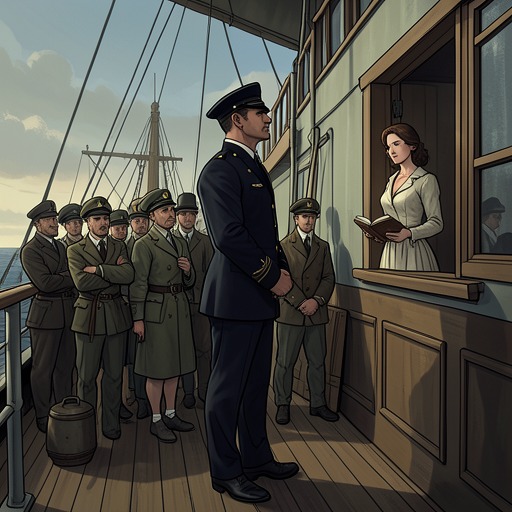
Radha Pentland’s marriage to Sir David Pentland
Just DesertsRadha Pentland’s marriage to Sir David Pentland is the decisive act by which a life shaped by captivity and imposed identities becomes a chosen household partnership. It joins an Indian survivor of enslavement, piracy, and religious coercion to a British naval hero who responds to her injuries not with disgust or social calculation but with sustained care. The marriage also becomes the foundation of their long life together in Britain, their purchase of Grenadine Reef, and the moral example through which Elizabeth Bennet later understands love, responsibility, and what it means to be a gentle-born lady.
Origins and Forced Displacement
Radha’s marriage cannot be separated from the chain of movements that preceded it. Born Radha Bhimani in Kutch in western India, she lost her mother in childbirth and was raised by her paternal grandmother and aunts. Her childhood was repeatedly disrupted by fighting among the Mughals, the Marathas, and the British. Because her Hindu family lived in a district conquered by Muslim Mughal forces, they fled and later returned; further political change brought the British into the same unstable landscape. Radha’s memories of the sequence had become fragmented, but the pattern was clear: war and imperial rule repeatedly made home precarious.
Her father remarried, yet Radha never lived with him, his new wife, or the siblings born from that union. When she was only a year older than Elizabeth Bennet at the time of their conversation, she was kidnapped for sale into slavery. Rescue came before the sale could be completed, but it did not restore her to India. A Spanish ship carrying several priests took her aboard off the coast of the Arabian Peninsula, taught her rudimentary Spanish, and carried her to Spain. The safety of that rescue had a coercive price: once she reached Spain, she was forced into a nunnery and remained cloistered outside Cadiz for six years.
At twenty-one, Radha was selected for a mission to South America and was given no say in the decision. In the spring of 1772, she and twenty-nine other members of her order sailed from Cadiz toward Cartagena on the Spanish Main. Her life before meeting Sir David therefore consisted not of one settled migration but of repeated compulsory relocations: flight from war, kidnapping, transport across the sea, confinement in a religious institution, and another assigned voyage. The marriage later matters because it is the first major change in this sequence that Radha can accept as her own decision.
Rescue, Injury, and Courtship
The ship carrying Radha and the religious order was captured by pirates during the voyage. The captivity lasted four days, and the conditions were grim. During the battle in which Sir David and the crew of HMS Glory engaged the pirates, the pirate captain dragged Radha onto the deck and stabbed her with a sword. The wound passed through her womb. As she collapsed in agony, her last apparent sight was Sir David cutting the pirate captain through the neck. The violence that had defined her earlier life thus reached its most intimate form at the very moment when rescue arrived.
Radha survived wounds that were considered nearly uniformly fatal. She received the last rites and continued to linger while fighting the infection. The rest of the surviving order was landed under a white flag of neutrality and continued onward, but Radha was too ill to be moved and was left behind. Sir David brought her to his large house in Bridgetown on Barbados, where his housekeeper and a nurse helped him care for her. Even with that personal attention, she nearly died twice before finally overcoming the last infection. By the time she recovered, she was an Indian woman who spoke Spanish, a forced nun separated from her order, a survivor of four days of pirate depredations, and a patient living in the home of a British naval hero.
Sir David’s care becomes the practical beginning of their relationship. After eleven weeks had passed since the original capture of her ship, Radha understood that she was alive in substantial part because of him. She regarded him as an exceptionally decent and kind man, but she did not allow gratitude to erase the need for honesty. For propriety, she moved into the home of a widow known to him, and Sir David began to court her. During one difficult afternoon, she alluded to what had happened during the four days before her rescue. He took her hand and told her that it did not matter.
That response is presented as extraordinary rather than socially ordinary. Elizabeth understands that Sir David’s reaction was not guaranteed and that Radha’s account makes it unusual. Radha had been subjected to innumerable crimes for nearly ten years, yet the surrounding society treated her survival as an embarrassment. She heard more than once that it would have been better if she had died from her wounds. Her supposed original fault was merely having lived too near the coast in India, where slavers could capture her. Barbados shunned her despite the fact that she had been the victim, not the author, of the crimes committed against her.
Marriage and Resettlement
The treatment of Radha became the final reason Sir David abandoned his naval career. He had already been knighted for his actions, but his uncertainty about continuing in the service hardened into resignation after witnessing the contempt directed toward the woman he had rescued and loved. The marriage therefore joins private affection to a public refusal: Sir David would not preserve his career at the cost of accepting the social punishment imposed on Radha.
Radha willingly converted, though she admitted that the conversion was superficial, to the Church of Scotland. She and Sir David married in his home town outside Edinburgh, then travelled to London after their wedding. There they learned of an estate available for purchase and acquired it. The couple subsequently lived there for thirty-two years, establishing the household later known as Grenadine Reef. Their movement from Barbados to Britain was not simply a return to Sir David’s professional world; it was a relocation into a shared domestic and landed life in which Radha was no longer a rescued dependent or a cloistered religious subject.
The marriage also carried physical consequences that shaped their household. Radha’s injuries meant that she could not bear children. Elizabeth later describes her as a shy woman born in India, kidnapped three times, horribly treated by pirates, and ultimately settled in Hertfordshire, while noting that she and Sir David were rarely visible in society. Their childlessness and limited social appearance did not diminish the marriage’s durability. Instead, the relationship is measured through care, loyalty, and daily responsibility rather than through heirs, display, or conventional social approval.
Example and Afterlife
For Elizabeth, Radha and Sir David’s marriage becomes a living alternative to the marriage market’s logic. Elizabeth had learned from Radha’s experience that a woman could be blamed for the violence done to her and judged by the social meanings attached to her body, birthplace, religion, and survival. Sir David’s conduct rejects that logic: he nurses Radha, hears what she can disclose, accepts her without demanding a spotless history, and changes the course of his own life in response to the injustice surrounding her.
Radha’s influence on Elizabeth is not merely emotional. Over eight years, Elizabeth learns what it means to be a lady chiefly through the examples of her aunt Madeline Gardiner and Lady Radha. The two women differ sharply in background and social activity, but both teach lessons connected with love and the practical realities of daily life. Radha’s visits to tenants at Grenadine Reef help Elizabeth and Jane Bennet conduct their own tenant visits at Longbourn more effectively. Through the marriage’s household, estate, and charitable consequences, Radha’s experience is converted into an ethic of active responsibility.
The union’s later significance is intensified by Radha’s sudden death from apoplexy in her sleep. More than a month after her death, Elizabeth visits the small chapel at Grenadine Reef and sees the devastation of Sir David’s bereavement: the light has gone from his life. Their marriage is thus shown not as a convenient arrangement that ends when its practical purposes are fulfilled, but as a bond whose loss leaves Sir David visibly altered. Its endurance is finally registered through grief, memory, and the obligations that Radha’s example continues to impose on Elizabeth and on the estate.
Legal and Moral Tensions
The marriage also exposes the conflict between formal institutions and lived justice. Radha’s passage through several systems of authority was repeatedly marked by the absence of meaningful consent: war displaced her family, slavers kidnapped her, Spanish clergy confined her in a nunnery, and the mission to Cartagena assigned her a new destination without consultation. Against that history, Sir David’s courtship begins only after she has been moved to a widow’s home for propriety and has been given the opportunity to disclose what she could about her captivity. His acceptance does not erase the violence, but it refuses to convert that violence into a reason to deny her the possibility of marriage.
The contrast becomes especially sharp when placed beside Elizabeth Bennet’s later refusal of William Collins. Elizabeth insists that a bride cannot be forced to marry and rejects the notion that she can be sold for the sake of Longbourn. Radha’s story gives that principle an earlier, harsher historical depth: Radha had literally been targeted for sale, while respectable society continued to judge her as though her victimhood were a stain. Sir David’s marriage to her therefore stands against both the commodification of women and the social double standard that excuses harm to women while condemning their survival.
Household, Estate, and Responsibility
Once settled in Britain, the marriage expanded beyond private protection into an organized household and estate community. Radha’s inability to bear children, caused by the pirate captain’s wound through her womb, meant that the couple could not build their future through descendants. Their life at Grenadine Reef instead acquired continuity through stewardship, tenant visits, and the humane administration of property. Elizabeth later identifies this practical attention to tenants as one of the lessons Radha taught her, even when the lesson was conveyed through ordinary activity rather than formal instruction.
Sir David’s later concern for the estate shows how closely the marriage’s emotional history is tied to succession and responsibility. After Radha’s death, his mortality became more pressing, and he began seeking a way to protect both Elizabeth and the future of Grenadine Reef. He had already recognized that Elizabeth’s difficulty at Longbourn was connected to his own lack of a clear solution. As he became slower, frailer, and more susceptible to cold, the question of what would happen to the estate could no longer be postponed. The household Radha and Sir David created thus survives them only through deliberate planning rather than through an uncomplicated hereditary line.
Sir David eventually explains that he had begun thinking about Elizabeth within a year of meeting her, although his original will left everything to his twin brother. After Radha’s death, and especially after the events of the previous autumn made Elizabeth’s reaching her majority essential to her escape from Mrs. Bennet, he considered how to assist her. The discovery of his cancer then compressed a long-term plan into weeks. He arranged for James Pentland to witness a new will, the marriage settlement, and the wedding, while a doctor and the local magistrate attested that he remained of sound mind. The proposal required Elizabeth and Fitzwilliam Darcy to place their personal happiness on hold for a year, making the estate’s continuity inseparable from an emotional sacrifice.
Lasting Significance
The union’s legacy reaches beyond Radha and Sir David because it supplies the standard against which later relationships are judged. Elizabeth sees that love is not a decorative sentiment or a financial transaction: it is care enacted under pressure, honesty offered despite shame, and responsibility accepted when society would prefer abandonment. Sir David’s conduct toward Radha becomes the model that allows Elizabeth to distinguish a partnership grounded in respect from an arrangement designed merely to preserve property or reputation.
Radha’s marriage also gives the novel a cross-imperial history that unsettles the apparent quiet of British landed life. Kutch, the Arabian Peninsula, Spain, Cadiz, Cartagena, Barbados, Edinburgh, London, and Hertfordshire are linked through one woman’s forced movements and one man’s decision to care for her. The connection reveals how slavery, piracy, religious authority, naval power, colonial conflict, and English estate society belong to the same historical world. Grenadine Reef is therefore not an isolated country house: it is the final form of a life assembled from displacement, rescue, illness, resistance, and chosen belonging.
The marriage ends biologically with Radha’s death, but not morally or narratively. Her absence leaves Sir David bereft, while her example remains active in Elizabeth’s education, her treatment of tenants, and her understanding of female dignity. The couple’s thirty-two years together provide the emotional foundation for that inheritance. What began with an injured survivor being carried into a naval hero’s house becomes a durable household ethic: women are not commodities, suffering is not culpability, and a marriage proves its worth through the freedom, protection, and responsibility it makes possible.