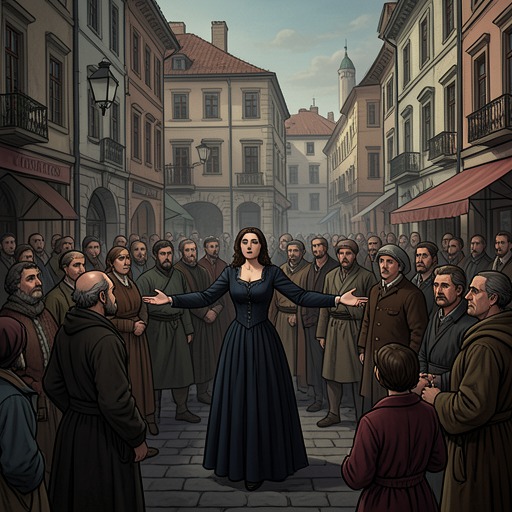
Regency British class society
Just DesertsRegency British class society governs the characters’ choices long before they understand it as a political system. Its visible surface is made of assemblies, estates, titles, letters, and marriage prospects; beneath that surface lies a harder structure of inheritance, parliamentary authority, gendered dependence, military discipline, and access to reliable networks. Elizabeth Bennet’s experience gives the society its sharpest perspective: she is born into a respectable family but denied secure control of its estate, while her later wealth and connections grant her practical independence without automatically granting the formal political power possessed by titled men.
Rank, Inheritance, and the Marriage Market
Regency British class society begins with the family estate and the rules governing its transmission. At Longbourn, the entail excludes the female line, and Mrs. Bennet’s fear that her daughters will be “thrown into the hedgerows” turns Jane Bennet’s first appearance in society into an urgent economic project. The pressure is not simply maternal vanity. Because no son is expected to preserve the estate, marriage becomes the family’s principal defense against dispossession. Elizabeth understands the logic while rejecting the human cost: her mother’s anxiety about Longbourn has become more powerful than any demonstrable concern for Elizabeth herself.
The novel presents marriage as a mechanism for arranging rank, property, connections, and future succession. Elizabeth explains that families marry their children to increase “the connections, the power and the wealth of their family,” while sons who cannot inherit enter professions and daughters are married into advantageous alliances. A baron’s daughter may marry a viscount and become a countess; a wealthy untitled man may be acceptable when his fortune compensates for his lack of rank; and an heiress may be desirable because her estate can strengthen another family’s position. The apparent romance of society therefore rests on a material grammar in which title, dowry, inheritance, and proximity to power are continually assessed.
The breaking of the Bennet entail reveals that such arrangements are historical rather than natural. The family’s investigation traces the line from Martin Bennet, whose royal service brought the deed to Longbourn, through successive legal records, parish documents, and the Bennet Family Bible. Once the last male heir dies without male issue, the entail is broken. A rule that had shaped several generations of women’s fears can therefore disappear through documentary proof and a break in the male succession. The episode makes institutional change visible: the social order seems immovable while it operates, but a legal fact can expose its contingency.
Political Power and Social Influence
The society distinguishes sharply between wealth and political power. Elizabeth describes a titled relative who sits in the House of Lords and votes on laws that may determine how ordinary people fare, including merchants whose trade depends on legislation affecting commerce with the Continent. Wealth can purchase security, employ servants, support estates, and create influence, but a title supplies a formal political voice that money alone does not provide.
This distinction remains important within Elizabeth’s later family. The Darcys are wealthy and possess extensive connections, yet Elizabeth explains that they do not possess the same direct power as a Marquess, an Earl, or other members of the House of Lords. Her relatives may disagree with titled men over the Reform Act, but their wealth and influence cannot turn that disagreement into an equal political contest. The family must therefore be careful in aristocratic company. Social intimacy does not erase institutional hierarchy, and kinship does not guarantee political authority.
The novel also treats social gatherings as instruments of class organization. An Assembly is not merely entertainment: it is where newcomers are assessed, eligible men are counted, and families measure their prospects. When Elizabeth asks whether the Bingley party will attend the evening Assembly, the arrival of two single gentlemen is immediately understood as a welcome addition to the local marriage market. The event’s conversational economy reduces strangers to possibilities, while the question of who attends determines which connections may become available.
Gender, Visibility, and Domestic Constraint
Class hierarchy is inseparable from gender. Elizabeth’s early life at Longbourn is shaped by the fact that women can belong to an estate without securely controlling it. The entail transforms the house into both home and threat: Elizabeth feels safe among the tenants and knows the land intimately, yet the legal structure denies her family a permanent female claim. Her walks along the northern boundary, reached by avoiding the visible path from the parlour window, also suggest how movement is regulated by observation. She can act independently only by managing when and where she may be seen.
That tension continues in her social life. Elizabeth’s visits to Grenadine Reef occur only during a small portion of the week and are carefully chaperoned, allowing her to maintain an otherwise conventional routine while concealing the significance of her relationship with Sir David Pentland. Her mobility is possible because it is made to appear respectable and ordinary. The rules of propriety do not eliminate women’s activity; they determine the conditions under which that activity can remain legitimate.
Elizabeth’s refusal of William Collins’s proposal gives the system a direct moral challenge. She argues that a bride cannot be forced to marry and that she will not be “sold” for the sake of Longbourn. Her appeal to the biblical injunction that parents must not provoke their children to anger exposes the asymmetry in the household’s moral expectations: daughters are told to obey and honor parents, while parental authority is treated as if it carried no corresponding duty of care. Marriage freedom is thus presented not as a romantic luxury but as a safeguard against converting a woman into an instrument of estate preservation.
Military Authority and Imperial Networks
Military institutions extend class society beyond the drawing room. The local militia brings a large body of unfamiliar men into Hertfordshire and increases the risks faced by women walking without escorts. Elizabeth’s awareness of the militia is therefore practical as well as social. Sir David Pentland’s jaundiced opinion of the organization makes her more alert to the danger its presence may create for her younger sisters, showing how military arrangements produce consequences in civilian domestic space.
The militia also reveals the difference between social misconduct and institutional discipline. When Lieutenant Denny proposes marriage to Lydia Bennet, the offer is not simply the result of affection or generosity. Military headquarters informs the family that Denny has purchased a commission in the 41st Regiment of Foot and will depart for Canada, while the threat behind the arrangement is that failure to complete the marriage ruse could expose him to a court martial for desertion and possibly execution. The “carrot” is a regular commission and a specified financial inducement; the “stick” is military law and exemplary punishment intended to discourage wider indiscipline. Lydia’s forced marriage is consequently produced by the collision of private scandal with the coercive machinery of the army.
The imperial world also complicates the relation between rank and service. Sir David Pentland’s life leads from the disadvantage of being the younger twin, who cannot inherit his father’s estate, into the Royal Navy and eventually into wealth, responsibility, and landed status. His trajectory shows a society in which professional service can create an alternative route to prominence, but not necessarily political equality. The family’s later concern for men who have lost limbs in service similarly exposes the human costs hidden beneath national prestige. Elizabeth supports the employment of disabled veterans, treating social responsibility as an obligation owed to those whose service has sustained the country’s power.
Mobility, Networks, and Social Contradictions
Regency British class society is rigid, but it is not closed. Movement between positions occurs through marriage, trade, military service, inheritance, and carefully maintained relationships. Catherine Bennet’s marriage to Nicholas Charrington, heir to a substantial brewing concern, demonstrates that commercial wealth can rival traditional status even when it is treated as socially inferior. Mary Bennet’s marriage to Oliver Jackson shows another route through which professional achievement can become institutional power: a clergyman who rises to be Bishop of Oxford eventually sits in the House of Lords.
These cases complicate the assumption that every family follows a single path. Lily marries a second son who is initially a solicitor, expecting to make his own way, and becomes a viscountess only because the heir dies prematurely. Georgiana Darcy chooses a more conventional aristocratic life after witnessing Elizabeth’s marriage and household, eventually marrying a viscount whose succession carries him to a marquessate. The contrast suggests that class identity is shaped by both structure and choice: individuals inherit opportunities and constraints, but they may still select different ways of inhabiting them.
The novel’s broader social map is therefore made from estates, churches, assemblies, military headquarters, commercial firms, and aristocratic parliamentary families. Elizabeth’s path through these spaces—from Longbourn’s threatened female household to the wealth and responsibility of the Darcy family—does not abolish hierarchy. Instead, it makes the hierarchy legible and permits her to redirect resources toward women’s refuge and injured veterans. The decisive alternative to the system is not withdrawal from society but the deliberate use of wealth, knowledge, and connections to widen the choices that the system ordinarily denies.