Royal Navy
Just DesertsThe Royal Navy is more than the professional background of Sir David Pentland and later naval officers. It is the institution through which the narrative connects Hertfordshire estates to the Caribbean, Spain, the Arabian Peninsula, Gibraltar, Malta, and the wider imperial economy. Its ships rescue Radha Bhimani from pirates, its officers accumulate honor and wealth through dangerous maritime action, and its veterans continue to shape domestic life after leaving the service. The Navy’s influence reaches from battlefield decisions to marriage, property, employment, protection, and the moral obligations owed to people damaged by war.
Nature and Imperial Reach
The Royal Navy appears as a mobile institution operating across a world structured by war, trade, colonization, and forced movement. Radha’s history brings this global dimension into sharp focus. Born in Kutch in western India, she experienced repeated displacement during conflicts involving the Mughals, the Marathas, and the British. After she was kidnapped as a child for sale into slavery, she was rescued off the coast of the Arabian Peninsula by a Spanish ship carrying priests. That rescue did not return her home: she was taken to Spain, compelled to enter a nunnery outside Cadiz, and later sent without meaningful choice on a mission toward Cartagena.
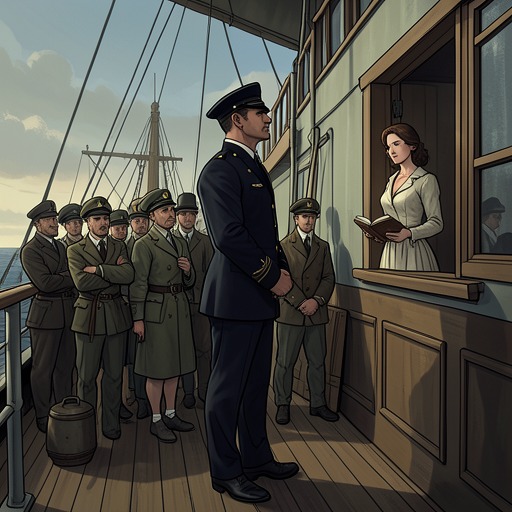
Her ship was captured by pirates, and her fate became entangled with the Royal Navy when Sir David, commanding HMS Glory, engaged the pirate vessel and freed the surviving members of the religious order. Radha had been attacked and displaced across several political and cultural worlds before a British naval operation changed the immediate course of her life. The institution thus enters the story as a force capable of interrupting private violence, while also reminding readers that maritime routes connected slavery, religious coercion, piracy, military intervention, and colonial administration.
Sir David Pentland and Naval Service
Sir David’s identity is inseparable from his long career in the Royal Navy. Although he came from East Linton, where his twin brother James was destined to inherit the family lairdship, Sir David had to find a profession as a younger son. With his father’s assistance, he entered the Navy as a midshipman in 1753 and spent the next twenty years at sea. His career gave him an alternative source of status and wealth, independent of the inheritance that would pass to his brother.
His public reputation rested chiefly on a single celebrated exploit. In 1770, as the newly appointed captain of HMS Glory, he was sent to the West Indies after the ship had been refitted at Plymouth. The Admiralty demanded that the vessel reach its station immediately, even though the hurricane season had begun. HMS Glory encountered the edge of the first hurricane, suffered damage to its spars, and sustained several injuries among the crew, including one broken leg, but survived. A Spanish treasure galleon attempting to reach Havana ahead of the storm was less fortunate: it ran aground on a reef near one of the Grenadine Islands and broke apart, with nearly all its crew perishing in the wreck.
When HMS Glory reached the wreck two days later, only part of the hull remained wedged on the reef. Sir David and his crew salvaged a substantial portion of the treasure before the wreck was destroyed and sank. The action earned him a knighthood, while his share of the captured treasure financed the purchase of Grenadine Reef. The estate’s name preserves the maritime origin of the family fortune, turning a distant reef and a wrecked Spanish vessel into a permanent feature of an English landed identity.
Rescue, Honor, and Moral Contradictions
The Navy’s rescue of Radha is presented as an act of courage and personal decency, but the surrounding circumstances prevent the institution from becoming a simple emblem of virtue. Sir David’s crew freed her from pirates after she had endured four days of captivity, and Sir David personally helped preserve her life after she was stabbed by the pirate captain. He took her into his house in Bridgetown, Barbados, where his housekeeper and a nurse helped care for her through severe infection. She nearly died twice before recovering.
Sir David’s conduct contrasts sharply with the social response Radha received once her survival became certain. She had been kidnapped, enslaved in intention, imprisoned in a nunnery, captured by pirates, and gravely wounded, yet people on Barbados treated her survival as an embarrassment and suggested that it would have been better had she died. Her supposed fault was merely living near the coast in India, where slavers could seize her. The Navy therefore becomes associated with rescue at sea while the society surrounding imperial power reproduces blame and exclusion on land.
That treatment helped determine Sir David’s later course. Already uncertain about continuing his naval career, he regarded the hostility directed at Radha as the final reason to resign his commission. He returned with her to Britain, converted, at least superficially, to the Church of Scotland, married her near Edinburgh, and eventually settled at Grenadine Reef. The naval institution gave him rank, honor, and wealth, but his moral response to its surrounding society required him to abandon active service.
Wealth, Estate Management, and Naval Networks
The fortune created by the treasure salvage continued to shape the Royal Navy’s indirect influence after Sir David’s retirement. He and Radha lived quietly, spent little on fashionable entertainments, and invested their surplus income. Their wealth expanded Grenadine Reef, funded the purchase of smaller estates, and later supported commercial opportunities connected to maritime consumption. When Elizabeth surveyed servants, tradesmen, and workers about the beer they preferred, she identified breweries in Alton and Lewes and proposed acquiring nearby hops and barley acreage. She also urged investigations into breweries in Southampton and Portsmouth, reasoning that merchant ships and the Royal Navy consumed large quantities of beer.
This episode shows Elizabeth translating naval knowledge into estate strategy. The Navy is not only a fleet at war; it is also a large, recurring market whose needs can reorganize agricultural investment. The same imperial system that produced Sir David’s prize money and estate also creates commercial demand for food and drink. Maritime power is consequently converted into landownership, capital accumulation, and local employment, even as the novel keeps the violence underlying that wealth visible.
The Navy also provides the framework for Elizabeth’s education in responsibility. After Lady Radha’s death, Sir David, a retired Royal Navy captain and knighted hero, was emotionally lost and unsure what to do. Elizabeth, though sixteen and fifty-one years younger than he, resolved to help him because he and Radha had helped her. His naval past gives him authority, but it does not protect him from grief or uncertainty. Elizabeth’s practical partnership with him allows the discipline, resources, and obligations associated with naval service to continue in the management of Grenadine Reef.
Veterans, Discipline, and Continuing Consequences
The Royal Navy’s effects remain evident in the treatment of former personnel. When Elizabeth became one of the richest women in the country, Edward Gardiner insisted that she travel with additional protection because secrecy about her wealth could not guarantee safety against kidnapping. She required two of her four bodyguards to be disabled former Royal Navy men, each of whom had lost an arm in battle and struggled to find employment. By placing them within a larger team, she gave them work while preserving the protection she needed. The Harkness sisters were also armed, and the coach carried muskets, although none of the weapons ultimately had to be used.
This employment choice changes the meaning of military protection. Elizabeth is not merely purchasing security from anonymous professionals; she is creating a place in civilian life for men whom service had injured and society had difficulty employing. Darcy recognizes the importance of the decision, telling Elizabeth that her example has made him think about ways to support former soldiers and sailors struggling with disabilities. The book thus moves from admiration for naval heroism toward a broader question: what obligations remain after the uniform, the battlefield, and the public honors have ended?
The Navy’s institutional culture also stands beside the less secure world of the Militia and the regular army. When Lydia Bennet’s relationship with Lieutenant Denny threatened scandal, military authorities forced the situation toward marriage. Denny had purchased a commission in the 41st Regiment of Foot and was due to leave for Canada, but he was warned that failure to carry out the stated marriage ruse could lead to a court-martial for desertion and even execution. The contrast places naval service within a larger military system in which commissions, discipline, deployment, and imperial posting shape private choices. The Navy is not identical with the Militia or the army, but the comparison clarifies the different forms of authority operating through Britain’s armed forces.
Later Naval Continuity and Narrative Significance
Naval service continues into the next generation of the story. In 1813, Jane Bennet traveled toward Malta with the Maitland party, only to be left at Gibraltar when an outbreak of plague made it impossible to proceed. There she met a naval captain, married him before reaching Malta, and followed him through successive postings for twenty years until his retirement as a Vice-Admiral. Her marriage extends the naval network from Sir David’s Caribbean career into Mediterranean and colonial administration, showing how service relocates families as well as officers.
The Royal Navy also remains embedded in the physical inheritance of Grenadine Reef. When Elizabeth and Fitzwilliam Darcy divided their estates among their children, they retained the land around the dower house and built St. Vincent Lodge there. The lodge was named after the nearest large island to the place where Sir David had found the wrecked treasure ship. The family’s future geography therefore continues to be organized by a naval event from the previous generation.
As an organization, the Royal Navy carries the book’s central tensions between violence and rescue, mobility and displacement, public honor and private cost. It enables Sir David to become a captain and knight, allows him to rescue Radha, and provides the prize that establishes Grenadine Reef. Yet its world is also inseparable from piracy, imperial conflict, colonial routes, wounded veterans, and the social consequences of military power. The Navy’s most lasting achievement in the narrative is not simply the treasure recovered from the reef, but the chain of responsibility that follows it: care for a survivor, stewardship of an estate, employment for the injured, and a family history permanently marked by the sea.