Sir David Pentland's marriage settlement
Just DesertsSir David Pentland's marriage settlement is the central legal mechanism in Sir David Pentland's last attempt to protect Elizabeth Bennet and preserve the future of Grenadine Reef. It is not an ordinary domestic contract: created under the pressure of terminal illness, disputed family interests, and Elizabeth's need to escape Longbourn, it joins marriage, property, inheritance, and female independence into one urgent institutional act.
Purpose and Circumstances
The settlement arises after Sir David tells Elizabeth that he is dying. His doctor believes he will not last the year, and his illness has advanced from a constant stomach ache with occasional spikes of pain to a rapidly shortening prognosis. Sir David had already begun considering Elizabeth's future after Lady Radha Pentland's death and after recognizing how important it was for Elizabeth to reach legal adulthood and escape Mrs. Bennet. The discovery of cancer removes the time needed for a slower plan, forcing him to replace long-term arrangements with documents that can take effect almost immediately.
The proposal is therefore a response to several pressures at once. Elizabeth has rejected the prospect of being treated as property in the marriage negotiations surrounding William Collins, insisting that a bride cannot be forced to marry and that she will not be sold for the sake of Longbourn. Sir David, meanwhile, must decide what will happen to his estate when his own death is near. His servants Vivian Harkness and Violet Harkness even ask him directly what will happen to the estate after his death, an inappropriate question from servants but one that exposes the practical uncertainty surrounding succession. The settlement gives that uncertainty a formal answer.
Drafting and Legal Safeguards
Sir David asks his brother James Pentland to witness the will, the settlement, and the wedding. He also arranges a letter in which his doctor and the local magistrate, Sir Frederick Wright, attest that he is of sound mind even though he is physically failing. James witnesses that letter as well. This documentation is designed to make the transaction watertight: the settlement is not left to the authority of a dying man's unsupported word, but is surrounded by witnesses, medical evidence, official certification, and a public ceremony.
The arrangement also reveals a layered legal strategy. Marriage, private contract, medical testimony, local magistracy, and testamentary succession all reinforce one another. Sir David knows that the settlement could be attacked if relatives alleged incapacity, coercion, or impropriety, so he constructs a record of deliberate consent and mental competence. His brother's agreement is secured through significant bequests to James Pentland and his named children, making the family witness a participant with a material reason to uphold the arrangement.
Terms and Transfer of Wealth
The will and marriage settlement are described as almost identical. The usual provisions for a widow, unmarried children, and the ordinary settlement of an allowance are unnecessary in this case. Except for specific bequests, everything passes to Sir David's widow. The named beneficiaries include James Pentland and his children, Sir David's valet, and other long-term servants; after those bequests, the residue is directed to Elizabeth.
This structure makes Elizabeth more than a protected widow. It places the economic substance of Grenadine Reef under her control and recognizes that she must become its governing mistress immediately. The document consequently performs a transfer of property, income, responsibility, and practical authority at the same time. Its force lies not only in what it leaves Elizabeth, but in the way it removes the normal assumptions that a woman's security must be mediated through male guardians or a narrowly calculated widow's provision.
Marriage and Execution
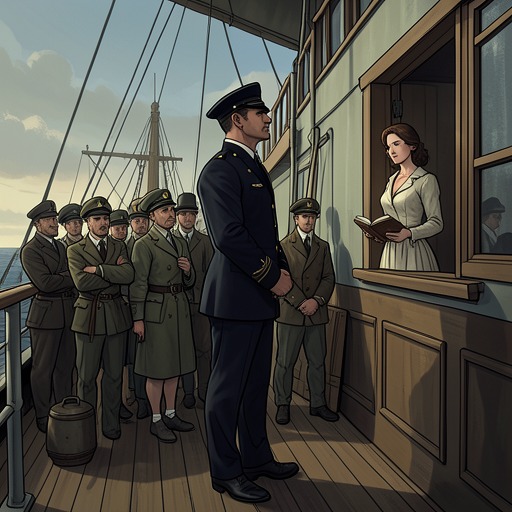
The settlement is inseparable from the wedding because Sir David needs the marriage, the documents, and the witnesses to form one coherent legal event. Six days after his proposal, he marries Elizabeth by common licence. By then he can no longer walk and must be carried into the church in a chair; Elizabeth is escorted down the aisle by Edward Gardiner, while Lily serves as maid of honour and James acts as groomsman. The small church is filled not only with the Gardiner family and Fitzwilliam Darcy but also with servants and tenants of the estate, whose presence gives the ceremony unmistakable public support.
The ceremony is conducted under the rites of the Church of England. Sir David had converted three years earlier after seeking counsel from a local vicar, following Lady Radha's death; Lady Radha had previously converted to the Church of Scotland when she married him. The short, functional service and the signing of the registry complete the chain by which private intention becomes public marriage and legally operative settlement. Sir David's final gesture is a gentle kiss on Elizabeth's forehead before the congregation returns to Grenadine Reef.
Consequences and Significance
The settlement converts Sir David's impending death from an unstructured personal catastrophe into a planned succession. It answers the question raised by the servants, protects Elizabeth from immediate dependence on the Bennet family, and gives her the material foundation for the active estate management she has learned through Lady Radha Pentland, Madeline Gardiner, and tenant work. Elizabeth's later understanding of what it means to be a gentle-born lady is grounded not in ornamental status but in practical care, responsibility, and the welfare of tenants.
Its moral significance is equally important. Sir David's plan is generous, but it also places Elizabeth and Fitzwilliam Darcy under emotional pressure: he asks them to put their personal happiness on hold for a year so that the marriage can appear to be a deliberate arrangement rather than a hurried attempt to manipulate inheritance. Darcy feels torn between supporting Elizabeth and resenting Sir David's interference. The settlement thus exposes the cost of legal protection when time, illness, and property make private affection subject to public strategy.
At the same time, the document challenges the logic of marriage as a transaction. Elizabeth had rejected a marriage that would have purchased family security at the expense of her consent. Sir David's settlement instead uses property law to preserve her agency: the marriage is still an arrangement under extreme circumstances, but its purpose is to give Elizabeth control rather than to buy her obedience. The instrument therefore stands at the intersection of legal vulnerability and practical power, making inheritance serve a woman's independence rather than merely reproducing male succession.